Dreamland Limited (TDIC): Event-management cash flows under a purchase commitment — what investors need to know
Dreamland Limited operates and monetizes by selling event-management and related services primarily in Hong Kong, billing clients on a project basis and recognizing revenue per engagement. The business translates bespoke event contracts into episodic revenue streams; recurring profitability depends on pricing power, cost control and the cadence of large-scale events. Revenue TTM of $54.75 million contrasts with deep operating losses (EBITDA -$38.4 million), underscoring a business that currently scales top line without converting to positive operating profit. For investors and operators evaluating Dreamland’s customer and capital relationships, the company’s ownership profile, thin float and the recent equity purchase commitment by Hudson Global Ventures are the most material signals. Visit the NullExposure homepage for more relationship analytics: NullExposure.
How Dreamland makes money and where margin pressure comes from
Dreamland is an event-management firm based in Kowloon, Hong Kong, that monetizes through event planning, execution and associated advertising/production services. The company reported revenue of $54.75 million TTM with a gross profit of $6.36 million, implying tight gross margins for the core services model. Operating metrics show a -91.6% operating margin and a -60.8% profit margin, which reflect high fixed or semi-fixed costs relative to project revenue and either underpricing or elevated overhead.
Key financial facts that drive commercial diligence:
- Market capitalization roughly $30.9 million, shares outstanding ~27.6 million with float ~4.35 million — this is a thin market structure that amplifies any institutional or strategic moves.
- High insider ownership (≈59%) and minimal institutional ownership (≈0.85%) signal concentrated control and limited sell-side coverage.
- Valuation indicators include Price-to-Sales ≈ 0.56 and Price-to-Book ≈ 8.3, while reported EBITDA is deeply negative (-$38.4 million).
These metrics point to a company with lumpy, contract-driven revenues and current earnings stress, requiring either scale efficiencies, better contract economics or fresh capital to achieve positive operating leverage.
The Hudson Global Ventures relationship — a purchase commitment that changes the capital posture
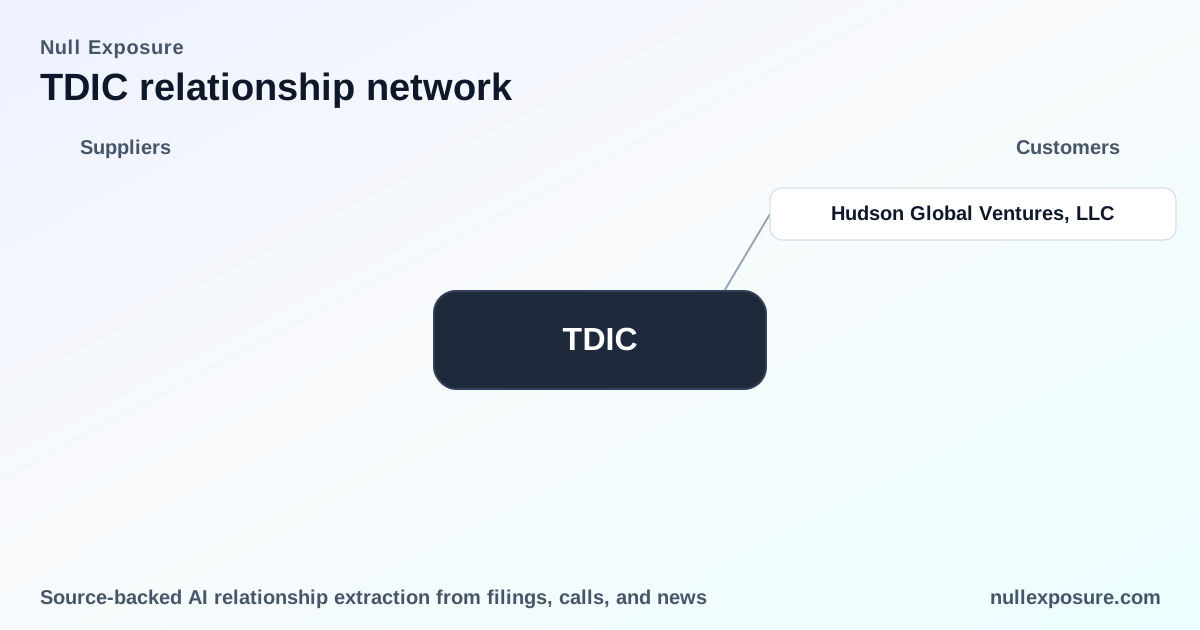
Hudson Global Ventures, LLC executed an equity arrangement described publicly in March 2026 in which Hudson committed to purchasing Dreamland shares under an equity deal while Dreamland was not contractually required to sell. This structure effectively gives Dreamland the option to access committed capital without an obligation to dilute unless management chooses to transact. A news report from Parameter on March 10, 2026, covered the equity arrangement and the related market reaction. (Source: Parameter report, March 10, 2026 — https://parameter.io/dreamland-limited-tdic-stock-surges-36-75-following-18-million-equity-deal/)
- The deal is described in public reporting as an $18 million equity arrangement with a purchase commitment from Hudson, and the headline reaction drove notable intraday share-price volatility in early March 2026. (Source: Parameter, March 10, 2026.)
This relationship is strategically important because it provides committed buy-side demand that can be tapped to strengthen the balance sheet or fund operations, and because the optionality of Dreamland not being obliged to sell preserves management discretion over timing and pricing.
What the Hudson arrangement means for customers, operators and investors
The practical implications of a committed-purchase equity arrangement are straightforward and material:
- Liquidity buffer: Committed capital from a third-party buyer reduces immediate funding stress and can be used to stabilize operations or invest in higher-margin service lines.
- Dilution optionality: Since Dreamland is not forced to sell, management controls dilution — this preserves current insiders’ high ownership share if they elect to avoid issuance.
- Market signaling and volatility: The public disclosure itself is a catalyst that increases trading interest in a thinly floated security; the March 2026 headline drove a sharp price move.
Operating-model signals and company-level constraints you should factor into diligence
Even with a committed buyer in place, company-level characteristics shape execution risk:
- Contracting posture — project-based and episodic. Event management is inherently lumpy: revenue realization depends on the timing and scale of individual contracts, and cost structures must flex with event calendars.
- Concentration and control. Insiders own ~59% and the free float is small; that concentration reduces governance friction but increases risk for minority investors and amplifies price moves on limited-volume trades.
- Criticality to customers versus margin capture. Dreamland offers differentiated services for events, but current gross-to-operating conversion is weak (gross profit $6.36M versus negative operating results), indicating the firm is not yet capturing pricing power sufficient to absorb fixed costs.
- Maturity and capital access. Negative EBITDA and thin institutional backing imply the firm is in a stage where external capital commitments (like Hudson’s) are a defining lever for near-term survival and optional growth.
These are company-level signals derived from the public financials and ownership data; they inform how any customer- or capital-related relationship fits into a broader strategic plan.
Risk factors investors and operators must prioritize
- Execution risk on margin expansion: Improving margins requires either higher-margin contract mix or cost rationalization; current operating margins are unsustainable for a cash-generating model.
- Dilution versus control trade-offs: Any use of the Hudson commitment for capital could dilute current insiders; given the concentrated ownership, management choices will materially affect minority holders.
- Market illiquidity: Thin float (≈4.35M) and high insider stake produce outsized price volatility on news and limit the ability of institutional investors to accumulate or exit easily.
- Customer concentration and cyclicality: Event businesses are sensitive to macro and discretionary spend cycles; revenue growth can reverse quickly if large clients pause spend.
Bottom line and next steps for due diligence
Dreamland is a specialized event-management operator with meaningful top-line scale but deep operating losses. The Hudson Global Ventures commitment provides a tactical source of funding optionality and a market signal that changes the company’s capital posture. For investors, the core decision is whether committed capital plus execution can close the gap between revenue scale and profitable operations. For operators, the question is whether contract margins can be restructured to deliver durable free cash flow.
If you want a deeper read on relationship-level analytics or to monitor further corporate developments, visit NullExposure for ongoing updates and primary-source tracking.