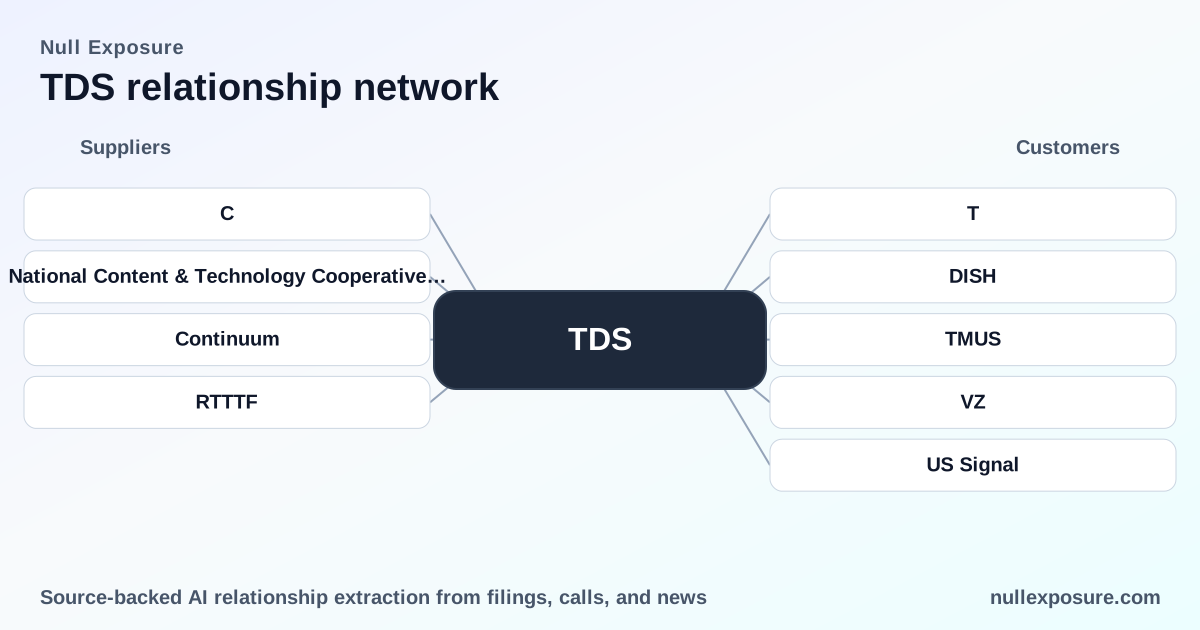
TDS customer relationships: how spectrum sales and tower leases rewrite the revenue map
Telephone and Data Systems, Inc. (TDS) now monetizes a shifted mix of assets: it sells select spectrum and wireless operations to national carriers while retaining tower and fiber infrastructure that generate recurring site-rental and broadband service revenue. The company converts legacy wireless assets into immediate cash through one‑off spectrum sales and into long-duration annuities via tower leases, while TDS Telecom continues to drive subscription broadband services. Learn more about how these relationships affect cash flow and risk at https://nullexposure.com/.
Why this matters to investors: TDS is trading a capital‑intensive, low‑margin wireless operator footprint for a capital‑light, recurring‑revenue infrastructure model with concentrated counterparties and meaningful one‑time proceeds that fund buybacks and dividends.
Strategy in plain English: selling on the runway, leasing for the future
TDS executed a deliberate derisking of its legacy wireless business by separating wireless operations, selling spectrum blocks to nationwide carriers, and spinning infrastructure into a tower company called Array. The corporate motion converts operating cash into liquidity while preserving recurring rental streams from towers and fiber. TDS monetizes via three primary levers: (1) asset sales (spectrum and business units), (2) long‑term tower leases and site rental revenue, and (3) subscription broadband services through TDS Telecom.
The company’s operating posture shows several structural characteristics:
- Contracting posture: a mix of spot monetizations (spectrum sales) and subscription/leased contracts (tower master leases and broadband subscriptions). The filings show device and equipment sales recognized on delivery (spot) and wireless/broadband services billed monthly (subscription).
- Concentration and counterparty criticality: major national carriers are the primary customers for large one‑time and long‑term transactions, increasing counterparty concentration but also counterparty credit quality.
- Revenue maturity and predictability: spectrum sales are immediate and episodic; tower and fiber site rental revenues are long‑dated and predictable, with master lease agreements extending for many years.
- Geographic focus: operations and counterparties are concentrated in the United States, reinforcing regulatory and market concentration domestically.
These constraints translate into an operating model that balances near‑term cash conversion with longer‑term annuity economics.
Customer and partner relationships that matter to valuation
Below I cover every named relationship in the record, with a concise, investor‑focused takeaway and a source reference for each.
DISH (and DISH Wireless)
Array reports ongoing contractual obligations under a master lease with DISH, and Array rejects DISH’s claims against that license agreement. DISH pays site rental commitments through 2031 with declining obligations thereafter, delivering a modest but multi‑year revenue stream to Array. (TDS Q4 2025 earnings call, March 7, 2026; InsiderMonkey coverage, May 2026)
T-Mobile (TMUS)
TDS sold its wireless operations to T‑Mobile and conveyed 30% of certain spectrum to T‑Mobile while finalizing a 15‑year master lease covering more than 2,000 towers, creating a large, long‑dated rental relationship. (TDS Q4 2025 earnings call, March 7, 2026; Investing.com reporting, May 4, 2026)
T / AT&T
Array closed a spectrum sale to AT&T for approximately $1.018 billion in January 2026, providing immediate liquidity that materially strengthens the balance sheet while reducing spectrum holdings. (TDS Q4 2025 earnings call, March 7, 2026; TradingView / Investing.com reporting, March–May 2026)
TMUS (separate result row)
Additional news rows confirm multiple spectrum sale tranches and tower agreements with T‑Mobile, including smaller August/October 2025 transactions totaling $178 million in gross proceeds; these follow‑on sales complement the larger T‑Mobile deal and add incremental cash. (InsiderMonkey transcript of Q4 2025 earnings call, May 2026)
Verizon (VZ)
TDS signed agreements to sell select spectrum to Verizon in a transaction sized in the neighborhood of $1.0 billion, mirroring the AT&T sale and diversifying one‑time proceeds across multiple national carriers. (TDS Q4 2025 earnings call, March 7, 2026; InsiderMonkey coverage, May 2026)
VZ (separate result row)
A duplicate reference reiterates the Verizon spectrum sale and underscores that multiple major carriers participated in asset purchases, reducing counterparty concentration for the sale proceeds. (TDS Q4 2025 earnings call, March 7, 2026)
New Cingular Wireless PCS, LLC
New Cingular (an AT&T subsidiary) is named as the counterparty in Array’s completed sale of select spectrum assets, confirming the counterparty identity behind the $1.018 billion transaction. (Investing.com news report, May 4, 2026)
US Signal
TDS sold its OneNeck data center business to US Signal, a transaction that trims non‑core infrastructure and reallocates capital away from enterprise data centers. (DatacenterDynamics reporting; Telecompetitor coverage, May 2026)
RiverStreet
RiverStreet announced acquisitions of several TDS broadband assets in multiple states, representing incremental localized divestitures of TDS subscriber bases to regional broadband operators. (Telecompetitor reporting, May 2026)
Eastern Slope Rural Telephone Association
TDS agreed to transfer ownership of Strasburg Telephone Company to Eastern Slope under a stock purchase agreement in April 2025, an example of portfolio rationalization at the local exchange level. (Telecompetitor report, May 2026)
Hilliary Communications
TDS sold its Oklahoma network to Hilliary Communications last July, further evidence of targeted divestitures to regional carriers and consolidation of the company’s footprint. (Telecompetitor, May 2026)
Nevill Holdings Inc.
Under an August 2024 purchase agreement, Nevill Holdings was designated to gain control of five TDS cable properties in Texas, illustrating prior asset carve‑outs to private acquirers. (Telecompetitor summary, May 2026)
Poka Lambro Telecommunications LTD
Poka Lambro was named alongside Nevill Holdings in the purchase agreement for five Texas cable properties, indicating multiple buyers for localized cable assets. (Telecompetitor report, May 2026)
Elevate (ELEV)
Elevate agreed to acquire TDS operations serving over 16,000 subscribers in Colorado, a focused subscriber sale that offloads regional broadband operations while allowing TDS to concentrate capital on higher‑return investments. (Telecompetitor report, May 2026)
DISH Wireless (separate result row)
Array recognized roughly $7.0 million of site rental revenue from the DISH master lease in 2025, and DISH retains contractual obligations for similar levels through 2031 with declining commitments thereafter, providing predictable near‑term site rental revenue. (InsiderMonkey transcript / company commentary, May 2026)
What this collection of relationships means for investors
The mix of counterparties and transactions establishes a clear financial profile: large, investment‑grade carriers provided one‑time spectrum proceeds that materially improve liquidity, while master lease agreements with those same carriers produce recurring, long‑duration rental revenue. This duality reduces operating leverage from running a mobile operator and shifts the business into infrastructure ownership and broadband subscription services.
Risk profile and monitoring checklist for investors:
- Counterparty concentration: major carriers dominate the high‑value transactions; monitor carrier credit and strategic incentives.
- Revenue composition shift: expect higher proportional contribution from site rental and broadband subscriptions; watch margins and churn in TDS Telecom.
- One‑off vs recurring: spectrum sales are non‑recurring; sustainable cash flow depends on tower lease uptake and broadband traction.
- Domestic exposure: operations are U.S.-centric, so regulatory and competitive dynamics in the U.S. telco market drive outcomes.
If you’re tracking asset sales, lease rollouts, and divestitures as drivers of valuation, these relationships provide a clear playbook: monetize spectrum when prices are attractive, lock-in long leases for tower economics, and shed non‑core business units to focus capital.
Bottom line and next step
TDS has traded scale in wireless operations for liquidity and recurring infrastructure cash flows. The company’s near‑term balance sheet strength is bolstered by billion‑dollar spectrum sales, while long‑dated tower leases with national carriers underpin the move to infrastructure economics.
For a deeper comparative read on counterparties and contract structures, visit https://nullexposure.com/ to explore how these relationship dynamics map to portfolio risk and valuation.