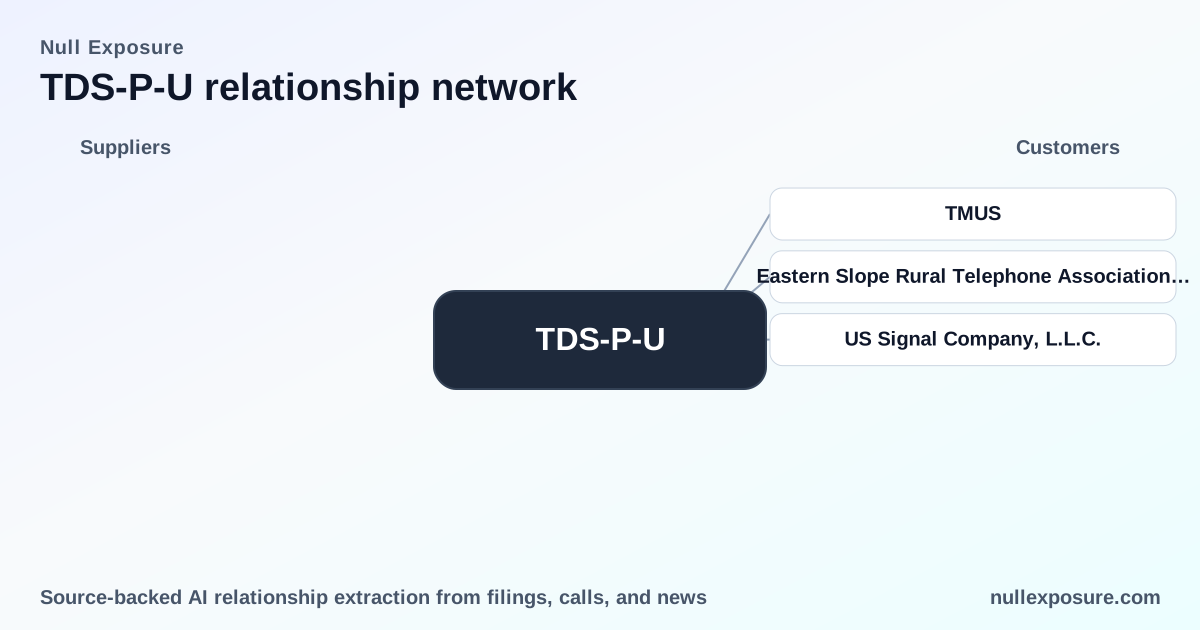
TDS-P-U: Capital Recycling and Preferred Income Backed by Strategic Asset Sales
Telephone and Data Systems, Inc. funds its preferred equity security TDS-P-U through a combination of operating cash flow from wireless, broadband and cable assets and an active program of asset monetizations; the company monetizes spectrum and wireless operations to pay special dividends, reduce leverage, and sustain fixed preferred distributions. Investors in TDS-P-U should treat the security as income-oriented exposure to a telecom operator that is deliberately reshaping its portfolio through large, discrete asset sales to national carriers and rural operators. For a concise look at sourcing and verification, visit https://nullexposure.com/.
How TDS converts network positions into shareholder returns
TDS leverages its regional wireless and infrastructure assets as fungible capital: it selectively sells wireless operations, spectrum licenses, and data-center businesses to larger carriers and local cooperatives while returning cash to holders via repurchases and special dividends. This is a monetization-first operating posture — asset sales are a material and repeatable lever for liquidity management rather than incidental transactions. That positioning affects contracting, counterparty concentration, and the maturity of remaining network exposure.
Detailed relationship log — every mention in the supplied results
Below I walk through each relationship reported in the collected coverage. Each entry is one to two sentences and cites the underlying reporting.
T-Mobile — large-scale purchase of UScellular wireless operations (Investing.com, FY2026)
TDS completed the sale of UScellular’s wireless operations to T‑Mobile for $4.3 billion in August, a transaction that materially reshaped TDS’s operating profile by exiting certain retail wireless assets and transferring customer and tower exposure to a national carrier. According to Investing.com reporting dated May 4, 2026, this sale is central to TDS’s FY2026 restructuring and liquidity plan.
AT&T — $1.018 billion spectrum sale executed (Investing.com, FY2026)
TDS finalized a $1.018 billion sale of select spectrum assets to AT&T during FY2026, a transaction explicitly cited as increasing TDS’s financial flexibility and funding shareholder returns. Investing.com coverage on May 4, 2026 describes this spectrum sale as a cash-proceeds event used for balance-sheet strengthening.
AT&T and Verizon — earlier $2 billion spectrum divestiture program (Investing.com, FY2025)
In FY2025 TDS initiated the sale of roughly $2.0 billion of spectrum licenses to AT&T and Verizon, with estimated after-tax proceeds around $1.6 billion; this program preceded and contextualized later, executed tranche sales. Investing.com reported the FY2025 disclosures that were material to S&P’s credit view and the company’s deleveraging trajectory.
T-Mobile — sale terms including spectrum and bond-exchange elements (Investing.com, FY2025)
TDS’s transaction structure with T‑Mobile in FY2025 included sale of US Cellular wireless operations along with a 30% carve-out of spectrum and an exchange offer element for US Cellular’s long-term bonds, illustrating deal structuring aimed at both cash and liability management. Investing.com’s FY2025 coverage highlighted the combined cash-and-debt mechanics that reduced TDS’s ongoing financial obligations.
Verizon — part of the FY2025 spectrum disposition (Investing.com, FY2025)
Verizon was named as a purchaser in the FY2025 spectrum distribution program, absorbing portions of licenses as TDS executed a broader strategy of selling non-core spectrum to national incumbents. Investing.com’s FY2025 note places Verizon alongside AT&T as a counterparty in the $2.0 billion program.
AT&T — special dividend and share repurchase funded by asset sales (Investing.com, FY2026)
Following the spectrum sale to AT&T, TDS paid a $10.25 per-share special dividend in February 2026 and executed share repurchases totaling 1.77 million shares for $67.4 million, demonstrating direct capital return to shareholders funded by monetizations. Investing.com’s FY2026 earnings follow-up details these capital actions as outcomes of the year’s asset sales.
Eastern Slope Rural Telephone Association — sale of Strasburg Telephone Company (SimplyWall.St, FY2025)
TDS sold Strasburg Telephone Company to Eastern Slope Rural Telephone Association, Inc., reflecting a strategy to divest smaller regional wireline assets to local cooperatives and rural carriers. SimplyWall.St reported this FY2025 transaction as part of TDS’s portfolio simplification and local-market exits.
T-Mobile (repeat mention in Intellectia.ai summary, FY2026)
Analysts and investor summaries reiterated TDS’s strategic exit from retail wireless via the sale to T‑Mobile and concurrent spectrum divestitures in FY2026, underscoring market consensus that these transactions are transformational for TDS’s risk profile. An Intellectia.ai piece (FY2026) summarized the company’s FY2026 moves as a substantive reshaping of operations.
T‑Mobile (again in Intellectia.ai, FY2026)
Investor-facing commentary linked the T‑Mobile deal directly to TDS’s broader repositioning away from operator responsibilities and toward a capital-return orientation, reinforcing the single-counterparty concentration risk in the wireless exit. The Intellectia.ai FY2026 note reiterated the same structural conclusion for investors.
US Signal Company, L.L.C. — sale of OneNeck IT and data-center assets (SimplyWall.St, FY2025)
US Signal completed the acquisition of OneNeck IT Solutions LLC and OneNeck Data Center Holdings LLC from TDS, illustrating TDS’s exit from certain enterprise IT and data-center businesses to specialized regional operators. SimplyWall.St’s FY2025 reporting lists this divestiture as an executed step in TDS’s corporate simplification.
Company-level constraints and what their absence signals
The provided feed contains no explicit constraint excerpts tied to TDS-P-U’s customer relationships. That absence is itself material: it signals the public reporting set did not surface long-running contractual constraints, litigation-driven encumbrances, or regulatory holdbacks tied to the transactions cited. For investors, a blank constraints slate suggests the monetizations were reported as executed transactions without documented conditional vesting or protracted contracting contingencies in the sampled sources. This operational posture supports a view of mature, negotiated disposals rather than provisional or contested dispositions.
What this means for investors in TDS-P-U
- Concentration and counterparty profile: Large proceeds were realized primarily through a small set of national buyers (T‑Mobile, AT&T, Verizon) and select regional purchasers, concentrating execution risk into a few counterparties while providing immediate liquidity.
- Contracting posture and maturity: Transactions reported are closed or described as executed, which signals mature negotiations and cash settlements rather than multi-year earnouts or contingent transfers.
- Criticality and business-model shift: TDS is shifting from being an operator with recurring service obligations to a company that realizes value through selective asset sales; this elevates the importance of successful capital redeployment and disciplined balance-sheet use for preferred holders.
- Operational implication for preferred holders: TDS-P-U investors benefit from the company’s monetization discipline when proceeds are used for dividends, buybacks, and deleveraging, but they must monitor for reduced recurring cash-flow if core operations are permanently wound down.
Key takeaways for valuation and monitoring
- TDS is executing a deliberate, monetization-driven strategy that produces near-term liquidity and reduces leverage — an attractive profile for income-focused preferred holders if distributions remain supported by cash returns.
- Counterparty concentration is material; large transactions with national carriers are a feature, not an anomaly, and should be monitored for pricing and regulatory impact on future monetization potential.
- No explicit constraints were reported in the provided sources, which supports the thesis that the disposals were clean and cash-settled in the sampled coverage.
For investors conducting deeper diligence, the transaction-level coverage cited above is the primary evidence set; for consolidated access to reporting and relationship intelligence, visit https://nullexposure.com/.
Bold decisions require clear evidence — TDS-P-U’s yield story rests on executed asset monetizations and disciplined capital returns; track counterparty activity, subsequent use of proceeds, and any new constraints or contingent liabilities disclosed in future filings.