TDS-P-V: How asset sales and strategic exits are reshaping cash flow for preferred holders
Telephone and Data Systems, Inc. (TDS) monetizes its telecom footprint through a mix of operating revenues from U.S. Cellular, asset monetizations (spectrum and business sales), and capital returns to shareholders via dividends and special distributions; the TDS-P-V series sits on top of that capital structure as a preferred claim on income and capital allocation decisions. Recent 2026 transactions — a multi-billion dollar sale of U.S. Cellular’s wireless operations and a roughly $1.02 billion spectrum sale — materially change the company’s cash generation profile and counterparty map, with direct implications for preferred security holders. Learn more about the firm-level context at https://nullexposure.com/.
Major deal flow that rewrites the balance between operations and liquidity
TDS executed two transformational moves in the fiscal year 2026 that shift the company from an operations-heavy posture to one with far greater liquidity and capital return capacity. In August 2025 TDS completed the $4.3 billion sale of U.S. Cellular’s wireless operations to T‑Mobile, a transaction that removes a large operational segment from the company and crystallizes proceeds that can be used for debt reduction, buybacks, or distributions. According to Investing.com, that sale “fundamentally reshaped its business model” and closed in FY2026 (Investing.com, May 4, 2026). Separately, select spectrum assets were sold for approximately $1.018 billion to AT&T / New Cingular, a transaction executed by TDS’s subsidiary Array Digital Infrastructure that created immediate cash flexibility and funded a special cash dividend (Investing.com and Sahm Capital reporting, early 2026).
Every public customer/partner mention in the record — what investors need to know
-
AT&T: TDS completed the sale of select spectrum assets to AT&T for $1.018 billion, providing immediate liquidity that underpinned a special dividend and improved near-term balance sheet flexibility (Investing.com, May 4, 2026).
-
T‑Mobile: TDS sold U.S. Cellular’s wireless operations to T‑Mobile for $4.3 billion in August (reported in FY2026), a transaction that reduces TDS’s direct wireless operating exposure while delivering a sizable cash inflow (Investing.com, May 4, 2026).
-
New Cingular Wireless PCS, LLC (Investing.com sec filing): Array Digital Infrastructure — the TDS subsidiary formerly structured around United States Cellular — completed the sale of select spectrum assets to New Cingular Wireless PCS, LLC, the AT&T subsidiary that executed the spectrum purchase (SEC filing coverage reported by Investing.com, May 4, 2026).
-
New Cingular Wireless PCS (Sahm Capital): Independent reporting highlighted that Array Digital Infrastructure’s sale of certain spectrum assets to New Cingular Wireless PCS generated “over US$1b in cash” and was paired with a special cash dividend to TDS shareholders, an action that repositions capital allocation toward immediate returns (Sahm Capital, March 10, 2026).
-
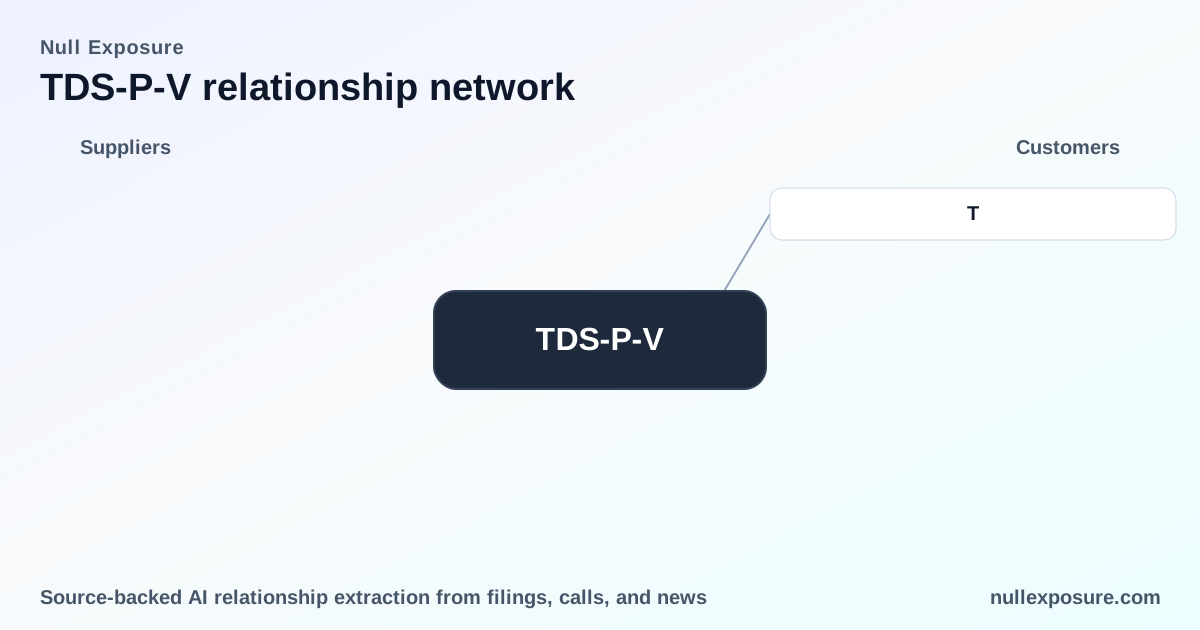
T (Sahm Capital): Coverage referencing AT&T’s New Cingular unit reiterated the same transaction: TDS’s subsidiary completed a spectrum sale for over $1 billion in cash, a catalyst for valuation re-assessment and capital return decisions in early 2026 (Sahm Capital, March 10, 2026).
What the deal activity signals about TDS’s operating model and business model constraints
These asset dispositions collectively reveal a deliberate liquidity-first operating posture: TDS is actively converting non-core or high-value assets into cash rather than retaining them as long-duration operating assets. That posture suggests a strategic preference for de-risking and capital redistribution over continued operational scale in U.S. wireless operations.
-
Concentration and counterparty profile: The counterparty set for these transactions is narrow and strategic — predominantly Tier 1 carriers (AT&T’s New Cingular and T‑Mobile). That concentration accelerates execution but increases dependency on a small group of large counterparties when monetizing telecom assets.
-
Criticality of assets: Spectrum and consumer wireless operations are mission-critical assets for national carriers; selling these assets removes operational exposure for TDS while transferring essential network inputs to buyers, intensifying the strategic importance of each counterpart relationship.
-
Maturity and reconfiguration: The mix of a definitive $4.3 billion business sale plus a $1.018 billion spectrum sale signals a company in transition from operating-led growth to portfolio realization and return-of-capital. This is a mature capital allocation phase where management is prioritizing cash conversion and simplifying the corporate footprint.
These are company-level signals: the constraints implied are structural and strategic rather than isolated, and they will shape how TDS allocates cash available to preferred stakeholders going forward.
How this matters to preferred stock investors
Investors evaluating TDS-P-V should weigh the following considerations:
-
Increased near-term cash availability from large asset sales supports the company’s ability to fund dividends and special distributions, directly relevant to preferred security coverage.
-
The sale of operating segments reduces operating cash flow volatility tied to running a consumer wireless business, but it also reduces diversified revenue streams, leaving future cash generation more dependent on capital markets and any remaining or new operations.
-
Counterparty concentration in the asset disposals is a double-edged sword: it enabled premium pricing and quick execution, but it also centralized transactional risk among a few large carriers.
-
Regulatory and execution follow-through risk remains relevant where stipulated approvals or asset-transfer conditions apply; investors should monitor filings and follow-on disclosures for covenants that might affect preferred claims or distributions.
Practical next steps for analysis
- Review the TDS FY2026 filings and the Array Digital Infrastructure SEC disclosures for the precise terms and any covenant language tied to the sales that could affect capital allocation.
- Monitor cash deployment: debt paydown versus buybacks versus ongoing or additional special dividends will indicate management’s priority and the security of preferred distributions.
- Track counterparty integration outcomes at T‑Mobile and New Cingular for potential contingent liabilities or transitional service arrangements that could generate future cash demands.
For a concise read on how these shifts alter the investment case for TDS securities, visit https://nullexposure.com/.
Bold takeaways: TDS-P-V investors are buying into a company that has converted large, strategic assets into cash, materially changing the origin of distributable cash; the reduced operating footprint lowers operating risk but increases dependence on capital allocation decisions and a small set of large counterparties. Watch the follow-through on capital deployment — that will determine whether preferred holders benefit from sustained cash distributions or one-off returns.