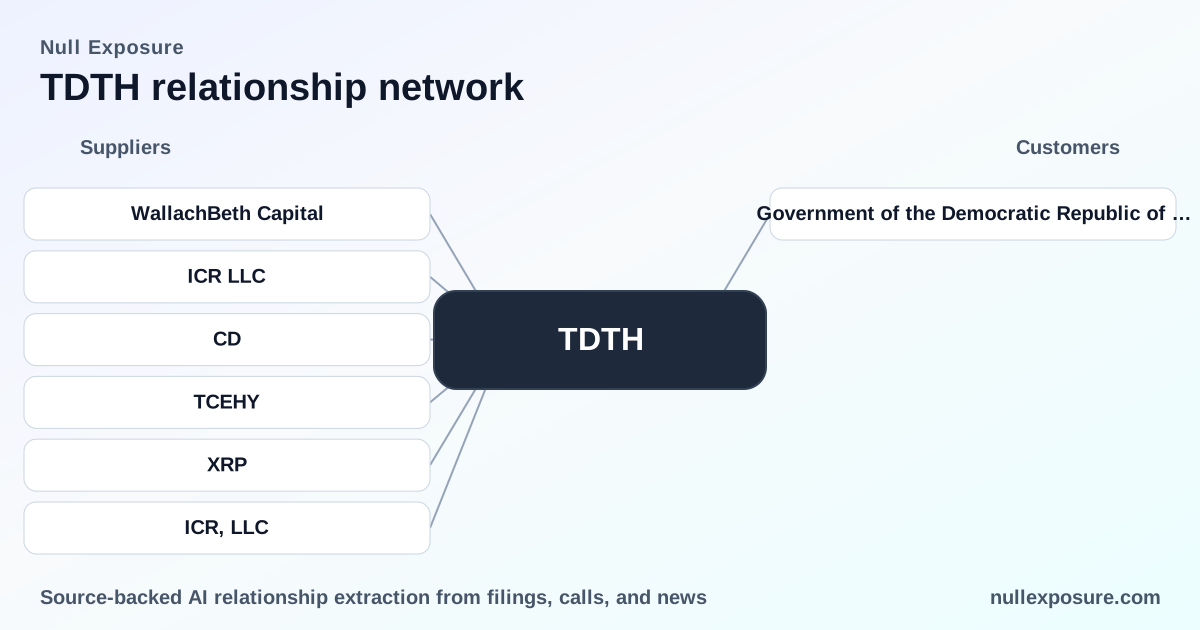
Trident Digital Tech Holdings (TDTH): Public-sector anchor, licensing volatility, and a fragile revenue base
Trident Digital Tech Holdings monetizes by delivering IT customization, business consulting and digital identity solutions, contracting with both public-sector partners and corporate licensees for implementation, licensing and ongoing services. Revenue today is concentrated, small in absolute terms, and sensitive to the presence or absence of multi-year public contracts and licensing arrangements; investors should value TDTH as a services-anchored tech contractor whose growth is driven by project awards and retained service contracts rather than steady recurring SaaS-like revenue. For a strategic snapshot and deeper client-level detail, see more at https://nullexposure.com/.
Why the customer base defines TDTH's risk-reward profile
Trident’s business model is typical of boutique digital transformation firms: win discrete projects (often under public-private partnerships), deliver integration and customization, then earn follow-on operations and maintenance fees. That contracting posture creates lumpy revenue, high client concentration risk, and outsized dependency on a small number of significant public or enterprise engagements. Financials underline the point: trailing revenue is very small (RevenueTTM: $123,210) while valuation multiples such as Price-to-Sales are extremely elevated, signaling that market value rests on successful execution of client relationships rather than current cash flows.
- Contracting posture: Project and PPP-driven, requiring long sales cycles, procurement navigation, and performance delivery.
- Concentration: Revenue and investor expectations hinge on a limited set of anchor customers and licenses.
- Criticality: Public-sector digital identity contracts are high criticality for clients but pose political, delivery and payment timing risks for vendors.
- Maturity: Company-level financials (negative EBITDA and large per-share losses) indicate early-stage cash flow dynamics rather than stable, recurring income.
Customer relationships: two material items to evaluate closely
Below I cover every customer relationship signal surfaced for TDTH in the dataset so investors can assess revenue durability and execution risk.
Government of the Democratic Republic of Congo
Trident announced a definitive public-private partnership (PPP) with the Government of the Democratic Republic of Congo to roll out a national digital ID and e-KYC system; this is a classic public-sector anchor engagement that, if executed, drives implementation revenue and potential longer-term operations contracts. Source: TechAfricaNews report on the PPP, June 2025 (https://techafricanews.com/2025/06/27/congo-partners-with-trident-to-roll-out-national-digital-id-and-e-kyc-system/).
LIMN (ticker LIMN)
A trading report notes that LIMN terminated a TDT license on August 11, 2024, which reduced LIMN’s R&D expenditures and transferred certain development responsibilities and costs away from LIMN—this implies a contract termination or non-renewal that removed a licensing revenue stream for Trident. Source: TradingView coverage of LIMN’s FY2026 filing and related commentary (https://www.tradingview.com/news/tradingview:ce3304431e447:0-liminatus-pharma-2025-10-k-0-revenue-net-loss-10-21m/).
What these relationships imply for revenue visibility and growth
The DRC PPP is a high-impact, high-reward client engagement: public digital identity platforms typically involve substantial upfront systems integration fees and the prospect of multi-year operations or transaction-based revenues. By contrast, the LIMN episode is a concrete example of licensing volatility—license terminations directly remove expected revenue and transfer costs back to the licensee, illustrating how fragile TDTH’s non-PPP revenues can be.
Together these signals paint a mixed picture: Trident can secure high-profile public deals that materially alter its revenue trajectory, but it also faces abrupt license losses that can quickly erode near-term cash flows.
Key investor takeaways and risk factors
- Growth is binary and execution-dependent. Successful delivery on the DRC PPP could substantially increase top-line visibility; failure or delays would leave current revenue base unchanged and fragile.
- High valuation vs. tiny revenue. The company’s Price-to-Sales and EV/Revenue multiples are extreme relative to current RevenueTTM ($123,210), which imposes a binary outcome for investors: execution on contracts or sustained downside.
- Contract concentration risk is structural. With a business model centered on large projects and a small set of relationships, client attrition (as illustrated by LIMN) imposes outsized earnings volatility.
- Public-sector contracts bring payment and political exposure. PPPs carry procurement, compliance and cash collection timelines that differ materially from enterprise software contracts.
Operational signals investors should monitor
Monitor these actionable indicators to track whether TDTH is converting opportunity into durable revenue:
- Progress milestones and payment schedules on the DRC PPP (award confirmations, implementation milestones, operations contracts).
- Evidence of new enterprise license agreements or renewals to offset prior terminations like LIMN’s.
- Cash runway and working capital given negative EBITDA and large per-share losses in recent reporting.
- Any disclosures of subcontracting or revenue-sharing that dilute gross margin on large public contracts.
A succinct view on constraints and what’s not shown
The dataset provided no explicit contractual constraints or restriction excerpts for TDTH, which itself is a signal: there are no captured, machine-identified constraint clauses attached to customer relationships in this review. That absence should be read as a company-level data point, not as proof of unrestricted contracting—public-sector PPPs typically include delivery milestones and performance bonds even if those elements are not visible here. Investors should therefore treat lack of recorded constraints as a gap that requires direct company disclosure or diligence rather than evidence of a constraint-free operating model.
Bottom line and next steps
Trident Digital Tech is a highly idiosyncratic, project-driven technology contractor whose valuation and investor returns will track execution on a small number of material relationships—chiefly the DRC PPP—and the company’s ability to replace lost licensing revenue like that from LIMN. For investment diligence, prioritize verification of contract economics, milestone payments, and renewal pipelines.
For a broader comparative look at customer-level signals and to track new relationship disclosures, explore the firm’s profile and ongoing updates at https://nullexposure.com/.