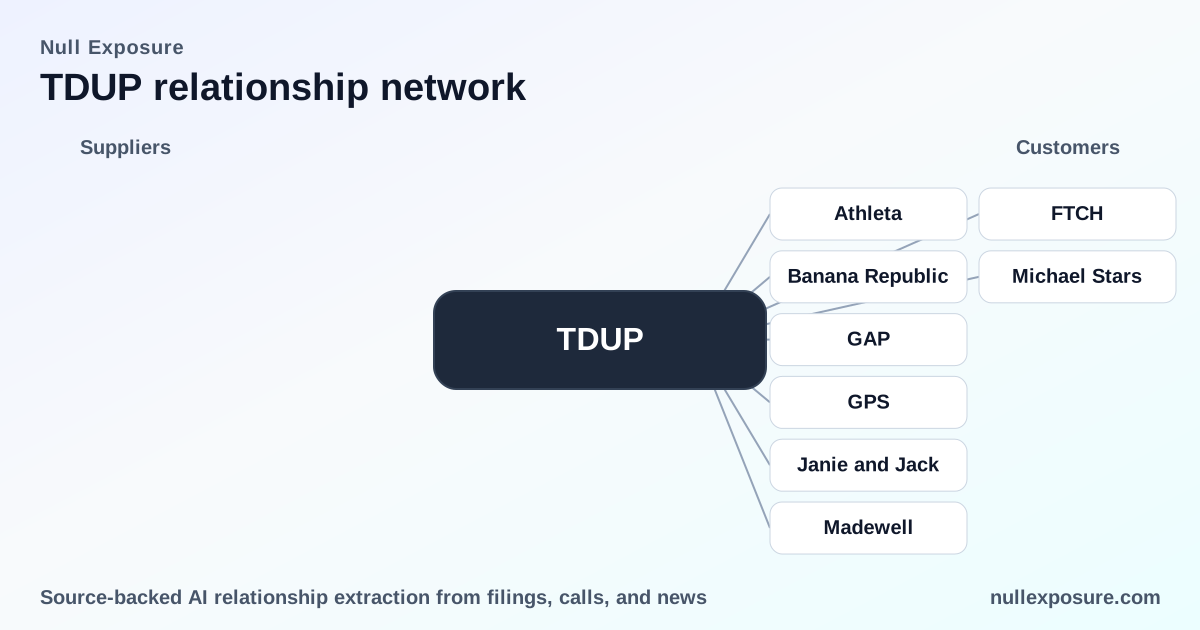
ThredUp (TDUP) — customer relationships and what they mean for value creation
Thesis: ThredUp operates a two-legged resale franchise: a consumer-facing marketplace that monetizes through consignment sales and buyer payments, and a growing enterprise-facing Resale-as-a-Service (RaaS) business that charges upfront integration and ongoing service fees to brands and retailers while driving consignment revenue. Revenue is therefore a mix of spot consumer purchases and recurring RaaS contracts with large retail partners, concentrated in North America and anchored on individual buyers. For a developer-grade feed of partner signals, see https://nullexposure.com/.
How ThredUp actually makes money — the business logic behind the headlines
ThredUp’s consumer marketplace drives direct gross profit when buyers purchase secondhand items; those are typically spot transactions paid upfront by individual buyers, which is the core of the consumer revenue stream. The company has layered an enterprise product — Resale-as-a-Service (RaaS) — which provides integration, a branded resale storefront, and fulfillment for retailers. RaaS combines an upfront integration fee and ongoing service fees that are recorded alongside consignment revenue, creating a hybrid subscription/transactional contract mix.
Operationally this produces several characteristics investors should track:
- Contracting posture: predominantly spot consumer sales with an emerging subscription-like component from RaaS clients. The company documents both payment-at-sale behavior for buyers and recurring service fees for partners.
- Counterparty concentration and type: the demand base is predominantly individual buyers (the revenue engine), while RaaS clients are large enterprise retailers that increase scale and distribution.
- Geographic focus: ThredUp’s business and logistics network are concentrated in North America, with distribution centers and a U.S.-centric marketplace footprint.
- Relationship maturity: ThredUp reports an active RaaS client list and millions of annual orders, indicating an active, mid-maturity portfolio of retail partnerships rather than nascent pilots. These characteristics imply predictable consumer cash collection but mixed margin implications as RaaS scales and fulfillment costs remain material.
Catalog of customer relationships (each entry tied to the original sources)
Banana Republic
ThredUp’s platform was used to enable clean-out programs that gave customers shopping credit redeemable at Banana Republic; this appears in Gap Inc.’s announcement linking ThredUp with Gap brand credits (FY2020). Source: Gap Inc. press release (FY2020).
Gap
Gap engaged ThredUp in a clean‑out partnership where customers received shopping credit redeemable at Gap and affiliated brands under the Gap Inc. program (FY2020). Source: Gap Inc. press release (FY2020).
GAP (duplicate listing)
The same Gap-branded partnership is documented in Gap Inc.’s communications about the clean‑out initiative, reiterating the credit-for-resale flow (FY2020). Source: Gap Inc. press release (FY2020).
Gap Inc.
Gap Inc. publicly announced a partnership with ThredUp to encourage trade‑ins of secondhand clothes in exchange for credits redeemable across its banners, formalizing ThredUp as a strategic clean‑out partner (FY2020). Source: Gap Inc. press release (FY2020).
Janie and Jack
Janie and Jack, a Gap Inc. children’s brand, was included as a redemption destination for shopping credits tied to ThredUp clean‑out programs (FY2020). Source: Gap Inc. press release (FY2020).
GPS (Gap Inc. symbol listing)
The Gap Inc. press materials cited ThredUp’s role in enabling credit redemptions at GPS‑listed brands, underscoring the corporate-level RaaS relationship (FY2020). Source: Gap Inc. press release (FY2020).
Athleta
Athleta — another Gap Inc. banner — was named among brands participating in ThredUp-enabled clean‑out credits, signaling multi‑brand deployment within a single retailer (FY2020). Source: Gap Inc. press release (FY2020).
Fabletics, Inc.
Fabletics expanded its resale program using ThredUp’s RaaS platform, enabling branded resale shops on its site and reflecting RaaS adoption by performance/apparel brands (FY2026 press release referencing April 20, 2023). Source: Fabletics, Inc. press release (via GlobeNewswire, FY2026).
Genesco Inc. (Journeys)
Genesco announced “Journeys Second-Hand,” a resale program enabled by ThredUp’s RaaS offering, positioning ThredUp as the fulfillment and marketplace partner for Genesco’s Journeys chain (FY2026 Business Wire release). Source: Genesco Inc. press release (FY2026).
The Container Store Group, Inc.
The Container Store announced a clean‑out resale program powered by ThredUp’s RaaS, indicating ThredUp’s reach beyond apparel into broader retail assortments via partner-branded resale (FY2026 Business Wire release). Source: The Container Store Group, Inc. press release (FY2026).
Torrid Holdings Inc.
Torrid became the first plus‑size brand to launch a resale program with ThredUp’s RaaS, a strategic niche deployment that expands ThredUp’s client mix (December 15, 2022 announcement cited in FY2026 feed). Source: Torrid Holdings Inc. press release (FY2026 feed referencing Dec 2022).
Madewell
Madewell launched “Madewell Forever,” a 360‑resale platform powered by ThredUp’s RaaS, highlighted as a deeper partnership to let customers both clean out and shop secondhand on brand channels (FY2021 announcement). Source: Madewell / PR Newswire (FY2021).
FARFETCH
ThredUp’s distribution expansion was announced alongside new RaaS deals including FARFETCH, indicating engagement with global luxury marketplace partners as part of RaaS growth (FY2021 press material). Source: ThredUp PR Newswire (FY2021).
FTCH (FARFETCH symbol listing)
Public PR for ThredUp’s Dallas distribution center referenced RaaS deals with FARFETCH (FTCH), confirming the brand-level connection in company filings and press releases (FY2021). Source: ThredUp PR Newswire (FY2021).
Michael Stars
Michael Stars was named among new RaaS clients in ThredUp’s distribution center announcement, representing direct-to-brand RaaS adoption (FY2021). Source: ThredUp PR Newswire (FY2021).
Journeys (duplicate entry)
Journeys was separately covered in a Genesco release announcing a Journeys-branded resale shop enabled by ThredUp, reiterating that Genesco leverages ThredUp across its banners (FY2026 Business Wire). Source: Genesco Inc. press release (FY2026).
New York & Co
ThredUp referenced launching RaaS programs for New York & Co during earnings commentary, indicating ongoing pipeline conversions into active RaaS relationships (Q3 2025 earnings call transcript). Source: ThredUp Q3 2025 earnings call transcript (FY2025).
CodeAvoxie
The same earnings commentary listed CodeAvoxie as a new RaaS client launched in the month referenced, demonstrating pipeline diversity beyond major chains (Q3 2025 earnings call transcript). Source: ThredUp Q3 2025 earnings call transcript (FY2025).
YITTY
Fabletics announced resale shops for both Fabletics and YITTY powered by ThredUp, illustrating multi‑brand implementations on a single platform (FY2026 GlobeNewswire citation of April 2023). Source: Fabletics, Inc. press release (via GlobeNewswire, FY2026).
Kate Spade New York
Kate Spade launched a “pre‑loved” program using ThredUp technology, which allowed purchase and trade‑in of secondhand products directly on its branded site, marking luxury/accessory-brand adoption (FY2023 report). Source: Retail Dive (FY2023 coverage).
J. Crew
J. Crew was named as one of ThredUp’s retail‑as‑a‑service deals reported in the same period as Kate Spade, signaling ThredUp’s broader penetration into mid‑tier retail brands (FY2023 press coverage). Source: Retail Dive (FY2023).
Francesca’s
Francesca’s was reported as another retailer that signed a retail‑as‑a‑service deal with ThredUp in the year of the Kate Spade announcement, adding to the roster of fashion retailers using RaaS (FY2023). Source: Retail Dive (FY2023).
What the relationship map tells investors about durability, risk and upside
- Durability: RaaS clients are large retail brands and multichannel retailers that can provide recurring revenue and marketing reach; this supports a path to more predictable revenue recognition as integrations and storefronts persist beyond pilots.
- Risk: The business remains dependent on consumer purchase behavior (spot payments) and on the economics of fulfillment; margins will fluctuate as RaaS scales and fulfillment costs remain material. Customer concentration in North America and heavy reliance on individual buyers create geographic and demand-cycle sensitivity.
- Upside: Expanding RaaS into fashion, specialty, and non‑apparel retail (e.g., Container Store, FARFETCH) increases TAM and creates cross‑sell opportunities for branded resale programs.
Key takeaways for portfolio managers
- ThredUp is a hybrid commerce operator: consumer-paid spot sales underpin revenue while RaaS builds recurring enterprise cash flow and marketing reach.
- Large-brand relationships validate the RaaS model, but the company remains exposed to fulfillment and margin pressure as it scales.
- Geographic concentration (U.S.) and buyer-driven economics are primary risk vectors; monitor RaaS client retention and per‑order fulfillment costs for inflection points.
For a compact feed of partner intelligence and to track new RaaS wins in real time, visit https://nullexposure.com/.
Conclusion: ThredUp’s customer roster reads like a deliberate push to convert retail partners into recurring resale channels. The combination of spot consumer revenue and subscription-style RaaS fees creates a compelling growth vector — contingent on margin improvement and geographic diversification.