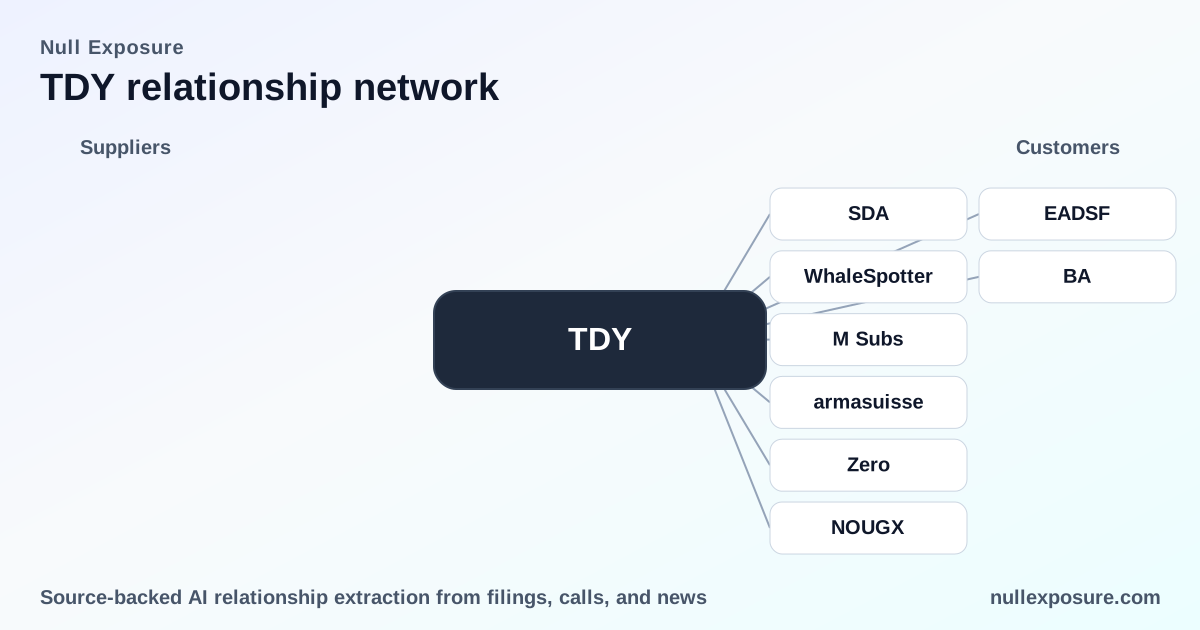
Teledyne (TDY): Customer relationships that drive durable hardware and defense revenue
Teledyne Technologies operates as a diversified industrial technology group that designs, manufactures and sells imaging sensors, infrared and visible cameras, marine sonars, instruments and defense electronics, monetizing through product sales, long-term government and aerospace contracts, and manufacturing services for high-reliability components. The company's revenue mix leans on recurring, contract-backed hardware sales and program-based service work, with material exposure to U.S. Government and large aerospace customers that create predictable backlog and multi-year visibility.
For an operational view of Teledyne’s customer links and how they translate into revenue risk and optionality, visit the NullExposure homepage: https://nullexposure.com/
What matters to investors: contracting posture, concentration and commercial characteristics
Teledyne’s public disclosures and recent press activity reveal a clear operating profile. Contracts skew long-term and framework-style, with remaining performance obligations reflecting firm orders under ordering-type arrangements; that posture supports revenue visibility but also concentrates execution risk into multi-year programs. Teledyne reports meaningful government exposure—roughly a quarter of net sales—creating both stability during peacetime procurement cycles and sensitivity to defense budgets. The business is global, sells into 100+ foreign countries, and derives material revenue from large aerospace OEMs; that geographic and customer breadth reduces single-buyer dependence but leaves the company exposed to cyclical aircraft production swings.
Other operating signals: Teledyne combines product sales and manufacturing services (including MEMS and high-reliability semiconductors), positions as both seller and service provider, and historically records material spend in the $100m+ band with government customers. These attributes create high-margin, capital-light benefits on product lines but elevated execution and program-risk tied to defense and aerospace customers.
Customer list and what each relationship contributes
Below I cover every customer relationship surfaced in recent Teledyne customer coverage and explain why each matters.
SDA
Teledyne announced start of production on multiple awards with SDA, indicating ongoing program deliveries and production-phase revenue recognition. Source: Globe and Mail press release covering Teledyne activity (March 10, 2026).
WhaleSpotter
WhaleSpotter integrates Teledyne FLIR’s Boson+ thermal camera module into an AI-powered whale-strike mitigation system, illustrating Teledyne’s FLIR OEM modules selling into environmental/industrial safety applications beyond defense. Source: Ecomagazine report on the partnership (March 2026).
SONM
Sonim’s XP Pro thermal functionality is powered by Teledyne FLIR OEM technology, showing Teledyne’s camera modules are embedded in rugged commercial handheld products and drive OEM revenue streams. Source: Yahoo Finance product announcement referencing Teledyne FLIR technology (2026).
M Subs
M Subs and Teledyne Marine signed an MOU to accelerate maritime solutions; M Subs praises Teledyne’s sensor integration and responsiveness, signaling Teledyne’s role as a systems integrator for maritime and defense-focused SMEs. Source: Hydro International coverage of the MOU (March 2026).
LTRX (Lantronix)
Lantronix’s drone and UAV reference platforms include native FLIR Hadron/640R and FLIR payload integration, and Lantronix cited Teledyne FLIR camera modules in earnings commentary about AI camera solutions—evidence Teledyne’s imaging modules are integrated into next‑generation autonomy and ISR stacks. Source: Lantronix product press releases and Lantronix earnings calls referencing FLIR integrations (FY2025–FY2026).
armasuisse
Teledyne won a $17.5M contract from armasuisse, reflecting direct procurement success with European defense procurement agencies and the company’s strength in wining medium-sized, programmatic orders. Source: Globe and Mail press release reporting the armasuisse award (March 10, 2026).
Defense Advanced Research Projects Agency (DARPA)
Teledyne Scientific was selected to participate in DARPA’s eX Virentia program as part of the Plants as Silent Sentinels (PASS) team, demonstrating the company’s R&D and advanced-sensor footprint in government research programs. Source: University of Nebraska/IANR news coverage of DARPA selection (May 4, 2026).
Zero
Teledyne SeaBat multibeam sonars were integrated and demonstrated on Zero USV platforms at REPMUS 2025, showing Teledyne’s marine sensors are adopted on commercial unmanned surface vessels and highlighted in joint maritime demonstrations. Source: Hydro International report on REPMUS demonstrations (March 2026).
NOUGX
Teledyne’s FY2024 Form 10‑K notes dependence on U.S. Government funding for certain contract revenue, a general disclosure recorded under the company’s government-sales discussion; the NOUGX entry reflects that regulatory and funding dependency. Source: Teledyne 2024 Form 10‑K (filed December 29, 2024).
U.S. Government
Teledyne reports that U.S. Government sales represented approximately 24% of total net sales in recent years, making government contracts a material and steady revenue pillar subject to appropriations and program timing. Source: Teledyne 2024 Form 10‑K, net sales by customer class (FY2024 disclosure).
Airbus
Teledyne’s 10‑K explicitly calls out Airbus as a large aerospace customer and notes that disruptions or pauses in aircraft manufacturing have negatively impacted sales to Airbus, underscoring cyclical exposure to commercial aircraft OEM production schedules. Source: Teledyne 2024 Form 10‑K (aero customer risk disclosure).
Boeing (BA)
Boeing is similarly identified in Teledyne’s 10‑K as a major aerospace customer; any reductions or pauses at Boeing have historically affected Teledyne’s aerospace sales and therefore represent a production-cycle risk to revenue. Source: Teledyne 2024 Form 10‑K (aero customer risk disclosure).
Operational constraints and what they imply for investors
Teledyne’s disclosures yield several company-level constraints that shape revenue durability and execution risk:
- Contracting posture: Teledyne uses framework and ordering-type contracts with remaining performance obligations that create firm backlog and multi-period revenue recognition dynamics rather than one-off spot sales. This increases revenue visibility but concentrates execution risk on program delivery and cost-estimate revisions.
- Contract length and maturity: The company explicitly targets longer-term relationships and recognizes that some contracts extend over multiple periods; this produces smoother revenue when programs execute and potential cumulative catch‑up effects if estimates change.
- Counterparty concentration: Government customers are material (~24% of sales) and the company records significant U.S. Government contract dollar volumes ($1.3bn+ range in recent years), which provides durability but ties results to appropriations and defense program cycles.
- Geography: Teledyne is global, selling across the U.S., Europe, Asia and other regions, which diversifies demand but requires supply-chain and regulatory management across jurisdictions.
- Business role and segment mix: Teledyne operates as both seller and service provider in hardware (imaging, sonars, sensors) and manufacturing services (MEMS, high-reliability semiconductors), creating multiple revenue streams with varying margins and capital intensity.
- Spend band: Government-related sales sit in the high tens to hundreds of millions annually, implying a program-scale exposure that will move revenue materially when large awards are won or lost.
Bottom line for investors
Teledyne’s customer mix and contractual posture create predictable, program-driven revenue with material government and aerospace exposure. The company’s strength in imaging and marine sensors gives it attractive margins on embedded OEM sales and systems integration work, while the multi-year contract profile supports backlog-led visibility — balanced, however, by execution and program-risk linked to defense budgets and aircraft production cycles.
For a systematic, relationship-level view of supplier and customer linkages across industrial technology firms, explore NullExposure: https://nullexposure.com/
Key takeaway: Teledyne’s revenue is driven by a combination of embedded OEM hardware sales and long-term program contracts; investors should track government appropriations and major OEM production cadence as primary lead indicators for topline visibility.