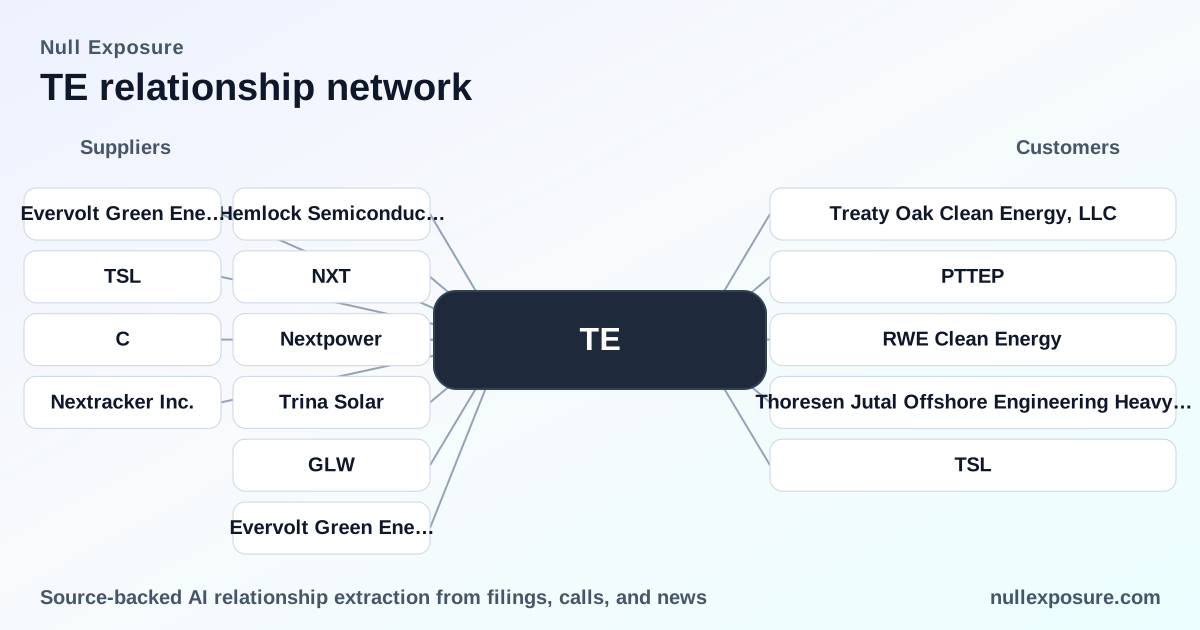
T1 Energy (TE): customer relationships that will determine margin capture and execution risk
T1 Energy sells and monetizes domestic PV solar modules and integrated battery solutions by locking long-term off-take contracts with utility-scale developers and by capturing value from U.S.-made solar cells and modules. The company’s revenue model depends on converting factory capacity into long-term supply contracts that qualify for U.S. content credits while managing working capital and counterparty execution risk. For investors, the interplay of large multi-year deals, strategic financing partners, and an emerging litigation backdrop will be the primary drivers of valuation upside or downside. Learn more at https://nullexposure.com/.
How T1’s commercial model actually works in practice
T1 is a hardware-first supplier: it plans to build cell and module manufacturing capacity (notably the planned G2_Austin cell fab) and then sell modules into utility-scale and commercial channels under multi-year off-take agreements. The company’s go-to-market posture is supplier/seller rather than a project developer — revenue comes from product sales and contract-backed deliveries, with federal content rules and tax-credit capture (Section 45X) acting as a commercial lever. Company disclosures describe a strategy to execute long-term module off-take contracts with U.S. customers and to prioritize domestic cell-to-module integration to maximize policy-driven incentives.
Constraints that shape the customer book
Several company-level signals shape how to read T1’s customer relationships:
- Contracting posture: T1 emphasizes long-term off-take arrangements for PV modules as part of its commercialization play, creating revenue visibility but committing production capacity.
- Counterparty mix: The company targets utility-scale developers, commercial & industrial (C&I) customers, and residential buyers, indicating a broad go-to-market that reduces single-segment concentration but increases execution complexity.
- Geographic focus: Core manufacturing and targeted sales are in North America, with U.S. domestic cell production aimed at qualifying for higher incentives.
- Product criticality and maturity: Modules are a core hardware product for T1; relationships are commercial (seller role) and characterized as active as production ramps. These constraints imply capital-intense delivery obligations and high operational leverage: success requires on-time manufacturing, clear compliance with content rules, and robust counterparty credit management.
The customer list investors need to track
Below are concise, plain-English takeaways for every customer relationship surfaced in the filings and press coverage, with sources.
Treaty Oak Clean Energy / Treaty Oak Clean Energy, LLC
T1 signed a three-year contract to supply Treaty Oak Clean Energy with a minimum of 900 MW of solar modules built from cells planned at the G2_Austin fab, effectively locking substantial future module demand to intended U.S. output and the company’s eligibility for U.S. content credits. A GlobeNewswire company release (March 31, 2026) and contemporaneous reporting (Dec 2025 announcement) document the arrangement and its tie to the G2_Austin cell facility.
PTTEP
T1 is referenced as a participant in PTTEP’s Arthit CCS facilities project in Asia, positioning the company as a supplier of environmental-technology solutions in the region and illustrating geographic diversification of tech applications beyond pure U.S. module sales. StockstoTrade coverage (Jan 13, 2026) cited T1’s role within the larger project narrative.
Stellar Hann Investment Ltd.
Stellar Hann Investment Ltd. is named as a private placement investor in connection with T1’s convertible notes and warrant issuances, indicating a financing relationship that supports liquidity and capital needs rather than a product purchase. An Investing.com report covering T1’s $160m convertible notes offering (May 2026) documents share and warrant placements to this investor.
Trina Solar (Schweiz) AG (TSL) / Trina
Trina Solar (Schweiz) AG and related Trina references appear as private placement recipients of shares and warrants and as a counterparty in reported receivable balances; third-party research raised questions around recorded sales and reported purchases, highlighting potential accounting and receivables concentration risk. Investing.com and investigative reporting summarized the securities placements (Investing.com, May 2026) and Intellectia’s compilation highlighted alleged discrepancies in reported sales and receivables (March 2026).
RWE Clean Energy
RWE Clean Energy is identified in press coverage as a plaintiff in litigation alleging T1 failed to meet an offtake agreement and misrepresented module compliance, exposing T1 to potentially material legal liability tied to contract performance and compliance with module-content rules. Intellectia.ai reported on the RWE Clean Energy lawsuit and the attendant allegations in March 2026.
Thoresen Jutal Offshore Engineering Heavy Industries Limited
Press coverage connects T1 to a regional carbon-capture project narrative where Thoresen Jutal Offshore Engineering awarded contracts for the first CCS project in Thailand; the mention signals opportunity for T1-linked environmental-technology work in Southeast Asia, though reporting (StockstoTrade, Jan 13, 2026) frames it as part of a broader project ecosystem rather than a definitive supply contract.
What these relationships imply for investors
- Demand lock-in vs. execution exposure: The Treaty Oak agreement is a positive commercial win because it ties substantial demand to T1’s planned U.S. capacity and to incentive-qualifying content rules; however, realizing revenue depends on timely commissioning of the G2_Austin cell fab and module production.
- Financing partners are strategic and dilutive: Private placements to Trina and Stellar Hann underpin near-term financing but create cross-party exposures and potential governance complexity.
- Legal and transparency risks are real and quantifiable: Public reporting of alleged receivable discrepancies with Trina and the lawsuit with RWE introduce credit, accounting, and legal execution risk that can impair access to incentives and shorten the investment runway if damages or remediation are required.
How to monitor progress going forward
Track three objective indicators: (1) operational milestones for G2_Austin cell and module capacity, (2) contract delivery cadence for the 900 MW Treaty Oak program, and (3) resolution of the RWE/Trina controversies and any related receivables audits. For a fast read on evolving newsflow and counterparties, visit our coverage hub at https://nullexposure.com/.
Bottom line for investors
T1’s business model is high-conviction and capital-intensive: winning large off-take contracts and qualifying for U.S. content incentives are major value drivers, but delivery risk, counterparty concentration, and active litigation materially raise execution risk. Investors should value near-term wins like the Treaty Oak contract while pricing in the operational and legal milestones required to convert backlog into sustainable margins.