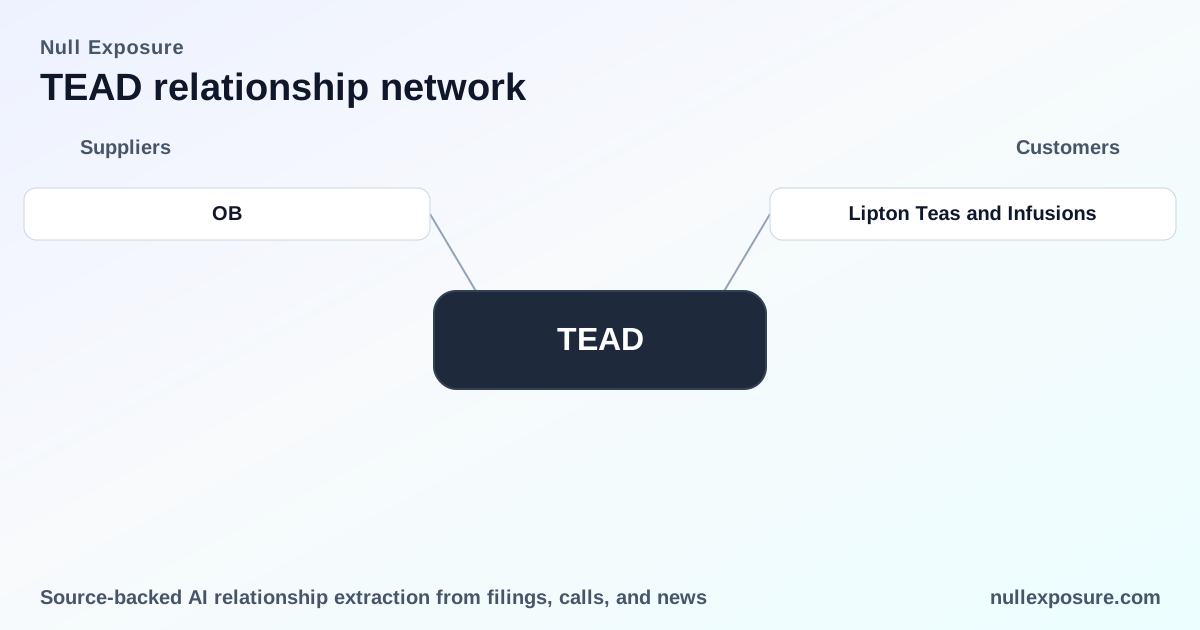
TEAD customer relationships: how advertisers drive revenue and what the Lipton signal reveals
Teads operates a global advertising technology platform that connects media owners and advertisers and monetizes by selling ad inventory and outcome-oriented media buying on a usage-based, short-term billing model—principally cost‑per‑click and cost‑per‑impression campaigns executed via insertion orders or self‑service tools and billed monthly. Revenue is recognized when control of the advertising service is transferred (click or impression), making Teads’ topline highly correlated with advertiser demand and campaign velocity. For investors, the implication is straightforward: the company is a scalable marketplace whose near‑term results track advertiser budgets and CPM/CPC dynamics rather than long multi‑year contractual lock‑ins.
For deeper analysis and ongoing coverage, see https://nullexposure.com/.
What the customer signals tell investors about Teads’ operating model
Teads’ customer relationships are governed by short-term, usage-based commercial terms that shape both upside and risk.
- Usage-based billing (CPC/CPM): Teads bills advertisers on a cost‑per‑click or cost‑per‑impression basis and recognizes revenue on clicks or delivered impressions, creating a direct link between platform engagement and revenue. This is disclosed in Teads’ revenue recognition discussion and underpins intra-quarter volatility in ad-dependent results.
- Short-term commitments and monthly billing: Advertisers largely contract via insertion orders or self-service budgets with payment terms typically in the 30–60 day range, which limits contract lock-in but enables fast scaling when demand increases.
- Wide counterparty spectrum: The commercial base ranges from Fortune‑level global advertisers to small and medium businesses, indicating simultaneous exposure to large strategic spend and high-volume, lower-value buyers.
- Geographic reach with EMEA concentration: The platform is global, with measurable scale in EMEA, supporting diversified regional revenue but also exposure to regional ad-market cyclicality and regulation.
- Revenue criticality to advertiser spend: Teads and its merger partner generate the overwhelming majority of revenue from advertisers (Teads: cited 88% in 2024), establishing advertisers as the primary revenue driver and economic dependency for the business.
- High‑value joint business programs (JBPs): Teads reports JBPs that average roughly $5 million in annual spend, fitting into a $1m–$10m spend band and highlighting pockets of concentrated enterprise spend that materially move results.
These characteristics produce a business model that is highly elastic to advertising demand: when advertiser budgets grow, Teads scales quickly through programmatic and direct insertion workflows; when budgets retract, revenue retracts quickly because commitments are short and usage‑based. This structure favors operational agility and topline responsiveness but increases exposure to macro ad cycles and brand safety/regulatory shocks.
Relationship inventory and what each partner signals
Lipton Teas and Infusions
Lipton described the Outbrain–Teads merger as an opportunity to “reach our audiences in a new and interesting way, to deliver full funnel solutions and better business outcomes,” highlighting advertiser appetite for unified, full‑funnel media solutions following the deal announcement in FY2025. This comment indicates that large CPG advertisers view the combined platform as strategically useful for integrated branding and performance workflows. Source: a martech news report covering Outbrain’s acquisition completion (afaqs.com, March 10, 2026).
(That is the complete customer relationship set disclosed in the review scope.)
For more context on Teads’ customer mix and enterprise programs, visit https://nullexposure.com/.
How these relationships and constraints affect commercial concentration and risk
Teads’ commercial posture creates both concentrated levers and broad market exposure:
- Concentration via advertisers: With the business deriving the majority of revenue from advertiser buys, advertiser demand is critical to results; enterprise JBPs of roughly $5 million apiece amplify concentration risk when a handful of partners drive outsized spend.
- Short-term contracts reduce downside protection: Monthly invoicing and 30–60 day payment terms limit guaranteed runway and increase sensitivity to immediate demand shifts.
- Mix of large and small buyers supports diversification but not protection: A dual base of Fortune‑level advertisers and small and medium businesses provides breadth, but usage-based billing keeps revenue correlated with aggregate ad spend rather than contract tenure.
- Regional footprint hedges but introduces regulatory/regional cyclicality: Global reach, including significant EMEA exposure, diversifies ad-market cycles across geographies but exposes Teads to localized macroeconomic and regulatory pressures.
Investment implications and key takeaways
- Topline is a real‑time read on advertiser budgets: Expect revenue to track ad market flows closely; acceleration in digital ad spend translates quickly into improved reported results.
- Profitability levers depend on scale and yield: Given short-term contracts, margin expansion comes from yield optimization and platform efficiency rather than long-duration contract economics.
- Corporate events reshape customer narratives: The Outbrain–Teads combination is already influencing advertiser sentiment (Lipton’s public comment), suggesting potential upside from integrated product offerings and cross‑sell into enterprise accounts.
- Watch JBPs and large account churn: Enterprise partnerships that represent multiple millions in spend are the most material levers—loss or expansion of a few such agreements will move the P&L.
Key facts to monitor in quarterly reports and investor calls: advertiser spend trends, average campaign CPM/CPC, JBP renewals and sizes, EMEA revenue trends, and days‑sales‑outstanding given the 30–60 day billing window.
- Bold takeaway: Teads is a scalable, usage‑driven media marketplace; advertiser demand—not long contracts—determines near‑term performance.
Final actionable note: for continuous tracking of customer signals and enterprise spend trends relevant to TEAD, explore our coverage hub at https://nullexposure.com/.