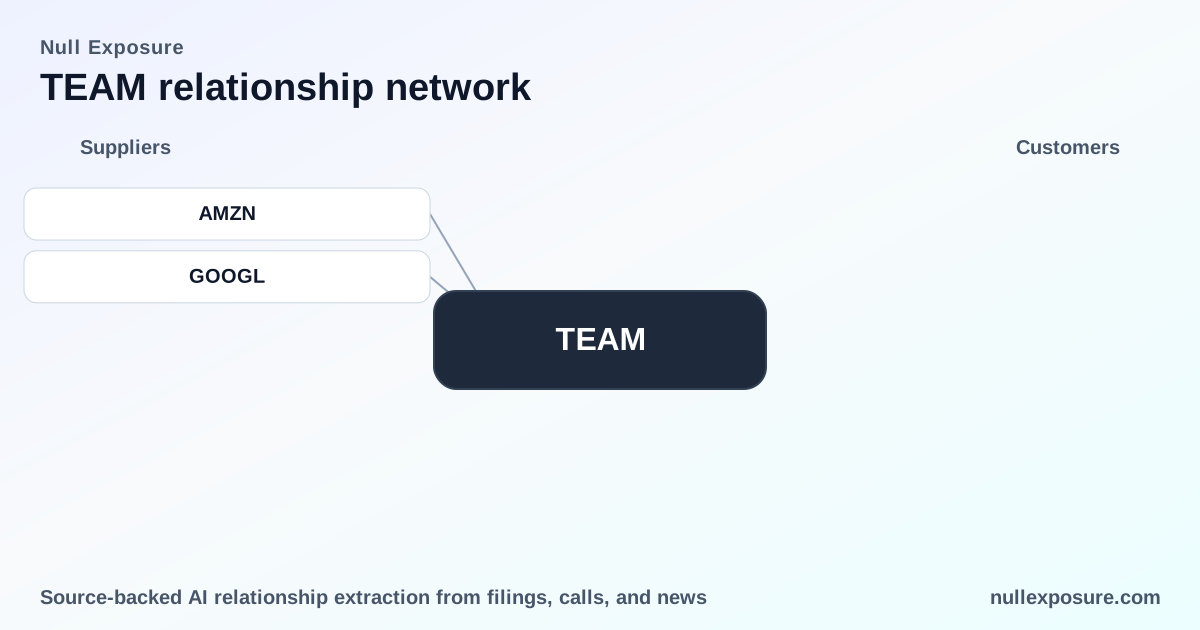
Atlassian (TEAM): Customer Relationships That Drive a Recurring Revenue Engine
Atlassian sells collaboration and developer tools (Jira, Confluence, Trello, Bitbucket) primarily on a subscription basis, delivering cloud-hosted software to organizations across the enterprise spectrum and monetizing through recurring fees and add-on collections. For investors, the core thesis is straightforward: a broad customer footprint plus high gross margins translate into a predictable revenue base, while product integrations with major platform vendors extend reach and stickiness.
Explore more corporate and investor materials at https://nullexposure.com/ to track customer signals and partnership disclosures.
How Atlassian’s commercial model influences customer risk and upside
Atlassian runs a classic SaaS subscription business: short-term contractual cadence (monthly to annual), transparent list pricing, and self-service upsell paths. That contracting posture reduces sales friction and supports high-volume, distributed customer acquisition, but it also means churn dynamics are a first-order driver of near-term revenue variability.
Operational and financial constraints to consider as an investor:
- Contracting posture: subscription-dominant with terms commonly between one and twelve months; revenue recognized through deferred revenue accounting.
- Concentration and scale: the customer base spans from small businesses to the largest enterprises — including over 80% of the Fortune 500 — creating a mix of low-ticket volume and high-value strategic accounts.
- Criticality and product maturity: Atlassian products are often embedded in team workflows (ticketing, documentation, project tracking), making them mission-relevant for software dev and operations teams; maturity is high for flagship products but the company continues to expand cloud offerings and government-compliant environments.
- Geography: global distribution across 200+ countries supports resiliency to single-region shocks but requires continued investment in localization and compliance.
- Materiality: subscription revenue constitutes a material, recurring revenue base and is the primary growth engine.
These are company-level signals drawn from public disclosures and product positioning; they explain why customer integrations and channel partnerships matter strategically for both growth and retention.
Documented customer / integration relationships (exhaustive list from available signals)
Zoom — SEC filing reference (FY2019)
Zoom’s SEC filing states the company’s platform integrates with cloud applications such as Atlassian, signaling Atlassian’s role as an integrated workflow provider in unified communications and collaboration stacks. This integration supports cross-product workflows and increases Atlassian’s exposure inside Zoom customer accounts. Source: Zoom S‑1 filing with the SEC (document referencing integrations, FY2019), filed at https://www.sec.gov/Archives/edgar/data/1585521/000119312519083351/d642624ds1.htm.
Zoom — Zoomtopia product announcement (FY2024)
A Zoom product announcement describing its AI Companion lists Atlassian (specifically Jira & Confluence) among third‑party apps that Zoom can connect to for orchestration and insights, reinforcing that Atlassian products serve as data and action points in third‑party automation and AI workflows. That public positioning elevates Atlassian’s strategic value as a platform partner for collaboration vendors. Source: Zoomtopia 2024 coverage at Onrec (product launch reporting, FY2024), https://www.onrec.com/news/launch/zoomtopia-2024-unveiling-ai-first-work-platform-innovations.
Justworks — company profile reference to Trello (FY2025)
A profile of Justworks cites the use of Trello for project management within the organization, demonstrating Atlassian’s penetration in HR and workforce platforms where task and project coordination are necessary. This is a functional user-level endorsement that supports broader enterprise adoption anecdotes. Source: BuiltIn company profile for Justworks (FY2025), https://builtin.com/company/justworks.
What these relationships reveal for investors
The documented ties to Zoom (two separate mentions across corporate filings and product announcements) and a usage instance at Justworks combine to present a consistent narrative: Atlassian is both a platform and a common integration target for collaboration and HR stacks. Integrations with large collaboration vendors like Zoom elevate product stickiness and create avenues for indirect acquisition; usage within companies such as Justworks demonstrates the practical, day-to-day relevance of Atlassian’s tools across corporate functions.
- Revenue implications: integrations can drive net-new users via ecosystem effects and reduce churn by embedding Atlassian into broader workflows.
- Strategic implications: being listed in platform partner catalogs (Zoom’s AI Companion) signals ongoing product relevance for emergent use cases such as AI-driven orchestration.
- Commercial posture: the mix of self-service purchasing and enterprise adoption means Atlassian benefits from both low-cost volume and strategic upsell opportunities.
Explore broader signals and relationship mapping at https://nullexposure.com/ for a deeper reading on how customer integrations convert into revenue resilience.
Risks, concentration, and operational considerations
- Churn sensitivity: short-term subscription terms create higher sensitivity to churn; retention improvements are the most direct lever to convert installed base into durable ARR.
- Platform dependence: integrations with dominant communication platforms are positive for distribution but increase reliance on third-party platform decisions and policy changes.
- Customer mix: heavy penetration among large enterprises reduces unit churn risk but increases negotiation and customization demands; conversely, a broad small-business base increases scale but raises acquisition cost pressure.
- Compliance and government demand: the availability of a FedRAMP-capable government cloud signals monetization opportunity in public sector accounts, but also requires sustained compliance investment.
Bottom line for operators and investors
Atlassian’s customer relationships are complementary rather than concentrated: the company sits in the center of productivity stacks and therefore benefits from integrations that expand usage and stickiness. The commercial model — subscription, largely short-term, and global — creates predictable revenue while making retention the key performance lever. For investors, monitor retention metrics, partnership productization (for example, how deeply Zoom integrates Jira/Confluence actions), and government/cloud compliance adoption to gauge the trajectory from large installed base to steady ARR growth.
For ongoing signal tracking and a consolidated view of customer disclosures, visit https://nullexposure.com/.