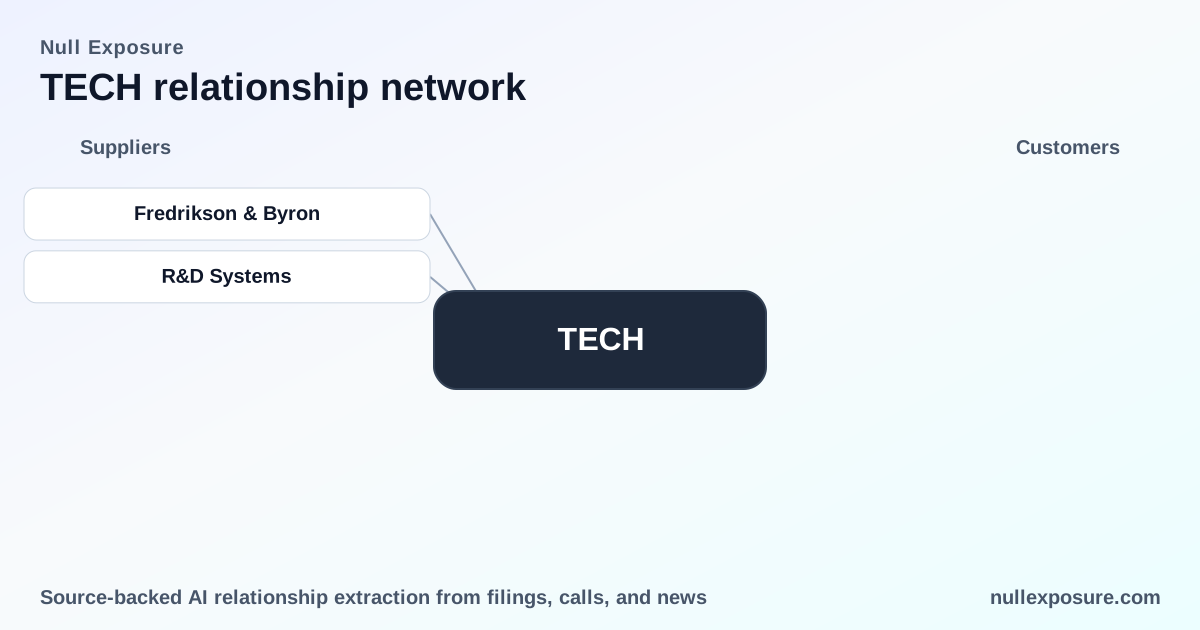
Bio‑Techne (TECH) — Customer Relationships That Shape Revenue Durability
Bio‑Techne sells life‑science reagents, instruments and services to research and clinical diagnostic customers worldwide and monetizes through direct product sales, instrument hardware, and recurring chemistry/service revenue — including usage‑based royalties and long‑term commercial partnerships that smooth top‑line volatility. For investors evaluating customer risk, the company combines broad end‑market diversification with targeted strategic alliances that both embed its biological content into third‑party platforms and create optionality through asset sales and licensing. Learn more about how we profile these relationships at https://nullexposure.com/.
Why customer mapping matters for TECH investors
Bio‑Techne’s model blends high‑margin reagents and biologics with capital equipment and service contracts. Revenue durability comes from repeat consumable demand and platform participation (where Bio‑Techne content runs on partners’ testing systems), while growth levers include instrument attach rates and occasional acquisitions or divestitures of diagnostic assets. The company’s customer footprint and contractual posture determine how predictable that revenue stream is — so examine partnerships that embed Bio‑Techne content in third‑party platforms and any receipts or promissory arrangements that affect near‑term cash flow.
Partner profile: Luminex Corporation (LMNX)
Bio‑Techne extended and expanded a partnership with Luminex to develop and commercialize Bio‑Techne biological content on Luminex’s immunoassay testing platform, cementing a content‑supply relationship rather than a simple one‑off sale. This agreement formalizes multi‑year collaboration around assay development and commercial distribution on Luminex hardware (reported in FY2015). Source: PR Newswire press release (FY2015) — https://www.prnewswire.com/news-releases/luminex-corporation-and-bio-techne-corporation-extend-and-expand-partnership-300162428.html; coverage in Clinical Lab Products (FY2015) — https://clpmag.com/uncategorized/luminex-bio-techne-expand-partnership/.
Partner profile: MDxHealth (MDXH)
MDxHealth’s reported growth was driven in part by contributions from the ExoDx test — a diagnostic product originally from Bio‑Techne that was recently acquired or integrated into MDxHealth’s portfolio, indicating Bio‑Techne’s role as an originator and seller of diagnostic IP/assays and the capacity to monetize tests via strategic sale or license. Financial commentary in FY2025–FY2026 links ExoDx directly to MDxHealth performance. Source: Investing.com analyst coverage (FY2025) — https://au.investing.com/news/analyst-ratings/btig-reiterates-buy-rating-on-mdxhealth-stock-maintains-7-price-target-93CH-4182711 and https://www.investing.com/news/analyst-ratings/mdxhealth-stock-price-target-raised-to-7-from-6-at-btig-on-growth-outlook-93CH-4354059; acquisition notice (FY2026) — https://intellectia.ai/en/stock/MDXH/news.
Partner profile: Akoya Biosciences (AKYA)
Bio‑Techne partnered with Akoya to adapt its RNAscope chemistry for automation on Akoya’s PhenoCycler‑Fusion system, tying Bio‑Techne reagent IP to a spatial‑omics instrument and expanding an addressable market for RNA analysis workflows. That first product launch for RNA analysis originated from the partnership and demonstrates strategy to build recurring reagent demand via instrument attach (reported in FY2022). Source: Akoya Q1 2022 earnings commentary (transcript coverage) — https://www.fool.com/earnings/call-transcripts/2022/05/06/akoya-biosciences-inc-akya-q1-2022-earnings-call-t/.
How these relationships read as commercial signals
- Partner embedding is a primary growth vector. Agreements with Luminex and Akoya convert Bio‑Techne biological content into recurring purchases when partners’ installed bases run assays that depend on Bio‑Techne reagents.
- IP monetization is active. The ExoDx transaction with MDxHealth is an example of converting in‑house assay development into cash‑generating exits or license revenue.
- Mixed contract economics. The company reports both long‑term receivable structures (promissory notes with multi‑quarter payment schedules) and sales/royalty recognition tied to usage, which produces a hybrid of predictable and usage‑sensitive revenue.
Company‑level constraints and what they imply for investors
The company disclosures yield several actionable signals about counterparty mix, contract structure, geography and materiality — presented here as company‑level characteristics rather than attributes of any specific partner unless explicitly named in the disclosure.
- Contracting posture: Evidence of a promissory note maturing in February 2027 and quarterly installments shows willingness to accept multi‑period payment schedules; the company also elects revenue recognition exemptions for short‑term contracts and for sales‑based or usage‑based royalties, pointing to a mix of long‑term receivables and usage‑linked flows.
- Concentration and materiality: Sales are widely distributed and no single end‑user exceeded 10% of the Protein Sciences segment in recent years — customer concentration is low, supporting revenue resilience.
- Counterparty profile: Customers include government entities (but none large enough to threaten results), academic and non‑profit researchers, pharmaceutical and biotech companies and contract research organizations — a diverse counterparty base that tempers single‑customer risk.
- Geographic reach: The company operates globally with exposure to North America, Europe (EMEA), China and broader APAC markets, and uses distributors (payment terms 30–90 days) to extend reach — geographic diversification reduces regional demand shocks but introduces distributor receivable risk.
- Role and segment mix: Bio‑Techne operates as manufacturer, seller and service provider, offering core products, hardware and services — revenue mixes combine high‑margin consumables with less frequent hardware sales.
- Spend footprint: Documented inventory purchase and associated receivable for approximately $8 million suggests the company handles mid‑single to low‑double‑digit million dollar counterparty transactions; material customer events are uncommon.
Investment implications — risk, optionality, and watch points
- Upside drivers: Platform embedding (Luminex, Akoya) generates repeat consumable revenue and stickiness; IP exits like ExoDx create near‑term value realization and raise margins if recurring royalties follow.
- Risk factors: Usage‑based recognition and distributor payment terms introduce demand sensitivity and working capital volatility; global exposure requires monitoring of regional funding cycles and capital equipment spend in research and clinical diagnostics.
- What to watch next: contract renewals with platform partners, royalty or license streams from ExoDx, receivable schedules tied to disclosed promissory notes (payments through 2027), and quarterly commentary on attach rates for Bio‑Techne instruments.
If you want a concise transaction map or credit‑level exposure analysis for TECH’s largest partners, we provide bespoke relationship scoring and maturity timelines — start here: https://nullexposure.com/.
Bottom line
Bio‑Techne’s customer base combines broad, low‑concentration sales with targeted strategic partnerships that convert biological content into embedded, recurring revenue. For investors, this mix supports steady consumable earnings while offering upside from asset monetization and platform alliances; downside comes from usage‑sensitivity, distributor payment timing and geopolitical demand cycles. Monitor partnership renewals, royalty receipts and the scheduled promissory payments into 2027 as the next inflection points for cash flow visibility.