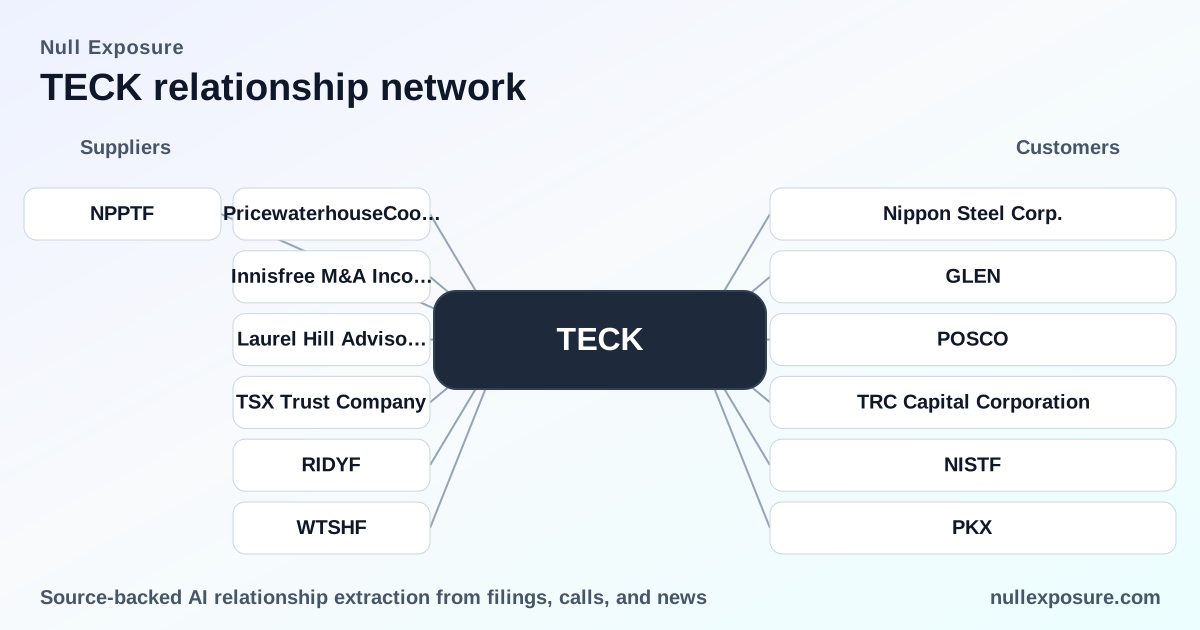
Teck Resources (TECK) — customer relationships that define transition value and near-term risk
Teck Resources is a diversified natural-resources producer that monetizes long-life mining and smelting assets by selling steelmaking coal, copper, zinc and other concentrates into global commodity markets and via strategic offtakes with industrial buyers; its revenue mix and asset sales (notably the Elk Valley/coal transactions) materially shape cash flow and strategic optionality. Investors should view Teck as a commodity producer whose customer relationships and asset dispositions drive both price exposure and structural cash generation, supported by a roughly $12.4B trailing revenue base and a ~$27.8B market capitalization (latest quarter to March 31, 2026).
Learn how Teck’s counterparty map affects contract risk and concentration at https://nullexposure.com/.
Why counterparty readouts matter for Teck’s valuation
Teck’s financial profile shows strong operating margins (about 39.8% operating margin TTM) and meaningful institutional ownership (~74%), but the company’s value is concentrated in a few commodity lines and in the strategic disposition of its coal business. Customer and partner relationships determine how market price moves translate to free cash flow: long-term offtakes, minority stake swaps and asset sales compress or amplify commodity cyclicality in different time frames.
Key investor takeaway: Teck’s customer/partner interactions are not mere commercial noise — they are corporate-finance events (stake swaps, offtakes, asset sales) that influence leverage, dividend capacity and strategic optionality.
Company-level operating model signals investors should apply
- Contracting posture: Teck balances spot market sales with multi-year offtakes and strategic joint-ventures, using minority equity deals and offtake arrangements to convert operating assets into locked-in cash or concentrated ownership interests.
- Concentration: The company historically had high exposure to steelmaking coal and a small set of large steelmakers, so disposals (e.g., Elk Valley) materially change counterparty concentration and cash flows.
- Criticality: For counterparties like Nippon Steel and POSCO, Teck’s coal supplies were strategically critical to steelmaking operations — those relationships historically justified equity-for-asset arrangements rather than pure commodity contracts.
- Maturity: Many of the arrangements described in the record are corporate-level project and asset transactions (asset sales, equity swaps, multi-year offtakes) rather than short-term purchase orders, indicating mature, structured commercial relationships.
If you want an at-a-glance platform view of how these relationships affect counterparty risk and concentration, visit https://nullexposure.com/.
Relationship log — every item in the results, one by one
Below are concise, investor-oriented summaries for each relationship entry in the provided results set, with a short source reference for verification.
-
XPL (Solitario Resources / XPL) — Teck is conducting evaluations at the Lik project and is in discussions about a 2026 program, indicating exploratory services or technical engagement rather than a long-term offtake. Source: TradingView news item referencing the matter (Mar 10, 2026) — https://www.tradingview.com/news/tradingview:7646e60f0e50a:0-solitario-resources-10-k-net-loss-3-8m-eps-0-04/.
-
Glencore (news report) — Glencore proposed a US$23 billion takeover of Teck in 2023 but ultimately executed a structured purchase of Teck’s coal business for approximately US$7.3 billion after protracted negotiations, marking a large-scale corporate reallocation of coal assets. Source: BNNBloomberg coverage of merger context (reported Sep 2025) — https://www.bnnbloomberg.ca/business/company-news/2025/09/09/vancouver-based-teck-resources-and-anglo-american-announce-merger/.
-
GLEN (duplicate entry of the Glencore mention) — The same reporting reiterates Glencore’s earlier bid and the eventual coal-unit deal, reinforcing that Glencore’s interaction with Teck transitioned from takeover interest to targeted asset purchase. Source: BNNBloomberg (Mar 10, 2026 entry timestamp) — https://www.bnnbloomberg.ca/business/company-news/2025/09/09/vancouver-based-teck-resources-and-anglo-american-announce-merger/.
-
Nippon Steel Corp. (Globe and Mail) — Nippon Steel and POSCO agreed to swap stakes in Teck’s B.C. coal mines for minority holdings in Elk Valley, demonstrating that major steelmakers took equity positions in coal assets as part of supply-security arrangements. Source: The Globe and Mail reporting on the Elk Valley transaction (FY2023 reporting) — https://www.theglobeandmail.com/business/article-teck-resources-teck-metals-steelmaking-coal-unit/.
-
USAS (Americas Gold and Silver / USAS) — Americas Gold and Silver executed a 5-year multi-metal offtake agreement to treat Galena concentrates at Teck’s BC smelter, signaling Teck’s smelter capacity continues to provide third-party processing services under multi-year commercial terms. Source: Markets/FinancialContent release (Dec 12, 2025) — https://markets.financialcontent.com/wral/article/newsfile-2025-12-12-americas-gold-and-silver-completes-strategic-acquisition-of-the-crescent-silver-mine-in-idaho.
-
GLEN (ResourceWorld report) — ResourceWorld covered Ottawa’s approval for Glencore to acquire 77% of EVR for roughly US$6.9 billion cash, underscoring the scale of the coal-unit sale and Glencore’s majority positioning in the new coal vehicle. Source: ResourceWorld (FY2024 reporting) — https://resourceworld.com/ottawa-approves-sale-of-teck-met-coal-assets-to-glencore/.
-
Glencore Plc (same ResourceWorld item) — The same piece frames Glencore Plc as the acquirer of the majority stake in EVR, consolidating operational control and payment obligations related to that asset purchase. Source: ResourceWorld (FY2024) — https://resourceworld.com/ottawa-approves-sale-of-teck-met-coal-assets-to-glencore/.
-
USAS (NewsfileCorp duplicate) — A separate press release again notes the 5-year multi-metal offtake and Teck’s role as a processor in BC, confirming the smelter arrangement from the issuer’s perspective. Source: NewsfileCorp press release (Dec 12, 2025) — https://www.newsfilecorp.com/release/277829/Americas-Gold-and-Silver-Completes-Strategic-Acquisition-of-the-Crescent-Silver-Mine-in-Idaho.
-
GLEN (InvestingNews) — InvestingNews reported Canadian government approval for Glencore’s acquisition of Teck’s steelmaking coal unit (approx US$6.93 billion), noting regulatory conditions intended to protect jobs and national benefits — a political and compliance dimension to the sale. Source: InvestingNews coverage (FY2024) — https://investingnews.com/teck-glencore-coal-acquisition-approved/.
-
Glencore (duplicate InvestingNews entry) — The story again frames Glencore as the buyer and highlights the government-imposed conditions tied to the coal-unit transaction. Source: InvestingNews (FY2024) — https://investingnews.com/teck-glencore-coal-acquisition-approved/.
-
POSCO (InvestingNews) — Under the approved deal, POSCO would hold roughly a 3% share in Elk Valley, demonstrating non-Canadian steelmakers’ use of equity stakes to secure coal feedstock. Source: InvestingNews summary of the transaction (FY2024) — https://investingnews.com/teck-glencore-coal-acquisition-approved/.
-
TRC Capital Corporation (The Globe and Mail release) — Teck publicly urged shareholders to reject an unsolicited “mini-tender” by TRC Capital to acquire up to 2.0 million Class B shares (about 0.41% of outstanding Class B), indicating active defense against opportunistic share purchases. Source: Teck press release quoted by The Globe and Mail (May 2025) — https://www.theglobeandmail.com/investing/markets/stocks/TECK-A-T/pressreleases/32555507/teck-recommends-that-shareholders-reject-mini-tender-offer-by-trc-capital/.
-
NISTF (InvestingNews label for Nippon Steel) — InvestingNews repeats Nippon Steel’s 20% acquisition of Elk Valley as part of the post-sale ownership split, confirming strategic equity participation by a major Japanese steelmaker. Source: InvestingNews (FY2024) — https://investingnews.com/teck-glencore-coal-acquisition-approved/.
-
Nippon Steel (InvestingNews duplicate) — The InvestingNews piece again notes Nippon Steel’s 20% role in Elk Valley, tying strategic supply security to equity ownership. Source: InvestingNews (FY2024) — https://investingnews.com/teck-glencore-coal-acquisition-approved/.
-
PKX (resourceworld small tag for POSCO / PKX) — ResourceWorld records that the remaining 3% of EVR would be held by POSCO, confirming the small but strategically significant stake allocation to Korea’s largest steelmaker. Source: ResourceWorld (FY2024) — https://resourceworld.com/ottawa-approves-sale-of-teck-met-coal-assets-to-glencore/.
-
PKX (The Globe and Mail / FY2023 entry referencing stake swaps) — The Globe and Mail earlier reported that Nippon Steel and POSCO would obtain minority holdings in Elk Valley in return for stakes in Elkview Operations, showing an earlier stage of the asset re-structuring. Source: The Globe and Mail (FY2023) — https://www.theglobeandmail.com/business/article-teck-resources-teck-metals-steelmaking-coal-unit/.
-
POSCO (Globe and Mail duplicate / FY2023) — The Globe and Mail again documents POSCO’s equity exchange for coal-mining interests, emphasizing the recurring narrative of steelmakers taking minority ownership to secure feedstock. Source: The Globe and Mail (FY2023) — https://www.theglobeandmail.com/business/article-teck-resources-teck-metals-steelmaking-coal-unit/.
-
POSCO (ResourceWorld duplicate / FY2024) — ResourceWorld reiterates POSCO’s 3% holding in EVR, underscoring the finished ownership split after regulatory approval. Source: ResourceWorld (FY2024) — https://resourceworld.com/ottawa-approves-sale-of-teck-met-coal-assets-to-glencore/.
Investment implications and final takeaways
- Asset monetization changed Teck’s customer map. The sale of the coal unit and minority-equity arrangements with Nippon Steel and POSCO convert operational exposure into longer-duration, owner-level commercial structures that materially de-risk or reallocate cash flow volatility.
- Counterparty concentration decreased in some ways but introduced new structural counterparties. Glencore’s majority ownership of EVR shifts buyer-seller dynamics from spot sales to owner-controlled output management.
- Processing capacity remains a revenue driver. Multi-year smelter agreements, like the five-year offtake with Americas Gold and Silver, provide recurring third-party processing revenue and strengthen Teck’s smelting cash flow line.
Bottom line: Teck’s recent customer and partner events are strategic and cash-flow decisive rather than tactical sales — investors should value the company through a lens that accounts for asset-level monetizations, minority equity stakes held by large steelmakers, and contracted smelter services.
For a structured counterparty risk dashboard and deeper document-level sourcing, visit https://nullexposure.com/.