Tela Bio (TELA): Commercial traction with a surgical implant franchise and an evolving go‑to‑market
Tela Bio designs, manufactures and sells reinforced tissue matrices under the OviTex brand and monetizes through direct product sales to hospitals and ambulatory surgery centers, contracting relationships with group purchasing organizations, and selective licensing of distribution rights. The company’s revenue base is product sales supplemented by licensing proceeds; commercial momentum is visible in rising unit volumes but financials reflect an early‑stage medical device company still working toward positive operating leverage. For a focused, investor‑grade view of Tela’s customer relationships and what they imply for revenue durability and execution risk, read on.
Discover more analysis at https://nullexposure.com/.
How Tela sells and where money comes from
Tela’s core commercial engine is the sale of OviTex Reinforced Tissue Matrix, a surgical implant used in hernia repair and abdominal wall reconstruction. The firm sells predominantly to hospitals and ambulatory surgery centers, which then obtain reimbursement from third‑party payors for procedures using the product. Tela also leverages national GPO contracts to accelerate hospital penetration and uses field inventory and consignment to support distribution and reps in the field.
- Product sales are the primary revenue stream. Revenue for the trailing twelve months is listed at $80.3 million with gross profit of $54.7 million, signaling a product with attractive gross margins but an operating cost base that still produces negative operating margin and EBITDA. (Company financials, FY2025–FY2026 reporting).
- Licensing is a complementary monetization channel. In March 2024 Tela sold distribution rights to MiMedx in exchange for a $5.0 million upfront payment and contingent payments of $3.0–$7.0 million tied to subsequent net sales of the product formerly marketed as NIVIS (now HELIOGEN), illustrating how the company converts some geographic or channel expansion into near‑term cash. (Company disclosure, March 2024).
What the contract and channel signals tell investors
Tela’s public disclosures and recent excerpts reveal a hybrid contracting posture: direct sales to clinical customers combined with selective licensing and third‑party distribution. This creates a mixed exposure profile:
- Contracting posture: active and pragmatic — the company signs national GPO agreements and also monetizes distribution/licensing rights when it accelerates cash or reduces operational burden.
- Concentration and geography: U.S.‑centric but with growing global sales; 15% of 2024 revenue came from outside the U.S., indicating early international penetration while the U.S. market remains the primary backbone of sales.
- Customer criticality: high for hospital procedures — products are used in surgical repairs and represent a clinical choice in reconstruction workflows; hospitals and payors determine uptake through reimbursement and clinical adoption.
- Maturity and stage: commercial growth phase — unit sales increased materially year‑over‑year (18,121 units in 2024 vs. 13,675 in 2023), supporting the claim that product adoption is scaling but overall profitability is not yet established.
These are company‑level signals derived from reported contractual actions and revenue geography rather than a single buyer relationship.
Financial posture that shapes the customer story
Tela’s headline financials frame the commercial narrative: solid gross margins on product sales but negative operating and net margins. Revenue of $80.3M and gross profit of $54.7M contrast with an EBITDA loss (~$32.7M) and negative profit margin (-48.4%), reflecting substantial fixed commercial and R&D spend. The market capitalization is approximately $48.8M, which compresses valuation relative to revenue and highlights investor skepticism about near‑term profitability despite product traction.
Operationally, management is balancing inventory placement, rep‑level consignment and GPO coverage against cash conservation measures such as monetizing distribution rights. That approach reduces working capital pressure while potentially ceding some upside in exchange for certainty.
The customer relationships identified (one by one)
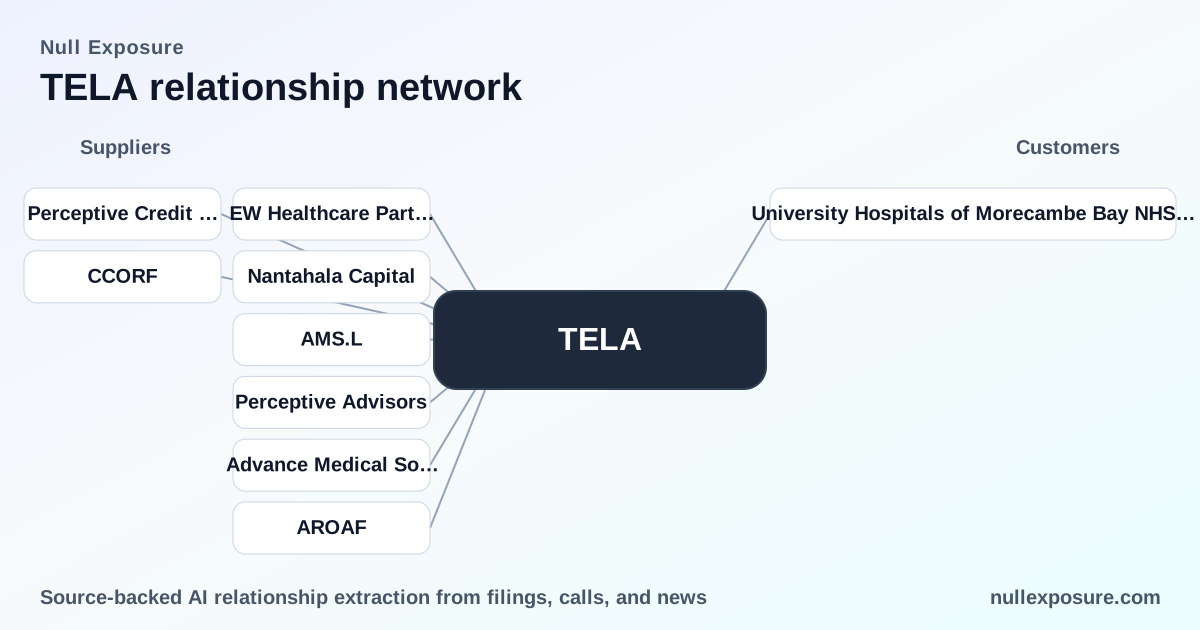
University Hospitals of Morecambe Bay NHS Foundation Trust — A UK NHS Trust clinician performed Europe’s first minimally invasive hernia repair using OviTex LPR, evidencing clinical adoption of Tela’s product in the UK and Europe and signaling acceptance among surgical practitioners outside the U.S. (Yahoo Finance news report, March 10, 2026: https://finance.yahoo.com/news/nhs-surgeon-first-europe-implant-122800285.html).
Why this relationship matters to investors
The Morecambe Bay instance is a clinical validation milestone for Tela’s European presence: successful first‑in‑region procedures increase the probability of subsequent institutional trials and hospital procurement decisions in national health systems. Because Tela has pursued both direct sales and licensing, a European clinical success can translate into either expanded direct sales or further distribution partnerships depending on management’s channel choice.
Risks that flow from the commercial model
- Reimbursement and hospital procurement are gating factors. Hospitals and payors determine procedure economics; any adverse shifts in reimbursement or procurement priorities will directly impact sales.
- Dependence on GPO and IDN access. The company uses national GPO contracts to scale; losing coverage or failing to expand GPO penetration would slow account growth.
- Mix of licensing and distribution trades upside for cash. Licensing deals such as the 2024 MiMedx arrangement accelerate cash but limit upside in some regions and create variable revenue profiles.
- Profitability runway is not yet secured. Despite rising unit volumes, negative EBITDA and operating margins indicate that Tela must sustain growth or compress costs to reach profitability.
Investment implications: what to look for next
Investors should watch three operational levers closely: (1) unit volume growth and expansion within GPO/IDN networks, which drives recurring product revenue; (2) the cadence and structure of licensing or distribution agreements, which affect cash and long‑term revenue capture; and (3) geographic revenue mix, as international adoption could diversify payor risk while adding complexity.
Key near‑term catalysts include additional European or APAC institutional adopters, expanded GPO agreements in the U.S., and progress toward positive operating leverage. Absent those, valuation compression relative to revenue is the default outcome given current margins.
For a structured tracking of Tela’s customer win flow and contract events, see resources at https://nullexposure.com/.
Bottom line
Tela Bio combines a clinically differentiated implant product with a pragmatic go‑to‑market that mixes direct sales, GPO coverage and selective licensing. Clinical adoption is real and growing, but the company’s financial profile requires continued volume expansion and disciplined channel decisions to translate surgical wins into sustained profitability. Investors should value Tela as a commercializing medical‑device opportunity where execution on contracting strategy and reimbursement engagement will determine whether product momentum converts to enterprise value.