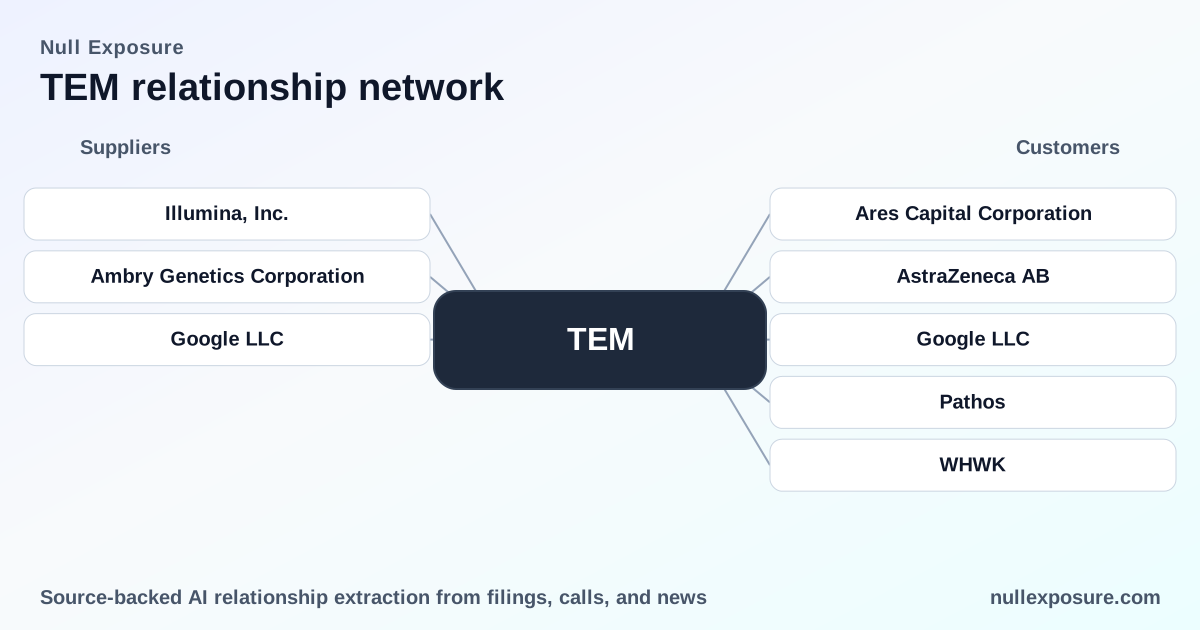
Tempus AI (TEM): Customer relationships are the engine — but concentration and payor complexity define the risk profile
Tempus monetizes an integrated genomics and AI offering by selling diagnostic testing and licensing access to its de‑identified multimodal data and Lens analytics platform, supplemented by fee‑for‑service sequencing and CRO support. Revenue mixes into recurring multi‑year subscriptions, one‑time data licenses, and usage‑based clinical services, with Diagnostics and Data & Services jointly driving the company’s go‑to‑market and unit economics. According to the company’s filing, Tempus generated roughly $1.27 billion in trailing‑12‑month revenue and reports material contractual commitments and a remaining total contract value that underscores enterprise‑grade engagement with large pharma customers.
If you evaluate Tempus as an operator or investor, treat the customer base as both the primary growth vector and the primary operational risk: big, concentrated counterparties and government payors create scale and stickiness — and cash‑flow timing and contract structure govern the margin path. Learn more at https://nullexposure.com/.
Why customers matter: a concise operating model view
Tempus sells multiple contract types across mostly large pharmaceutical and biotech clients: time‑limited data licenses recognized on delivery, multi‑year access subscriptions recognized ratably, and fee‑for‑service work billed as delivered. Payment terms sit on a short cycle (company disclosures reference collections generally within 30–120 days from service), which amplifies working‑capital sensitivity but keeps revenue cadence visible. The company reports that three unnamed customers accounted for $111.6 million — roughly 46% of Data & Services revenue for the year ended December 31, 2024, signaling concentration that investors must price into valuation and covenant stress tests.
Operationally, several company‑level signals matter:
- Contracting posture: A mix of licensing, subscriptions, and usage‑based engagements creates diversified revenue drivers but different revenue recognition and renewal mechanics. Licensing revenue for one‑time data delivery is recognized on delivery, while multi‑year access is recognized over time.
- Counterparty profile: The primary buyers are very large pharmaceutical companies; Tempus reports working with 19 of the top 20 pharma companies (2023 basis), and government payors (Medicare/Medicaid) account for a major share of testing reimbursement.
- Concentration and criticality: The firm discloses materiality from a small customer subset and a Remaining TCV north of $940 million, indicating meaningful committed spend and potential upside if opt‑ins convert.
- Geographic and service maturity: Revenue and lab operations are heavily U.S.‑centric and the Diagnostics business leverages lab capacity in multiple states that are not fully redundant, consistent with mid‑stage commercial maturity rather than global commodity scale.
These features create high revenue visibility with corresponding counterparty concentration and payor exposure — a core tradeoff for investors.
Relationship roll call — who is on the buying side (and why it matters)
Below are the customer and related counterparties identified in the public record. Each entry is summarized in plain English with the source.
Pathos
Tempus has executed agreements with Pathos that provide access to its Lens product plus sequencing, clinical research organization services and other data services. This is described directly in Tempus’ FY2024 10‑K disclosure. (Source: Tempus FY2024 10‑K filing.)
AstraZeneca AB
Tempus issued a warrant to AstraZeneca in connection with a Master Services Agreement signed in November 2021, a commercial detail disclosed in the FY2024 10‑K that reflects strategic commercial negotiation mechanics with a large pharma customer. (Source: Tempus FY2024 10‑K filing.)
Ares Capital Corporation
Ares is the lender under Tempus’ senior secured term loan facility — the FY2024 10‑K shows $272.4 million outstanding under the Term Loan Facility with Ares as of December 31, 2024, linking capital structure to the company’s operating commitments. (Source: Tempus FY2024 10‑K filing.)
Google LLC
Tempus issued a convertible promissory note to Google (the Amended Note) with $168.2 million outstanding as of December 31, 2024, reflecting strategic financing and potential strategic partner economics rather than a classic customer purchase. (Source: Tempus FY2024 10‑K filing.)
Gilead Sciences (GILD)
Tempus expanded a multi‑year collaboration with Gilead to provide enterprise‑wide access to its Lens platform and multimodal data to support oncology research and drug development, a development reported in 2026 business coverage. This extension underscores Tempus’ traction with top‑tier biopharma R&D teams. (Source: SahmCapital news piece, April 2026.)
Whitehawk Therapeutics (WHWK)
Tempus and Whitehawk announced a multi‑year collaboration where Whitehawk will use Tempus’ de‑identified multimodal database and AI analytics to refine clinical trial design and identify patient populations; multiple press releases and news articles covering March 2026 document the initiative and subsequent real‑world analyses. (Sources: Whitehawk/Tempus press release via PR Newswire and multiple news outlets, March 2026.)
Recursion Pharmaceuticals (RXRX)
Recursion issued shares to Tempus for annual license fees, indicating a commercial arrangement where equity was accepted as payment for licensing access — a non‑cash consideration that links business development and capital allocation choices. (Source: TradingView news report, March 2026.)
What these relationships imply for risk and upside
- Upside: Large pharma collaborations (e.g., Gilead, AstraZeneca) validate Lens as an enterprise tool and drive material recurring revenue if multi‑year access contracts renew; the disclosed Remaining TCV > $940 million suggests a pathway to predictable growth. Big‑ticket collaborators provide both revenue scale and reference value for smaller biotech deals.
- Risk: Customer concentration is real — three customers drove nearly half of Data & Services revenue in 2024 — and U.S. payor complexity (Medicare/Medicaid exposure) creates reimbursement volatility, particularly across diagnostics lines that face evolving coverage policies. Short invoice collection windows raise working capital dynamics especially if government reimbursement slows.
- Structural: The mix of license, subscription and usage contracts gives Tempus flexibility to capture value across discovery and clinical stages, but investors should model renewals and one‑time data sales conservatively given the company’s admitted immateriality of lens subscription revenue in some periods.
How investors and operators should follow up
For analysts building a forecast or an operator benchmarking GTM, focus on renewal rates for multi‑year access contracts, the pipeline conversion of Remaining TCV, and payer reimbursement trends for genomics testing. Tempus’ public filings and accompanying press releases on collaborations are the primary source of record; for curated customer intelligence and continuity monitoring, see our platform at https://nullexposure.com/.
Bottom line: Tempus has assembled enterprise‑grade customer relationships that underpin its commercial thesis, but the company’s valuation and cash‑flow profile depend on managing concentration, payor complexity, and the cadence of multi‑year contract renewals.