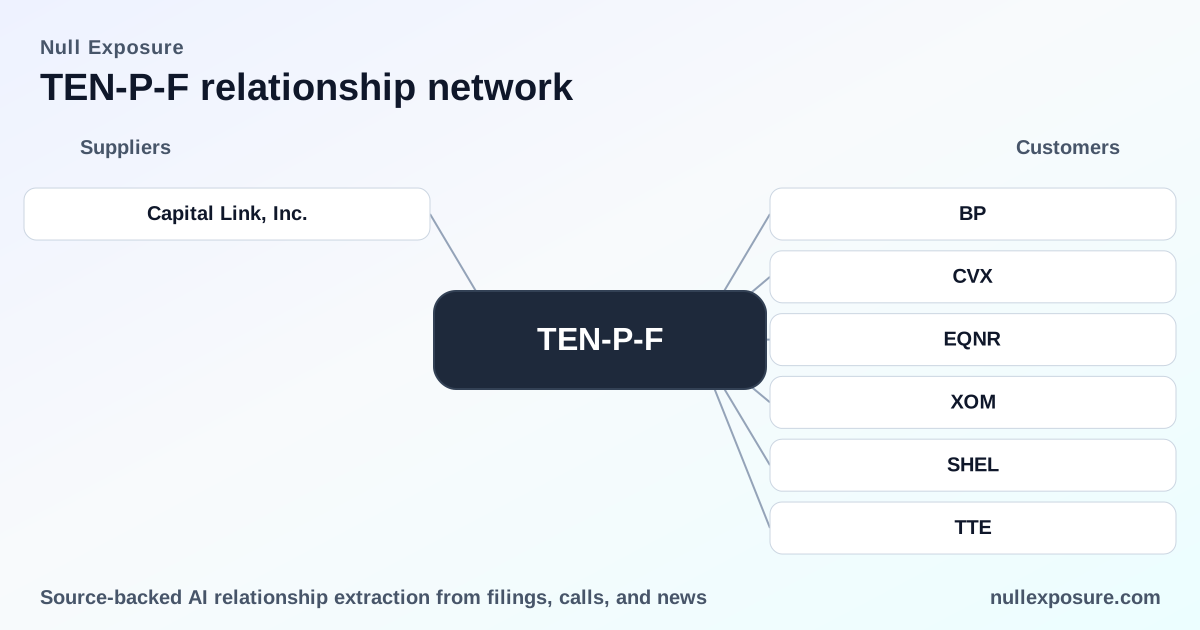
TEN-P-F Customer Map: What reported counterparties tell investors about concentration and operational risk
Tenet Healthcare (ticker: TEN-P-F) operates an integrated U.S. healthcare services platform comprised of hospitals, outpatient centers, and ancillary care facilities, and it monetizes through fee-for-service patient care, managed-care contracts, and outpatient procedure growth. For investors evaluating customer relationships, the most consequential signals are payer and large-system contracting posture, revenue concentration among a small number of counterparties, and the contractual maturity that drives recurring cash flows. For deeper customer intelligence, see https://nullexposure.com/.
Why customer counterparties matter for healthcare operators
Tenet’s economics are driven by contracted reimbursement rates, referral flows and case mix. Large, repeat counterparties — health plans, physician groups, and integrated delivery networks — determine utilization, negotiating leverage and working capital dynamics. When counterparty lists concentrate around a handful of names, investors should prioritize three company-level signals:
- Contracting posture: Are relationships short-term fee schedules or multi-year, high-friction network agreements that effectively lock in volumes?
- Concentration: High revenue share tied to a small set of payers or partners amplifies earnings volatility if one counterparty re-prices or exits.
- Criticality and maturity: Long-standing, mission-critical contracts increase predictability; nascent or churn-prone relationships signal underwriting risk.
These are company-level characteristics and apply regardless of the identity of any single counterparty.
Reported counterparties in FY2026 and what each mention implies
The public reporting captured in FY2026 sources lists a core set of counterparties across multiple news and transcript items. Below are the relationships identified in the reporting with concise, source-backed descriptions.
ExxonMobil (XOM)
News and transcript coverage list ExxonMobil as the largest revenue client in the cited slide and remarks, indicating a dominant commercial relationship among named counterparties. According to an FY2026 earnings-call transcript referenced on Investing.com, management presented ExxonMobil as the largest revenue client among repeat customers (Investing.com transcript, FY2026).
Equinor (EQNR)
Equinor appears among a short list of repeat clients in the same FY2026 slide and transcript, signaling a recurring commercial relationship with materiality behind it. The transcript cited by InsiderMonkey (March 2026) lists Equinor as one of the follow-on clients after ExxonMobil (InsiderMonkey earnings transcript, FY2026).
Shell (SHEL)
Shell is explicitly named as a repeat client in FY2026 remarks and also appears in sector commentary linking client exposure to favorable market dynamics; one market note ties Shell exposure to expected income growth driven by rising tanker rates. The company’s clientele including Shell is referenced in an FY2026 presentation transcript and a March 30, 2026 analysis by Sahm Capital that highlights Shell among major clients (InsiderMonkey/Investing.com transcripts and Sahm Capital, Mar 2026).
Chevron (CVX)
Chevron is listed alongside the other majors as a repeat client in FY2026 public remarks, putting it within the peer group of large, stable counterparties. The FY2026 earnings-call transcript on Investing.com lists Chevron as a named follow-on client after ExxonMobil (Investing.com transcript, FY2026).
TotalEnergies (TTE)
TotalEnergies is included in the set of follow-on clients reported in FY2026 materials, which indicates recurring contractual activity with global energy majors. The FY2026 transcript referenced on Investing.com specifically lists TotalEnergies among the named clients (Investing.com transcript, FY2026).
BP (BP)
BP is identified as part of the repeat-customer cohort in the FY2026 slide and commentary, placing it among the top-tier counterparties named by management. An FY2026 earnings transcript cited on InsiderMonkey and Investing.com lists BP as one of the major repeat clients following ExxonMobil (InsiderMonkey/Investing.com transcripts, FY2026).
What these reported relationships imply for investors
The roster of large, global counterparties — as reported in FY2026 sources — creates a clear, actionable set of implications for Tenet’s investor base:
-
Concentration risk is front and center. When a single counterparty is described as the “largest revenue client,” investors must treat that relationship as a potential swing factor for near-term revenue and cash flow volatility. The reporting places ExxonMobil at that top slot (Investing.com transcript, FY2026).
-
Counterparty credit and operational exposure are material. Large energy or industrial clients carry different credit cycles and demand patterns than diversified payer panels; exposure to a small set of corporates concentrates operational risk.
-
Macro and geopolitical sensitivity is present. Third-party commentary linked rising tanker rates (an industry driver) to income growth expectations tied to the client mix, highlighting the sensitivity of operating performance to external market dynamics (Sahm Capital, Mar 2026).
-
Contract maturity and stickiness are the real determinants of predictability. The listed names suggest repeat business, but publicly available transcripts do not detail contract tenure; investors must therefore prioritize verifying contract length and termination terms in filings or direct disclosures.
Practical investor checklist
Use the reported relationships as a starting point for diligence. Key next steps:
- Confirm reported client names and quantify revenue share in the next quarterly filing or investor presentation.
- Obtain clarity on contract terms (duration, termination rights, price reset mechanics).
- Monitor counterparties’ credit profiles and sector cyclicality for second-order effects on utilization and receivables. For a consolidated stream of customer signals and relationship analytics, consult https://nullexposure.com/ for ongoing updates.
Bottom line: concentration creates both leverage and risk
The FY2026 reporting maps a tightly concentrated group of large repeat clients that can deliver outsized revenue impact — a structural lever that amplifies both upside from stable contracts and downside from re-pricing or contract loss. Investors must shift from passive reading of client names to active verification of revenue share, contract maturity, and counterparty credit to move from headline-level signals to an investment-grade view of operational risk.