Tenax Therapeutics: Investors as the Short-Term Bedrock for a Clinical-Stage Pharma Story
Tenax Therapeutics operates as a specialty pharmaceutical developer focused on cardiovascular and pulmonary disease — principally advancing an oral formulation of levosimendan — and monetizes through eventual product commercialization, licensing, and milestone-driven partnerships; until regulatory approval and market launch, the company is reliant on institutional capital to fund late-stage clinical development and regulatory activities. The August 2024 $100 million private placement that brought a cohort of new healthcare-focused investors onto the cap table materially resets Tenax’s financing runway and its operational priorities. For a concise company snapshot, see the firm’s investor profile and financials at the company site and market summaries. NullExposure homepage
Why the investor list matters: capital as a strategic supplier to a pre-revenue drug developer
Tenax is pre-revenue, loss-making, and development-centric — the firm reported negative EBITDA and no product revenues through the most recent reporting periods — which makes capital relationships effectively the company’s most critical counterparties. The August 2024 financing was oversubscribed and led by an institutional healthcare investor, providing an anchor that reduces near-term financing execution risk and enables acceleration of Phase 3 activity on the oral levosimendan program. This changes the company’s operating posture from ad hoc financing to a more predictable, program-funded cadence. According to Tenax’s August 12, 2024 announcement, the private placement closes at $100 million and is explicitly tied to accelerating the oral levosimendan Phase 3 program (GlobeNewswire, August 12, 2024).
Operationally, Tenax’s business model shows these characteristics as company-level signals:
- Contracting posture: Capital-intensive, contract-heavy with CROs and regulators; financing rounds set the tempo for trial execution and vendor commitments.
- Concentration: Revenue concentration is currently theoretical (single lead asset), and financing sources are concentrated around a limited set of institutional investors providing rounds rather than diverse commercial customers.
- Criticality: Investor commitments are critical to program continuity; clinical milestone delivery is the primary de-risking vector for valuation.
- Maturity: Development-stage company profile — clinical progress and regulatory milestones dictate transition to a commercial posture.
These are company-level operational constraints and not assigned to any individual investor unless stated in a primary source.
The investor roll call — who joined the $100M placement
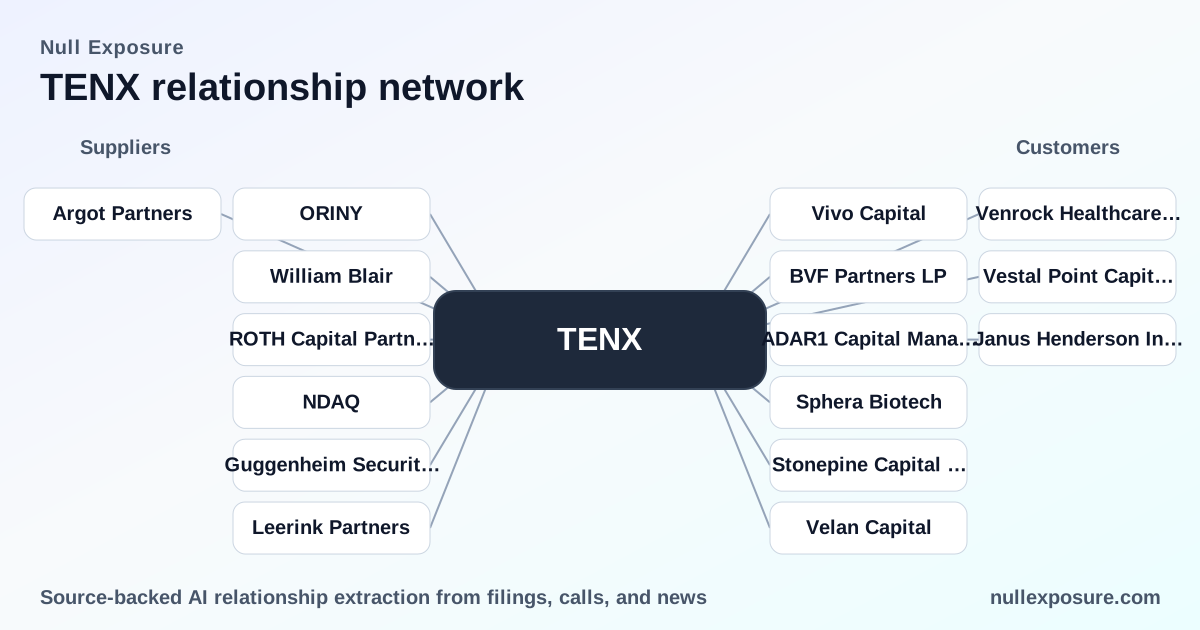
Below I list every participant named in Tenax’s August 12, 2024 financing announcement and summarize each relationship in plain English with the source cited for verification.
-
BVF Partners LP — BVF Partners led the $100 million private placement and acted as the anchor investor for the round, providing the governance and capital weight that effectively structured the transaction (GlobeNewswire, August 12, 2024).
Source: GlobeNewswire press release, August 12, 2024. -
Vivo Capital — Vivo Capital participated as a new institutional investor in the oversubscribed placement, signaling healthcare-specialist confidence in Tenax’s Phase 3 strategy (GlobeNewswire, August 12, 2024).
Source: GlobeNewswire press release, August 12, 2024. -
Venrock Healthcare Capital Partners — Venrock joined the placement as a new investor, contributing additional industry-focused asset management capital to fund late-stage development (GlobeNewswire, August 12, 2024).
Source: GlobeNewswire press release, August 12, 2024. -
Janus Henderson Investors — Janus Henderson, described in the release as a large investment management firm, participated as a new investor, bringing diversified institutional allocation to the financing (GlobeNewswire, August 12, 2024).
Source: GlobeNewswire press release, August 12, 2024. -
Vestal Point Capital — Vestal Point Capital was among the new investors in the round, adding to the group of healthcare- and event-driven managers underwriting the program (GlobeNewswire, August 12, 2024).
Source: GlobeNewswire press release, August 12, 2024. -
Velan Capital — Velan Capital participated in the private placement as a new investor, expanding Tenax’s investor base of specialized managers (GlobeNewswire, August 12, 2024).
Source: GlobeNewswire press release, August 12, 2024. -
ADAR1 Capital Management, LLC — ADAR1 Capital joined as a new investor in the oversubscribed placement, adding a smaller, specialized investment manager to the cap table (GlobeNewswire, August 12, 2024).
Source: GlobeNewswire press release, August 12, 2024. -
Stonepine Capital Management — Stonepine Capital participated as a new investor, diversifying the investor mix supporting Tenax’s clinical acceleration plans (GlobeNewswire, August 12, 2024).
Source: GlobeNewswire press release, August 12, 2024. -
Sphera Biotech — Sphera Biotech was listed among the new investors in the $100 million transaction, completing the syndicate noted in Tenax’s financing announcement (GlobeNewswire, August 12, 2024).
Source: GlobeNewswire press release, August 12, 2024.
What this investor syndicate implies for valuation and execution risk
The composition of the syndicate is meaningful for two reasons. First, an anchor lead (BVF) plus a mix of healthcare specialists and generalist institutional allocators reduces immediate market risk for a follow-on equity need because the company has secured diverse institutional support. Second, the financing is explicitly targeted at a Phase 3 push: that means operational budgets, vendor commitments, and regulatory interactions will scale materially over the next 12–24 months — and execution on the clinical program directly controls valuation uplift.
From a capital markets lens, Tenax’s balance as of its latest public financials shows market capitalization of roughly $343 million and negative EBITDA, underscoring why institutional investors took a development-stage exposure rather than a commercial equity play. Analysts aggregated a consensus target in the mid-to-high twenties per share at the time of coverage, reflecting hypothesis-driven upside tied to approval and launch scenarios.
Explore more company-level relationship intelligence at NullExposure
Bottom line for investors and operators
- Capital relationships are the operational lifeline for Tenax until product revenues exist; the August 2024 placement materially extends runway and aligns shareholders around Phase 3 execution.
- Leadership of the round by BVF Partners is the most important single development — anchor investors set credibility and provide follow-on financing optionality.
- Risks remain concentrated in clinical execution and regulatory timing; the investor list reduces financing risk but does not remove clinical readout risk.
- Operators should prioritize clear milestone calendars tied to the use of proceeds and vendor contracting; investors should monitor trial enrollment, site activation, and any use-of-proceeds disclosures.
These are decisive factors for valuation and partnership strategy as Tenax transitions from a capital-dependent developer to a product-led specialty pharmaceutical company.