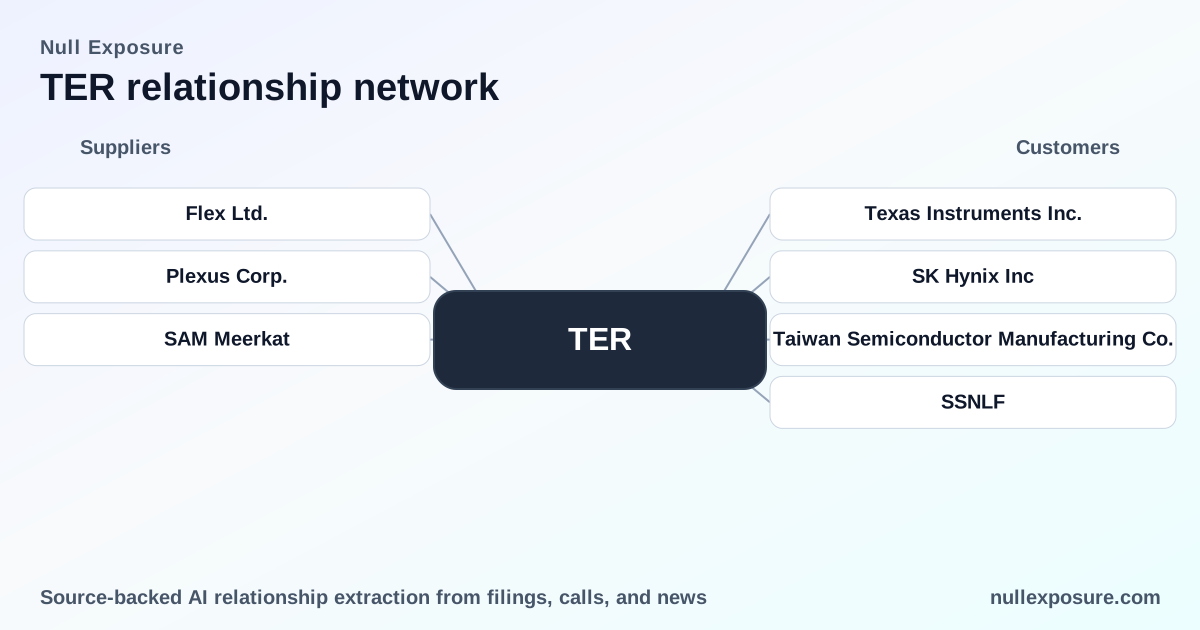
Teradyne (TER) — Customer Map and Commercial Implications for Investors
Teradyne designs and manufactures automated test equipment and robotics and monetizes through high-margin hardware sales complemented by recurring services and multi-year warranty contracts. The business is globally distributed with pronounced revenue concentration in APAC semiconductor OEMs and foundries, and it balances spot hardware recognition with deferred revenue from extended service arrangements. For investors, the critical questions are customer concentration, counterparty criticality for advanced nodes, and the mix between spot systems and longer-term service commitments. Learn more at https://nullexposure.com/.
Why customer relationships matter for valuation
Teradyne’s financial profile combines product-led revenue recognition (point-in-time hardware) with an 18–19% services stream, resulting in volatile quarterly revenue but durable aftermarket margin. Five customers accounted for 36% of revenues in 2024, which creates both upside when major chipmakers expand capex and downside when a single OEM pauses orders. Customer credit flows (accounts receivable concentration) and strategic alliances with system integrators and contract manufacturers affect working capital and go-to-market economics as much as pure demand.
Relationship roll call — who buys from Teradyne and what that means
Below I cover every customer relationship flagged in the source set with a short, plain-English summary and the cited source.
Texas Instruments Inc.
Teradyne reported that Texas Instruments accounted for 10% of consolidated revenues in 2023 and represented 18% of accounts receivable as of December 31, 2023, signaling both meaningful revenue contribution and receivables concentration. According to Teradyne’s 2024 Form 10‑K, this customer is material to working capital and near-term cash conversion.
Source: Teradyne 2024 10‑K (FY2024 disclosure of 2023 revenue and A/R).
SK Hynix Inc.
As of December 31, 2024, SK Hynix accounted for 10% of Teradyne’s accounts receivable, indicating a notable receivables exposure tied to a major memory-chip OEM. This level of A/R concentration underscores sensitivity to SK Hynix’s purchasing cadence.
Source: Teradyne 2024 10‑K (FY2024 accounts receivable disclosure).
Taiwan Semiconductor Manufacturing Co. (TSMC)
TSMC likewise represented 10% of accounts receivable as of year-end 2024, reflecting the company’s deep engagement with leading foundries that drive demand for advanced-node test systems. Teradyne’s exposure to TSMC links revenue to foundry capex cycles.
Source: Teradyne 2024 10‑K (FY2024 accounts receivable disclosure).
Samsung (SSNLF)
Teradyne discloses that Samsung drove 12.5% of consolidated revenues in 2024, combining direct sales and shipments through its OSAT partners, a substantial share that highlights the company’s dependence on one of the industry’s largest IDM customers.
Source: Teradyne 2024 10‑K (FY2024 revenue by customer disclosure).
Flex
Teradyne expanded its robotics partnership with Flex, under which Flex both manufactures components for Teradyne’s Universal Robots and deploys Teradyne Robotics solutions in Flex’s own production facilities, creating a commercial and supply-chain alliance that extends distribution and manufacturing capacity.
Source: PR Newswire announcement and contemporaneous coverage (May 2026).
Analog Devices (ADI)
Teradyne announced a strategic automation agreement with Analog Devices to deploy Universal Robots (UR) cobots and MiR autonomous mobile robots (AMRs) for collaborative semiconductor automation, indicating growth in integrated factory automation sales and cross-selling into analog/mixed-signal manufacturing lines.
Source: Q1 earnings call transcript coverage reported by The Motley Fool (April 28, 2026).
Nvidia (NVDA)
Teradyne received its first orders from Nvidia, with shipments occurring in the second quarter, marking an entrance into the hyper-growth AI-compute testing segment and a relationship with one of the largest GPU buyers.
Source: Morningstar coverage reporting Q2 shipments (May 2026).
Apple (AAPL)
Industry research and Morningstar reports characterize Apple as one of Teradyne’s vital partners, reflecting Teradyne’s role supplying testers for advanced logic and systems-on-chip where Apple’s product roadmap exerts meaningful demand influence.
Source: Morningstar company report (May 2026).
FormFactor (FORM)
FormFactor executives said they work closely with Teradyne on an open test-ecosystem basis, signaling collaborative vendor relationships within the broader test equipment supply chain and potential OEM/distributor interactions.
Source: InsiderMonkey earnings call coverage (May 2026).
Operating and commercial constraints that shape customer relationships
Teradyne’s operating model creates a distinct set of commercial characteristics investors should internalize:
-
Contracting posture — mixed spot and multi-year: Teradyne’s hardware is recognized at a point in time on transfer of control, producing lumpier revenue, while extended warranties longer than one year are deferred and recognized straight-line, producing predictable services revenue. This dual posture reduces top-line visibility while providing recurring aftermarket earnings.
-
Customer concentration and materiality: Five largest customers comprised 36% of revenues in 2024, a concentration that magnifies the impact of single-customer capex cycles on Teradyne’s top line. Accounts receivable concentration (e.g., Texas Instruments 18%) tightens working-capital risk.
-
Geographic footprint — APAC-led demand with global coverage: Teradyne sells globally, but APAC dominates (Korea 25%, Taiwan 21% in 2024); sales outside the U.S. equaled roughly 87% of revenues in 2024, linking performance to regional semiconductor cycles and foundry investment.
-
Counterparty mix and criticality: The company serves IDMs, foundries, memory OEMs, and governments, with defense and aerospace contracts evidencing government counterparty exposure. For the most advanced chips, Teradyne is one of two suppliers globally able to deliver cutting-edge testers, making its equipment mission-critical for customers pursuing leading-edge nodes.
-
Channel and go-to-market: Robotics products are sold principally through distributors and OEMs, while semiconductor test systems rely on a direct sales force, impacting margin and customer intimacy differently across segments.
-
Segment maturity: Products represented ~81.4% of revenue in 2024, with services at ~18.6%, so the business remains hardware-dominant but with meaningful services margin contribution that supports long-term profitability.
Investment takeaway
Teradyne sits at the intersection of hardware cyclicality and structural demand from AI-driven compute and advanced-node semiconductors. The company’s high customer concentration and APAC revenue skew create both leverage to cyclical capex and elevated counterparty risk. Positive signals—new orders from Nvidia, strategic robotics partnerships with Flex and Analog Devices, and deep relationships with TSMC, Samsung, and Apple—point to durable demand in high-value segments. Investors should weigh upside from AI and foundry cycles against receivables and revenue concentration when sizing risk and upside.
For a more detailed map of vendor and customer exposures, visit https://nullexposure.com/ for our full coverage and interactive relationship tools.