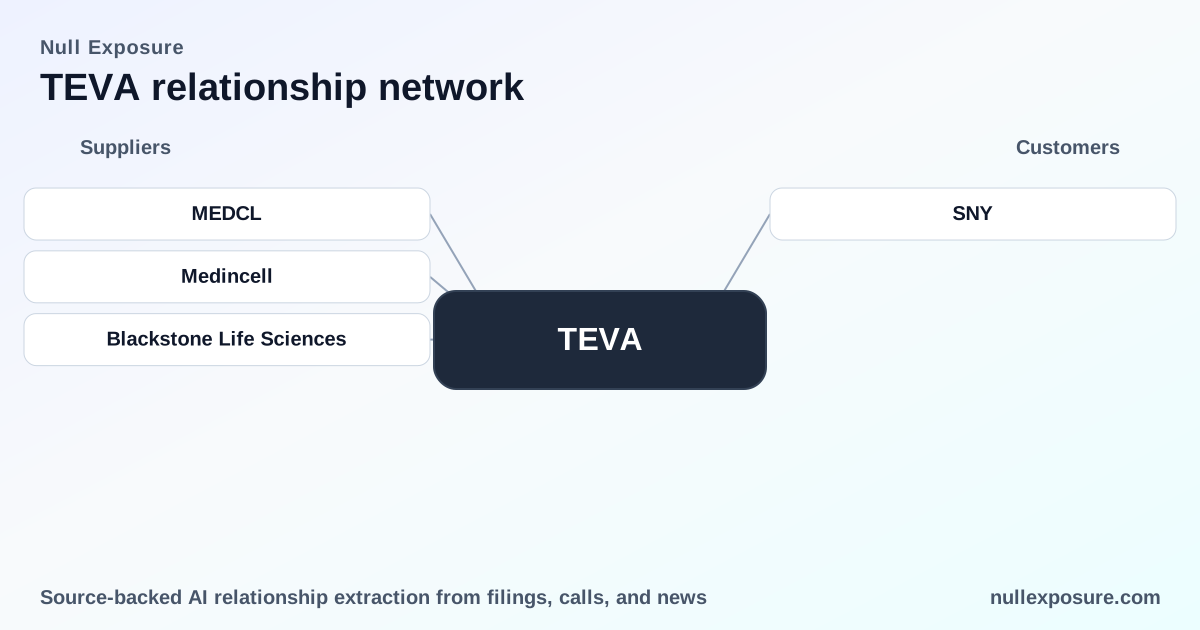
TEVA: Partnered commercialization and licensing are driving near‑term cash and longer‑term optionality
Teva Pharmaceuticals operates as a diversified generics and specialty pharma manufacturer that monetizes through three axes: large‑scale product sales in North America and Europe, licensing and milestone receipts for development programs, and targeted co‑development/co‑commercialization deals for specialty assets. Investors should view Teva’s partner map as a hybrid commercial play: steady, high‑volume generics cash flow underpins the P&L while selective licensing and funding agreements shift development risk off the balance sheet and accelerate optionality for specialty drugs.
For a concise, machine‑independent analysis of Teva’s customer and partner profile, visit https://nullexposure.com/ for complementary coverage and relationship scoring.
What the partner map reveals about Teva’s operating posture
Teva’s relationships reflect a dual business model: commodity generics distribution and sponsored specialty development. The relationship evidence and company disclosures produce these clear company‑level signals:
- Contracting posture: licensing and milestone monetization. Teva recognizes significant revenue from licensing arrangements, including a reported $500 million development milestone tied to Phase 3 initiation for an anti‑TL1A asset in late 2025; that fact signals an active out‑licensing program that converts R&D progress into near‑term cash. (Company filings and segment notes for the 2025 period.)
- Counterparty profile: large enterprises dominate commercial flows. Teva sells generics and APIs into major retail chains, wholesalers and hospital groups, creating concentrated counterparty bargaining dynamics in the U.S. market. (U.S. market disclosures.)
- Geographic concentration: North America and Europe remain core. The U.S. accounts for roughly half of consolidated revenues with Europe/EMEA also material; the firm’s commercial footprint is therefore weighted to developed markets. (FY2025–2026 revenue breakdowns.)
- Commercial roles: buyer, distributor and reseller channels. Teva distributes through owned channels (Anda in the U.S.) and sells to wholesalers and pharmacy chains; the company operates both as a manufacturer and a distribution/reseller platform. (Corporate disclosures on Anda and distribution strategy.)
- Materiality and concentration risk. Teva notes that a significant share of U.S. revenue derives from relatively few key customers, so customer stress or payment delays could create material operating risk. (Risk disclosures in recent annual reporting.)
- Core product orientation: generics and core pharmaceuticals drive the revenue base. Sales of goods remain the primary revenue stream, while licensing and strategic partnerships supply episodic, high‑value inflows. (Segment and “sale of goods” revenue notes.)
Collectively, these signals define a business that is operationally mature in generics and strategically active in transferring specialty program risk to partners.
Detailed customer and partner relationships investors should know
Below are the relationships discovered in recent reporting and press coverage, each summarized in plain English with source context.
OABI
Teva disclosed a funding agreement with Royalty Pharma of up to $500 million to accelerate clinical development of its anti‑IL‑15 antibody TEV‑408, a move that converts program risk into immediate development capital. This detail comes from OABI’s Q4 2025 earnings commentary where the Teva‑Royalty arrangement was referenced in the context of conference disclosures. (OABI earnings call, 2025Q4.)
NeuroGen
Teva signed a strategic partnership and licensing deal with China‑based NeuroGen to commercialize AJOVY in mainland China, granting NeuroGen exclusive commercialization and related patent/trademark rights for that territory. The transaction was reported in Chinese outlets as part of Teva’s targeted China commercialization strategy for specialty assets. (China Daily, May 2026; Yicai Global, May 2026.)
Sanofi (reported as Sanofi / SNY)
Sanofi paid Teva $500 million in 2023 for rights to codevelop and co‑commercialize an anti‑TL1A therapy; ongoing development updates and a Phase‑2 extension were covered in industry press, highlighting continued joint development obligations and potential co‑commercial upside subject to regulatory approvals. (ContractPharma and FierceBiotech coverage, 2026; original agreement announced 2023.)
SNY (separate listing for the same Sanofi connection)
Industry reports reiterate that Teva and Sanofi are partners on an autoimmune/IBD program with co‑development and co‑commercialization economics and a prior upfront that materially de‑risks Teva’s development exposure for that asset. This duplicate result reflects multiple press summaries of the same Sanofi agreement. (ContractPharma and FierceBiotech, 2026.)
RPRX (Royalty Pharma)
Royalty Pharma acquired a royalty interest in Teva’s long‑acting injectable olanzapine (TEV‑749), a Phase‑3 asset for schizophrenia, under a November 2023 deal; that transfer monetized future royalties to provide Teva near‑term proceeds. (Royalty Pharma press release cited in SEC filing, FY2024/press release archive.)
NeuroGen Pharma (Yicai listing)
A separate industry dispatch confirmed that NeuroGen Pharma will hold exclusive mainland China commercialization and licensing rights for AJOVY from Teva, underlining Teva’s strategy of territory‑specific out‑licensing to local partners. (Yicai Global, May 2026.)
BX (Blackstone)
Blackstone committed up to $400 million to support Teva’s autoimmune drug program, representing a life‑sciences funding relationship that supplies program capital while sharing development economics. The commitment was reported in financial press as part of a broader Blackstone life sciences push. (Simply Wall St coverage summarizing Blackstone news, May 2026.)
MDWD (MediWound)
Financial reporting from MediWound notes repayment of liabilities in respect of Teva in 2025, reflecting historic financial linkages between Teva and smaller biotech partners where Teva has served as creditor or funding counterparty. (MediWound financial release via GlobeNewswire, November 2025.)
Investment implications: optionality, cash conversion, and concentration risk
- Positive: licensing and co‑development deals convert R&D upside into real cash. Recent milestone recognition and external funding agreements provide near‑term balance‑sheet relief while preserving upside on partnered programs. The $500 million licensing/milestone example for an anti‑TL1A asset is material to Teva’s FY2025 cash profile.
- Positive: diversified monetization paths. Teva’s mix of high‑volume generics sales plus selective specialty partnerships reduces single‑vector dependence and creates a portfolio of revenue converters.
- Risk: customer concentration and counterparty bargaining power. The U.S. generics channel concentrates revenues among large buyers and wholesalers; pressure or payment delays from a few large customers can produce outsized earnings volatility.
- Risk: partnership complexity and milestone dependency. Value realization increasingly depends on binary development milestones and regulatory outcomes; while these are hedged by partner funding, milestone timing creates earnings lumpiness.
For investors assessing credit or equity exposure to Teva, the partner set underlines a company that is leaning into deal‑based monetization of specialty programs while relying on established generics cash flow for baseline earnings. Track milestone receipts and partner funding commitments closely as near‑term drivers of free cash flow.
If you want structured, scored partner intelligence for Teva and peer companies, explore additional analysis at https://nullexposure.com/.
Appendix: sources cited above include company filings and investor calls (FY2024–FY2026 filings and Q4 2025 earnings commentary), news coverage from China Daily, Yicai Global, ContractPharma, FierceBiotech, SimplyWallSt summaries of Blackstone activity, Royalty Pharma press releases filed with the SEC, and MediWound corporate releases.