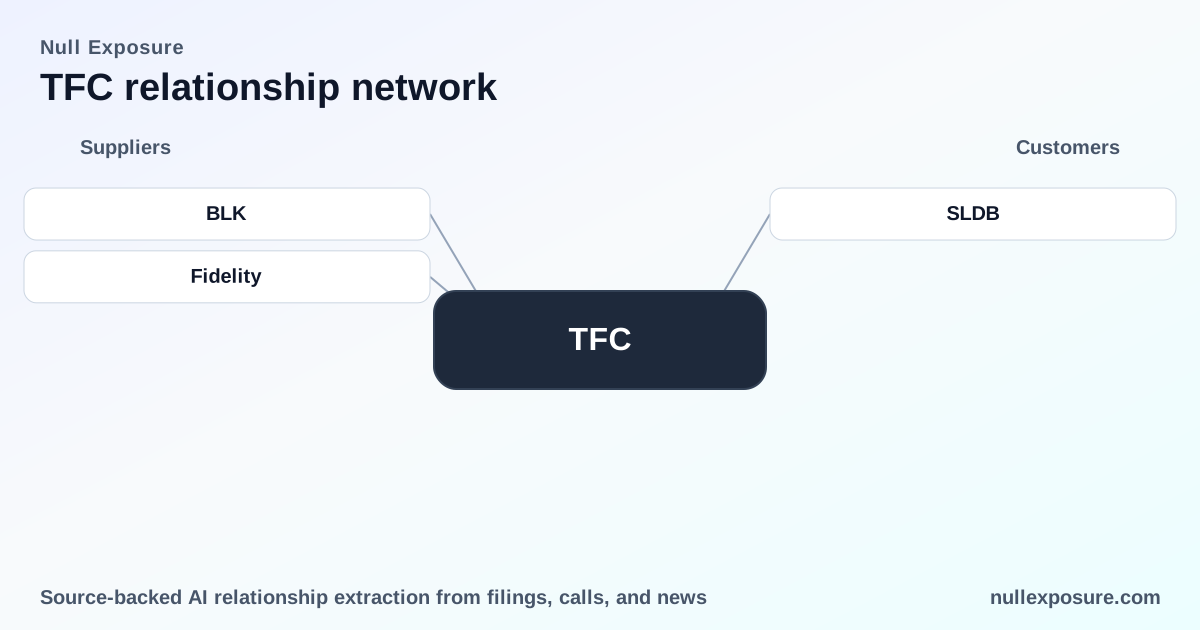
Truist (TFC) Customer Footprint: Who Depends on the Bank and How It Gets Paid
Thesis: Truist Financial Corporation monetizes through a mix of deposit and lending spread, fee-based capital markets and advisory work, and payments and wealth-management fees; its customer relationships range from short-duration investment banking mandates to multi-year syndicated credit facilities where Truist often acts as administrative agent or lead arranger. For investors, the commercial dynamics to watch are revenue diversification across transaction banking and lending, concentration in US regional markets, and the bank’s role (principal vs. agent) on deals that determine fee capture and balance-sheet risk. Learn more at https://nullexposure.com/.
What the relationship map tells investors about Truist’s operating model
Truist runs a hybrid bank/investment-banking model: retail deposits and consumer lending provide funding and margin, while Truist Securities and Truist Bank capture advisory fees, underwriting and syndication revenue. Investment banking engagements are often short-term contracts recognized on completion, whereas credit facilities and term loans create multi-year, material exposures on the balance sheet. The firm serves individuals, small and middle-market businesses, and large corporates, with a geographic concentration in North America—particularly the Southeastern and Mid‑Atlantic U.S. Truist is both seller (adviser/bookrunner) and service provider (lender/agent), which amplifies revenue diversity but also concentrates operational risk in credit and capital markets execution.
Key operating constraints as company-level signals
- Revenue timing split: Investment banking and advisory performance obligations are typically satisfied within one year, producing short-latency fee recognition. (Company disclosures, 2024–2025.)
- Credit concentration and maturity: The loan book contains significant multi-year exposures; loan maturities stretch to 15+ years in some categories, indicating long-term credit exposure management is material. (Loan maturity table, 2024.)
- Counterparty mix: Truist serves individuals, small businesses (targeting $2M–$500M revenue), and large enterprises—supporting diversified fee and credit profiles across client segments.
- Geographic focus: Primary footprint in the U.S., especially Southeastern and Mid‑Atlantic markets; cross-border activity is limited relative to peers. (Headquarters and branch map, 2024.)
- Role diversity: Truist alternates between principal (earning advisory fees, underwriting risk) and agent/arranger roles (administrative agent for syndicated facilities and placement agent), affecting both fee capture and balance-sheet utilization.
If you want a deeper map of counterparties and trending deal flow, visit https://nullexposure.com/ for the underlying signals and source links.
Relationship catalogue — concise takeaways for each customer relationship
Below are the customer relationships surfaced across recent filings and press coverage, each with a short plain‑English description and source context.
- Denny’s Corporation (DENN): Truist Securities acted as financial advisor in Denny’s acquisition process in FY2025–FY2026. Source: GlobeNewswire and related press releases (FY2025–FY2026).
- Morgan Stanley Direct Lending Fund (MSDL): MSDL reported $293.1 million outstanding under a Truist credit facility, indicating Truist as a committed lender to the fund (FY2025). Source: FinancialContent (FY2025).
- Solid Biosciences (SLDB): Truist and H.C. Wainwright served as co-placement agents for a $240 million private placement (FY2026). Source: GlobeNewswire (Mar 2026).
- Blue Owl Capital Corp (OBDC): Truist Securities was lead financial advisor to OBDC’s special committee in a merger transaction (FY2025). Source: PR Newswire and Yahoo Finance (FY2025).
- Alpine Income Property Trust (PINE): Truist Bank led a syndicate as administrative agent under an amended and restated credit agreement (FY2026). Source: Company press release and QuiverQuant (Q1 2026).
- Exzeo Group (XZO): Truist Securities served as lead left bookrunner on a proposed IPO (FY2025). Source: GlobeNewswire (FY2025).
- PennantPark Investment Corp (PNNT): The company increased its Truist credit facility to $500M (potential to $750M) and adjusted terms, showing Truist as a strategic lender (FY2025–FY2026). Source: SEC filing summaries and press (FY2025).
- Biote (BTMD): Transaction supported by committed debt financing from Truist Bank and Truist Securities, with Truist advising on the deal (announced earlier, referenced FY2021 item in later coverage). Source: IPO‑Edge (historical FY2021 note referenced in FY2026 coverage).
- Collegium Pharmaceuticals (COLL): Truist Bank acted as administrative agent on a $980 million syndicated credit and Truist Securities was joint bookrunner/lead arranger (FY2025–FY2026). Source: StockTitan and TradingView (FY2025–FY2026).
- Repay Holdings (RPAY): Truist Bank provided a $500M term loan commitment and $100M undrawn revolver for an acquisition financing (FY2026). Source: Investing.com (FY2026).
- Fulcrum Therapeutics (FULC): Truist Securities acted as a book-running manager for an offering alongside Oppenheimer (FY2025). Source: Yahoo Finance and GlobeNewswire (FY2025).
- Marine Products / MasterCraft (MPX): Truist Securities served as exclusive financial advisor to Marine Products in a strategic combination (FY2026). Source: GlobeNewswire / Yahoo Finance (Mar–Apr 2026).
- Midcap Financial Investment Corp (MFIC): Truist Securities was a joint bookrunner/lead arranger on an amended senior secured revolving facility (FY2025). Source: FinancialContent (FY2025).
- PennantPark Floating Rate Capital (PFLT): Proceeds from note issuance intended to repay indebtedness under a revolving credit facility with Truist Bank (FY2026). Source: Investing.com (FY2026).
- Kimco Realty preferred (KIM-P-M): Truist Securities adjusted price target and maintained a Hold rating in coverage notes (FY2026). Source: Investing.com (FY2026).
- Enova International / OnDeck (ENVA): OnDeck’s receivables facility amended with Truist Bank via a credit agreement amendment (FY2026). Source: Investing.com (FY2026).
- Cousins Properties (CUZ): Truist Bank named as a documentation agent on an unsecured revolving facility upsizing (FY2026). Source: Yahoo Finance (FY2026).
- Carlsmed (CARL): Truist Securities acted as joint book-runner on a proposed IPO registration (FY2025). Source: BioSpace (FY2025).
- Quipt Home Medical (QIPT): Truist Securities acted as financial advisor to Quipt and the strategic transactions committee in an arrangement and merger (FY2025–FY2026). Source: Globe and Mail / Bitget (FY2025–FY2026).
- Curis (CRIS): Truist Securities and Laidlaw acted as placement agents for a registered direct and concurrent private placement (FY2024). Source: PR Newswire (FY2024).
- Southern States Bank (SSBK): Truist Securities acted as joint bookrunner on an IPO for Southern States Bank (historical FY2021 coverage cited). Source: Renaissance Capital (FY2021).
- Adicet Bio (ACET): Truist Securities acted as passive book-runner or joint bookrunner on public offerings (FY2021, FY2025 references). Source: GlobeNewswire / StockTitan (historical FY2021 and FY2025 notes).
- Instil Bio (TIL): Truist Securities acted as lead manager on an upsized IPO in earlier filings (FY2021 referenced). Source: GlobeNewswire (historical FY2021).
- Riley Exploration Permian (REPX): Truist’s equity research or investment banking coverage upgraded or underwrote IPO activity via SunTrust Robinson Humphrey branding (FY2026). Source: MarketBeat (Mar 2026).
- Whitestone REIT (WSR): Truist Securities reiterated a Buy and hosted a non‑deal roadshow in support of coverage (FY2026). Source: Investing.com (May 2026).
- Nextracker (NXT): Truist Securities served as a joint book-running manager on an offering (historical FY2023 noted in later aggregated coverage). Source: Nextracker investor releases (FY2023).
- Oaktree preferred (OAK-P-A): Truist Securities served as lead structuring agent on an equipment finance securitization (FY2026). Source: ABF Journal (2026).
- EquipmentShare (EQPT): Truist acted as a joint bookrunner on IPO plans alongside major firms (FY2026). Source: industry press summaries (FY2026).
- Goldman Sachs BDC (GSBD): Truist Bank served as administrative agent on an amended senior secured revolving credit agreement, with multiple facility amendments (FY2025–FY2026). Source: The Globe and Mail / TradingView (Dec 2025–2026).
- Delek Logistics Partners (DKL): Truist Bank led a $1.3 billion revolving credit syndicate to refinance prior facilities and extend maturities (Mar 2026). Source: SahmCapital and The Globe and Mail (Mar 2026).
- Encompass Health (EHC): Entered a new $1.0 billion secured revolving credit agreement with Truist, extending maturity to 2031 (FY2026). Source: TradingView (May 2026).
- HealthStream (HSTM): Amended its revolving credit agreement with Truist Bank on March 13, 2026 to improve flexibility (FY2026). Source: Bitget and The Globe and Mail (Mar 2026).
- FSK (FSK): Truist Securities reiterated a Hold rating on FSK and maintained a price target in coverage notes (FY2026). Source: Investing.com (May 2026).
- ANDG (ANDG): Truist Securities participated as a book-running manager in an IPO syndicate (FY2025). Source: Investing.com (FY2025).
- Cedar Realty (CDR-P-C): Truist Bank included among banks referenced in corporate coverage or servicing relationships (historical FY2021). Source: CityBiz (historical).
- Priority Technology (PRTH): Former Truist leveraged-finance executive linked to financings led while at Truist, indicating personnel bench strength in TMT leveraged finance (FY2022 historical reference). Source: CityBiz (FY2022).
- Leerink / Larimar (LRMR): Truist Securities acted as a joint book-runner on a public offering (FY2025). Source: Mintz (FY2025).
Investment implications and risks
- Revenue diversity is a strength: Truist’s role across advisory, underwriting and lending creates multiple fee streams. Advisory work is short-term revenue; lending is long-duration credit exposure—monitor mix trends.
- Concentration in the U.S. regional market concentrates credit and deposit risk; macro shocks in key states would pressure both margins and asset quality.
- Principal vs. agent roles matter: When Truist acts as principal (underwriting, lead arranger) the firm faces balance-sheet and market risk; when acting as agent it captures fee income with lower capital usage.
- Counterparty mix spanning individuals to large corporates supports resilience, but syndicated credits to larger corporates (e.g., DKL, EHC, COLL) are material and should be tracked for covenant and default risk.
For a granular, source-linked view of each relationship and to monitor changes in Truist’s customer map, visit https://nullexposure.com/.
Bold takeaway: Truist’s commercial strength sits at the intersection of traditional banking and investment-banking execution; watch the split between short-term advisory fees and multi-year credit commitments to assess earnings stability and balance-sheet risk.