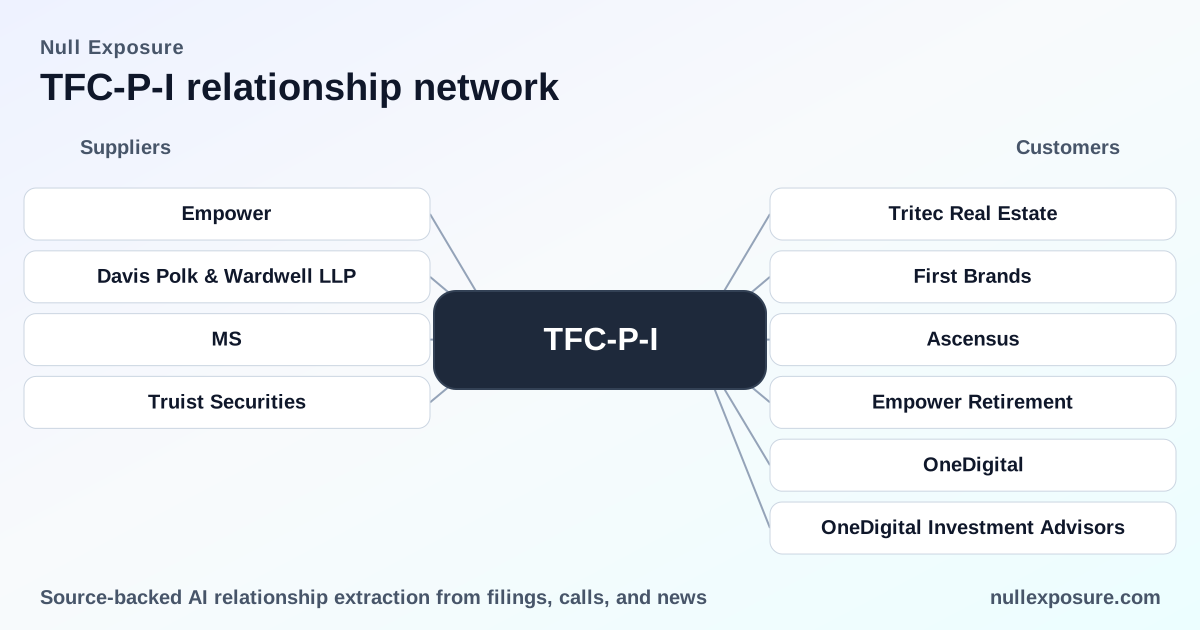
Truist (TFC-P-I) — Customer Relationships that Shape Credit and Fee Risk
Truist Financial is a diversified regional bank that monetizes through net interest income on lending and deposit products, fee income from wealth and brokerage services, and periodic sales or restructuring of non-core business lines. The firm’s customer relationships span commercial real estate lending, retirement-services divestitures, and monitored credit exposures — each relationship informing credit risk, fee runway, and strategic focus for preferred-holders and credit analysts. For an at-a-glance view of relationship signals and risk implications visit https://nullexposure.com/.
How Truist’s operating model converts relationships into earnings
Truist operates as a classic bank holding company: deposit funding supports commercial and consumer loans, while treasury and wealth platforms generate fee income. The bank’s revenue mix gives priority to loan originations and servicing, but the company regularly exits or restructures non-core businesses to optimize capital deployment and limit operational complexity. Contracting posture is standard for large regional banks — a mix of long-term loans, contractual servicing agreements, and periodic one-off sales of business units. Concentration risk is mitigated by a large retail footprint and diversified product lines, yet individual commercial credits and portfolio divestitures create episodic pockets of exposure and earnings volatility. Overall maturity of customer relationships ranges from long-term depositors and mortgage borrowers to transactional, once-off sales of retirement-business assets.
Relationship catalogue: what the reporting shows and why it matters
Below are the customer and counterparty relationships in the dataset, summarized plainly with source context. Each entry indicates the nature of Truist’s commercial connection and the public reference supporting that linkage.
OneDigital Investment Advisors / OneDigital
Truist sold its institutional 401(k) investment advisory relationships to OneDigital as part of a 2021 transaction that dismantled the bank’s institutional retirement advisory footprint. According to NAPA Net and InvestmentNews reporting from January 2021, OneDigital acquired the advisory relationships while recordkeeping was allocated to third parties, signaling Truist’s exit from that advisory channel (NAPA Net, Jan. 2021; InvestmentNews, Jan. 2021).
Ascensus
Ascensus took on a portion of Truist’s institutional 401(k) recordkeeping business when Truist sold the retirement unit in 2021. InvestmentNews and NAPA Net reported the division of recordkeeping responsibilities between Ascensus and Empower Retirement, reflecting Truist’s decision to monetize and transfer operationally intensive retirement recordkeeping (InvestmentNews, Jan. 2021; NAPA Net, Jan. 2021).
Empower Retirement
Empower Retirement absorbed another portion of Truist’s 401(k) recordkeeping operations in the same 2021 divestiture, joining Ascensus as a successor recordkeeper. Public reports indicate that Truist prioritized downstream partners to take custody and servicing roles while exiting the recordkeeping business (InvestmentNews, Jan. 2021; NAPA Net, Jan. 2021).
Tritec Real Estate
Truist provided a $140 million refinance loan to Tritec Real Estate for the Shoregate 418-unit multifamily property in Bay Shore, N.Y., in 2025. Commercial Observer reported the loan in June 2025, representing Truist’s active role as a commercial real-estate lender in multifamily financing markets and underscoring exposure profiles in specific regional CRE sectors (Commercial Observer, June 2025).
First Brands
Truist disclosed under-$200 million exposure to First Brands and confirmed that the exposure was fully reflected in loan-loss reserves, highlighting a localized credit issue within the bank’s portfolio. Coverage of Truist’s Q3 2025 comments indicates management has already provisioned for this issue, treating the exposure as contained in current reserves (Yahoo Finance summary of earnings call, FY2025; earnings call transcript, Q3 2025).
Madison Marquette
Madison Marquette acquired a bank-owned real estate portfolio from Truist, indicating Truist’s disposal of legacy CRE assets as part of portfolio management and capital redeployment. GlobeSt reported the October 2022 transaction, which demonstrates the bank’s use of asset sales to reweight balance-sheet composition (GlobeSt, Oct. 31, 2022).
What these relationships imply for investors and operators
- Credit profile: Commercial lending transactions such as the Tritec loan signal ongoing CRE origination appetite; however, discrete stressed credits like First Brands are covered by reserves, indicating active credit management.
- Fee and operational profile: The 2021 sale of the 401(k) unit to OneDigital, Empower and Ascensus reduces Truist’s fee-bearing asset base for retirement advisory and recordkeeping, shifting fee-generation to other channels while removing operating complexity. This is a deliberate monetization of non-core revenue streams.
- Portfolio management: The Madison Marquette sale and the recorded refinance activity demonstrate portfolio pruning and active deployment of capital into core lending. These moves evidence a bank balancing yield opportunities against legacy asset cleanup.
Company-level signals where the data is silent
The supplied constraint set contains no explicit contractual constraints or flagged legal encumbrances. As a company-level signal, the absence of recorded constraints indicates that, in this dataset, no material contractual limitations on customer relationships were identified. From an operating-model perspective, Truist demonstrates:
- Conventional contracting posture: standard loan and servicing agreements rather than bespoke, high-dependency vendor arrangements.
- Moderate concentration risk: diversified retail and commercial footprint reduces single-counterparty concentration, but episodic material credits still appear.
- Operational maturity: management executes divestitures and portfolio sales to simplify operations and reallocate capital.
Key takeaways for analysis
- Truist monetizes primarily through lending and retained fee lines, while selectively divesting non-core retirement operations.
- Credit risk is managed reactively through reserves; material but contained exposures such as First Brands were acknowledged and reserved for in FY2025 commentary.
- Active portfolio management—selling retirement assets in 2021 and bank-owned CRE in 2022—signals priority on capital efficiency and operational focus.
For a consolidated view of how customer relationships drive credit exposure and revenue risk across Truist and peer institutions, explore our analytics at https://nullexposure.com/.