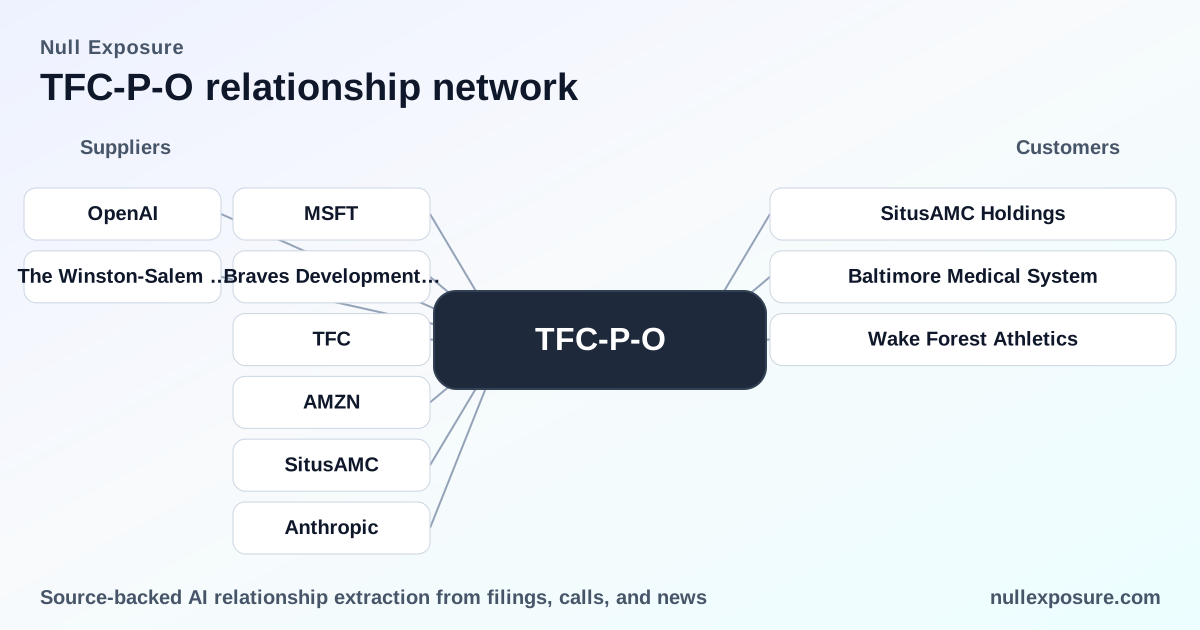
Truist (TFC-P-O) — customer relationship map and investor implications
Truist Financial Corporation operates and monetizes as a diversified regional bank: retail and commercial banking across a 2,781-branch footprint, combined with securities brokerage, asset management, mortgage, and insurance products. Revenue flows from interest margin on lending, fee income from transaction and wealth services, and recurring fees from asset-management and insurance businesses; the firm amplifies brand reach and community access through targeted sponsorships and grants that support client acquisition and local market penetration. For a concise, navigable view of these corporate relationships and what they signal about Truist’s customer and community posture, visit NullExposure.
How Truist’s customer and community relationships drive the franchise
Truist’s operating model is built on scale in branches and diversified product distribution. That combination supports cross-sell and sticky deposit relationships while philanthropic and partnership activity underpins local brand equity and commercial origination in targeted markets. Key operating characteristics for investors:
- Contracting posture: Truist contracts for both commercial outsourcing (e.g., platform disposals and third‑party servicing) and strategic sponsorships/grants that are discretionary but important for brand and community access.
- Concentration and criticality: Consumer and commercial banking remain the critical revenue engines; philanthropy and sponsorships are non‑essential to core earnings but important for customer acquisition and reputational risk management.
- Maturity: The firm is mature and scale-oriented, executing selective divestitures to streamline operations while investing in community-facing programs to protect long-term deposit and fee flows.
These dynamics frame how the customer relationships in the record should be read: partnerships and grants signal brand strategy and community penetration rather than direct revenue lines.
Relationship inventory — what every tie says about Truist
Below I summarize each relationship in the provided results with source context and a single-sentence take on its investor relevance.
Baltimore Medical System (FY2026)
Truist provided a $100,000 grant via the Truist Charitable Fund and Truist Foundation to support Baltimore Medical System’s Middlesex Health Center relocation and expansion, reflecting targeted philanthropic investment in community health access. According to an I95Business release (Feb 8, 2022), the donation is part of Truist’s local community giving programs: https://i95business.com/releases/3733.
Main Street America (FY2023)
Truist’s Foundation awarded funds to Main Street America as part of a $2.2M initiative to reduce financial inequity and create pathways for underrepresented businesses and workers, demonstrating Truist’s strategic use of philanthropy to support small-business ecosystems. Coverage in WCNC describes the allocation and program objectives (FY2023): https://www.wcnc.com/article/features/truist-bank-solutions-22m-initiative-where-it-starts-program/275-56c8d4df-74a5-4ac9-8257-119eb6b6874e.
The Council for Adult and Experiential Learning (CAEL) (FY2023)
Truist’s Foundation named CAEL as a grant recipient to expand career pathways and adult learning opportunities, aligning the bank’s corporate social responsibility with workforce development priorities that can broaden future customer bases. See WCNC’s reporting on the initiative (FY2023): https://www.wcnc.com/article/features/truist-bank-solutions-22m-initiative-where-it-starts-program/275-56c8d4df-74a5-4ac9-8257-119eb6b6874e.
Living Cities (FY2023)
Living Cities also received part of Truist’s multi‑million program to address financial inequities and systemic barriers, indicating Truist’s strategic funding of metropolitan-scale finance and housing intermediaries. The program and grantee list are summarized in WCNC’s FY2023 coverage: https://www.wcnc.com/article/features/truist-bank-solutions-22m-initiative-where-it-starts-program/275-56c8d4df-74a5-4ac9-8257-119eb6b6874e.
SitusAMC Holdings (FY2020)
Truist sold its legacy Cohen Financial commercial real estate loan servicing platform to SitusAMC Holdings as part of post‑merger rationalization and operational simplification, a move consistent with divesting non‑core servicing assets to focus on banking operations. American Banker reported the sale and contextualized it within the BB&T/SunTrust merger integration (FY2020): https://asreport.americanbanker.com/news/truist-sells-off-legacy-suntrust-cre-loan-servicing-platform.
Wake Forest Athletics — Presenting Partner (FY2023)
Truist became an official banking partner and presenting partner of Wake Forest Athletics, a sponsorship that drives regional brand visibility and consumer product placement among university alumni and local markets. The athletics partnership announcement is recorded on Wake Forest’s site (June 20, 2023): https://godeacs.com/news/2023/6/20/truist-presenting-partner-of-wake-forest-womens-athletics.
Wake Forest Athletics — “Her Victory” platform (FY2026)
Truist and Wake Forest launched “Her Victory,” a platform to amplify women’s sports and provide financial contributions for program growth, underscoring Truist’s targeted sponsorship strategy to engage specific demographics and enhance community goodwill. Wake Forest coverage of the initiative (Sept 26, 2024) details the presenting-partner role and program aims: https://godeacs.com/sports/2024/9/26/her-victory-presented-by-truist.
What these relationships signal to investors
Collectively, these ties show a two‑track approach: operational simplification on the back‑end and brand/community investment on the front‑end. The SitusAMC divestiture (FY2020) is an example of active portfolio pruning, while the grants and sponsorships are deliberate brand- and deposit‑acquisition strategies. For investors, this implies:
- Earnings relevance is indirect. Grants and sponsorships are expense-line items that build long-term franchise value through customer acquisition and reputational capital rather than immediate fee revenue.
- Reputational and deposit benefits are asymmetric. Community grants and college athletics partnerships increase brand penetration in targeted markets with relatively low incremental cost compared to branch CAPEX.
- Operational risk reduction via divestitures. Selling legacy servicing platforms reduces operational complexity and frees capital to invest in higher-return activities.
Company-level signals and operating constraints
There were no specific constraint excerpts extracted in the data feed for these customer relationships; at the company level, the available profile confirms Truist’s scale (2,781 branches across 15 states and D.C.) and diversified product mix. This profile supports a contracting posture that is pragmatic: the bank will divest non-core servicing platforms while funding discretionary community programs that support market positioning. Investors should treat philanthropic and sponsorship flows as strategic marketing investments, not as indicators of core credit exposure.
Investment takeaway and next steps
Truist is executing a disciplined operating strategy: prune non‑core platforms, monetize scale in retail and commercial banking, and underwrite brand-enhancing community programs. For investors evaluating TFC‑P‑O, the preferred shares sit on top of a bank that is defensive on operation complexity and proactive on customer-facing marketing and community engagement.
For a more complete map of corporate relationships and structured research support, visit NullExposure to explore further.