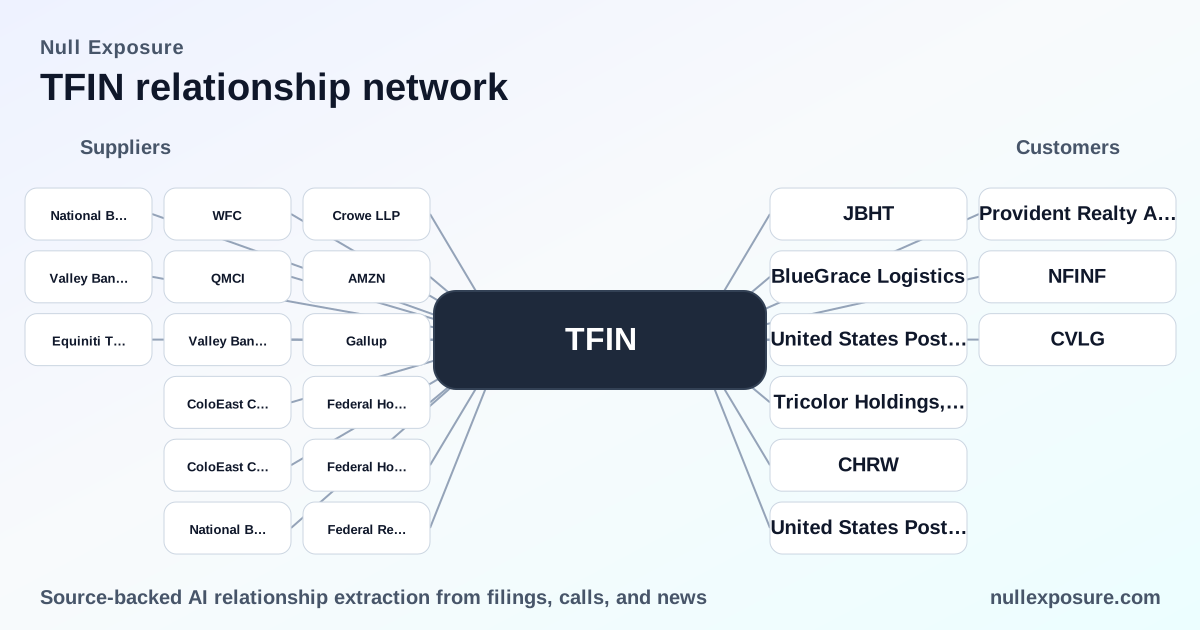
Triumph Financial (TFIN) — Customer relationships that move the payments needle
Triumph Financial operates as a hybrid financial-technology platform focused on freight payments, factoring and bank services, monetizing through a mix of transaction fees, interest on factored receivables, subscription and licensing fees for intelligence software, and bank-originated lending products. For investors, the core investment thesis is simple: scale network volume (brokers/shippers) to generate recurring transaction revenue and cross-sell higher‑margin intelligence and lending services, while managing credit exposure in the factoring portfolio.
For a concise view of Triumph’s customer relationships and how they drive fee income and balance‑sheet risk, see the profile at https://nullexposure.com/ — the summary below synthesizes the public disclosures and news flow that moved the story through FY2025–FY2026.
What triumphant scale looks like: network clients and revenue cadence
Triumph’s recent go‑to‑market momentum centers on large shippers and managed logistics providers joining its payments network. Management has guided that payments revenue growth is back‑half weighted in 2026 as new large clients onboard and transaction volume converts into fee income. That ramp story, together with the company’s mix of services, underpins the near‑term revenue trajectory. According to the company’s FY2025 disclosures and subsequent press coverage, Triumph is actively onboarding both enterprise shippers and a broad base of small and mid‑market carriers that use its LoadPay and factoring services.
Bold takeaway: enterprise signings (large brokers and shippers) drive outsized incremental fee income; small- and mid‑market carriers provide breadth and recurring transaction density.
(Explore the platform snapshot at https://nullexposure.com/.)
Customer roster: who’s on the network and why it matters
Below I cover every relationship referenced in the public results set. Each entry is a short, plain‑English summary with the source cited.
J.B. Hunt / JBHT / J.B. Hunt Transport Services
J.B. Hunt has agreed to adopt Triumph’s automated payment solution, a strategic enterprise signing that management says strengthens the network and is included in 2026 payments guidance; the company explicitly called the addition a key catalyst for fee growth. Sources: Triumph press release and the company’s Q4 2025 earnings commentary (January–March 2026) and follow‑on coverage on Finviz and Alphastreet (FY2026).
BlueGrace Logistics / BlueGrace / Bluegrace Logistics
BlueGrace, a managed logistics provider, joined the Triumph Network to gain faster, more transparent payment options for carriers, representing an enterprise or managed‑services partner that expands distribution. Source: GlobeNewswire press release (December 11, 2025) and subsequent earnings commentary (FY2026).
C.H. Robinson (CHRW)
Triumph indicated C.H. Robinson is an integration partner whose volume — along with J.B. Hunt’s — is expected to produce a back‑half weighted revenue ramp in 2026 as fee income from these partnerships scales. Source: Alphastreet recap of Triumph’s Q4 results and guidance commentary (FY2026).
NFI / NFINF
NFI expanded its relationship with Triumph to integrate payments and audit solutions, signaling broader adoption among freight and fleet operators for Triumph’s payments and audit products. Source: MarketScreener news item summarizing Triumph’s announcements (Nov. 12, referenced in FY2026 press coverage).
United States Postal Service (USPS)
Triumph carried a receivable described as a “Misdirected Payments Receivable” related to invoices factored to a large carrier and reached a settlement with the USPS under which the Postal Service agreed to pay Triumph $47.5 million to resolve litigation and related proceedings. This is a discrete, material collections event tied to prior factored activity. Source: Triumph’s Form 10‑K / SEC filing for the year ended December 31, 2025 (FY2026 filing).
Tricolor Holdings, LLC
TBK Bank, Triumph’s banking subsidiary, is the agent bank for a $60.5 million floorplan loan facility for which Tricolor is the lead borrower; TBK Bank retains approximately $22.5 million of the facility on its balance sheet. This represents direct lending exposure managed inside Triumph’s bank arm. Source: Triumph’s FY2025 annual SEC filing (Form 10‑K, Dec. 31, 2025).
Covenant (CVLG)
Triumph disclosed an arrangement with Covenant under which Covenant reimbursed Triumph for $1.7 million of a charge‑off. This indicates Triumph uses contractual remediation or indemnification in at least some commercial relationships to mitigate credit losses. Source: Triumph’s FY2025 SEC filing (Form 10‑K, Dec. 31, 2025).
Provident Realty Advisors, Inc.
Provident Realty Advisors acquired One Lincoln Park from Triumph Financial, a real‑estate divestiture noted in market coverage; this is a non‑core real‑estate transaction rather than a payments client relationship, but it shows Triumph’s active asset dispositions. Source: MarketScreener transaction notice (CI Dec. 11, reported FY2026).
How the relationships translate into business model constraints and risks
Triumph’s public disclosures provide several company‑level signals about how customer relationships are structured and what that implies for investors:
- Contracting posture: Triumph combines subscription and licensing revenue for its Intelligence software with usage‑based transaction fees for Payments, and many Payments contracts are short‑term / month‑to‑month for certain customer classes. The mix implies recurring but variable cash flows: software and seat licenses dampen volatility while transaction fees scale with volume.
- Counterparty mix and concentration: The platform serves a broad base of small‑to‑mid‑sized carriers (owner‑operators and small fleets) while selectively onboarding large enterprise shippers and brokers (e.g., J.B. Hunt, C.H. Robinson) — a two‑sided model that depends on both breadth and a few large anchors.
- Revenue criticality: Payments volume is material — Triumph reported that ~42% of 2025 revenue derived from transportation activity and a high proportion of factored receivables come from transportation clients — so payment volume and collections are critical to both fee income and credit performance.
- Maturity and stage: The business is in a scaling phase for payments revenue (management expects significant growth in 2026), while the Intelligence and bank lending products are incremental monetization levers.
- Operational counterparty risk: Large client signings accelerate fee growth, but the factoring and floorplan lending exposures (e.g., Tricolor, misdirected USPS receivable, Covenant reimbursement) introduce balance‑sheet credit risk that requires active management.
Investment implications — what investors should watch next
- Conversion of announced enterprise contracts into fee income: monitor quarterly metrics for payments processed and fee revenue as J.B. Hunt and C.H. Robinson volume ramps.
- Factoring credit trends and one‑offs: follow the receivables aging, reserve build, and any further collection or settlement events tied to the USPS receivable.
- Cross‑sell and retention: watch subscription/licensing ARR or equivalent disclosures for Intelligence products and any seat‑license traction.
- Balance‑sheet composition at TBK Bank: changes in the bank’s loan portfolio (floorplans, retained facility amounts) will influence capital needs and ROA.
Final read
Triumph’s model is network‑driven payments revenue augmented by software subscriptions and bank lending; the recent enterprise signings materially de‑risk the revenue growth narrative if volume converts as guided, but credit events and balance‑sheet exposures remain a live risk. For a structured view of the client list and press filings that back these conclusions, visit https://nullexposure.com/ for the compiled source links and timeline.