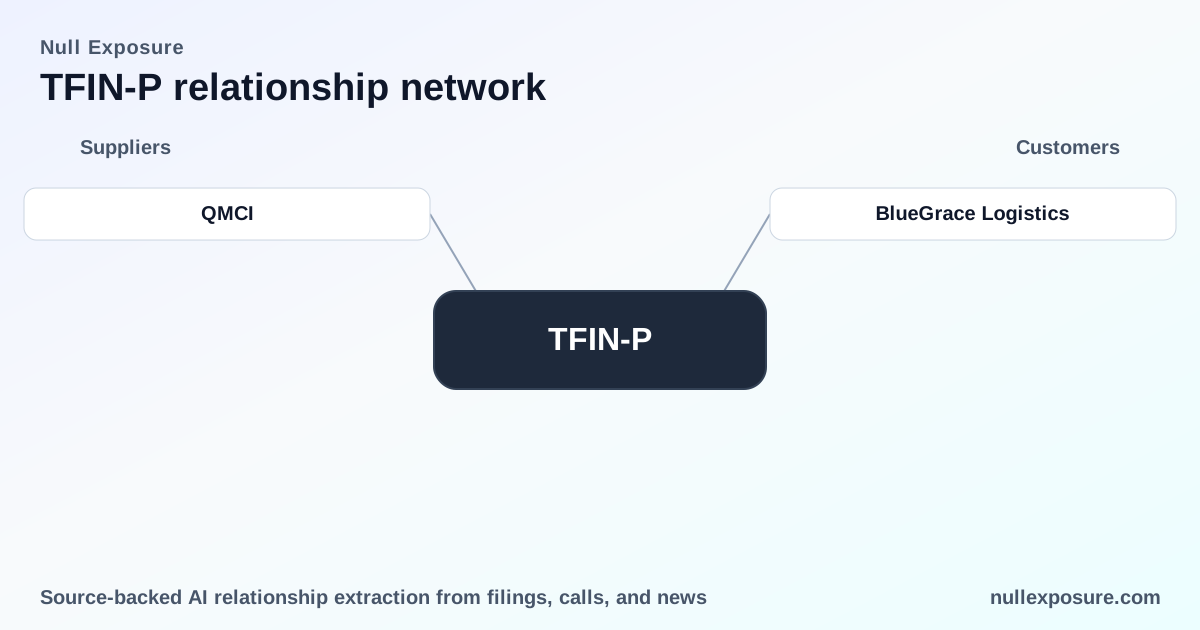
Triumph Financial (TFIN-P) — Customer Relationships That Drive Payments, Factoring and Intelligence Revenue
Triumph Financial operates a blended financial-technology model: it provides banking, factoring, payments and a subscription-based intelligence platform to participants in the U.S. trucking ecosystem, and it monetizes through transaction fees, interest and factoring spreads, subscription and license fees, and usage-based instant transfer charges. For investors, the company’s value proposition is the vertical integration of capital (factoring and banking) with payment rails and software that embeds pricing and audit capabilities into broker and shipper workflows—creating recurring and transactional revenue streams tied to freight movement.
Explore more about these customer relationships and what they mean for revenue and risk at https://nullexposure.com/.
Why the customer roster matters: operating posture and business-model drivers
Triumph’s customer relationships combine short-term transactional contracts with recurring subscription economics. Payments and factoring customers often operate on month-to-month terms for presentment and invoice purchase, while the Intelligence segment generates subscription and seat-license revenue under SaaS agreements. Instant transfer fees create usage-based revenue that scales with transaction volume. This mixed contracting posture yields stable recurring cash from subscriptions and variable upside from transaction growth.
The company’s customer base is concentrated in the U.S. transportation sector: about 42% of revenue is transportation-related and 97% of factored receivables are from transportation clients (company disclosures through FY2025). Geographical exposure is materially concentrated—Texas, Illinois, Colorado and Iowa constitute 44% of non-factoring gross loans at year-end 2025—so macro and regional freight cycles will directly affect cash flows. Triumph functions both as a service provider (payment rails, audit, platform access) and as a buyer of receivables (factoring), giving it multiple points of revenue capture and operational criticality to brokers and carriers.
The customer roll call: who has joined the Triumph Network
The following captures every customer relationship identified in public reports and press releases. Each entry is a concise, plain-English take with sources cited.
J.B. Hunt Transport Services, Inc. (JBHT)
J.B. Hunt has joined the Triumph Network, integrating with Triumph’s payments and audit platform so J.B. Hunt can streamline carrier payments and leverage Triumph’s presentment capabilities. According to a Triumph press release published via FinancialContent in FY2026, this is positioned as a strategic network addition that increases scale and transactional flow. (FinancialContent press release, May 4, 2026 — https://www.financialcontent.com/quote/NY:TFIN/pressReleases)
BlueGrace Logistics
BlueGrace Logistics adopted the Triumph payment platform to accelerate and simplify carrier payments, gaining faster, more transparent payment options and flexible settlement choices for its carrier base. This move was disclosed in Triumph communications referenced in a GlobeNewswire release in FY2025, which highlighted customer adoption of the payment platform. (GlobeNewswire release, Nov 28, 2025 — Triumph press materials)
GoodShip
GoodShip integrated Triumph’s Market Buy Rates and Verified Buy Rates into its workflows, embedding Triumph’s pricing signals directly where shippers and brokers make procurement decisions. Triumph’s FY2026 press announcement framed this as a product integration that expands the reach of its Intelligence and payments outputs. (FinancialContent press release, May 4, 2026 — https://www.financialcontent.com/quote/NY:TFIN/pressReleases)
Highway (HIHO)
Highway launched a “Trusted Freight Exchange” that is powered by the Triumph Network, leveraging Triumph’s payment rails and audit functionality to underpin marketplace transactions between brokers, shippers, and carriers. Triumph’s FY2026 disclosures present Highway as a customer that utilizes both payment settlement and networked pricing capabilities. (FinancialContent press release, May 4, 2026 — https://www.financialcontent.com/quote/NY:TFIN/pressReleases)
What these relationships reveal about Triumph’s commercial strategy
- Network effects are central. Signing large brokers and marketplaces like J.B. Hunt and Highway increases transaction flow and cross-sells factoring and instant-transfer services.
- Multi-product monetization. Triumph captures value across payments (transaction fees), factoring (interest and discount spreads), intelligence (subscription and seat licenses), and instant transfers (per-transaction fees).
- Customer mix across scales. Relationships span small owner-operators to large enterprises, consistent with company disclosures that its clients range from one-to-four truck owner-operators to fleets of over 50 trucks.
Risk and concentration — what investors should watch
Triumph’s commercial model creates several concentration and counterparty risks that affect predictability of earnings:
- Sector concentration: Transportation accounts for a sizable share of revenue; freight downturns reduce payment volume, factoring demand and instant-transfer usage.
- Geographic concentration: Heavy exposure to specific U.S. states (Texas, Illinois, Colorado, Iowa) creates sensitivity to regional economic swings and regulatory changes.
- Contracting posture: Many payments and factoring relationships are month-to-month, which enables rapid growth capture but increases churn risk during market stress.
- Revenue mix sensitivity: Usage-based instant transfer fees and transaction fees amplify revenue cyclicality; subscription revenue from Intelligence stabilizes the base but is a smaller component.
These points derive from company disclosures for FY2025–FY2026 that describe contract types, counterparty segments, and the concentration of factored receivables.
Practical monitoring checklist for analysts
- Track quarterly trends in payment volumes and instant transfer transaction counts to gauge short-term revenue momentum.
- Monitor the rate of new enterprise integrations (J.B. Hunt, Highway) versus churn among smaller carriers; enterprise onboarding drives scale but small-fleet retention sustains factoring volume.
- Watch regional loan and receivable performance in the top states listed in the company filing; rising delinquencies would signal concentration stress.
- Follow product mix evolution: expansion of Intelligence seats and license uptake will increase recurring, higher-margin revenue over time.
If you want a deeper look at how Triumph’s customer contracts and product mix translate into revenue sensitivity and credit exposure, see our platform: https://nullexposure.com/.
Conclusion — clear opportunities with concentrated risks
Triumph Financial’s strategy to fuse capital, rails and pricing intelligence creates multiple monetization points and a defensible commercial position in trucking finance. The company’s recent customer wins across large brokers, logistics providers and marketplace operators validate the network approach and can scale transaction fee and factoring revenue. However, transportation concentration, regional loan exposure and short-term contracting introduce measurable cyclicality and counterparty risk that investors must actively monitor.
For institutional investors and operators evaluating Triumph’s customer relationships, the key is to balance the company’s network-driven revenue upside against the real operational and concentration risks disclosed in FY2025–FY2026 filings and press releases.