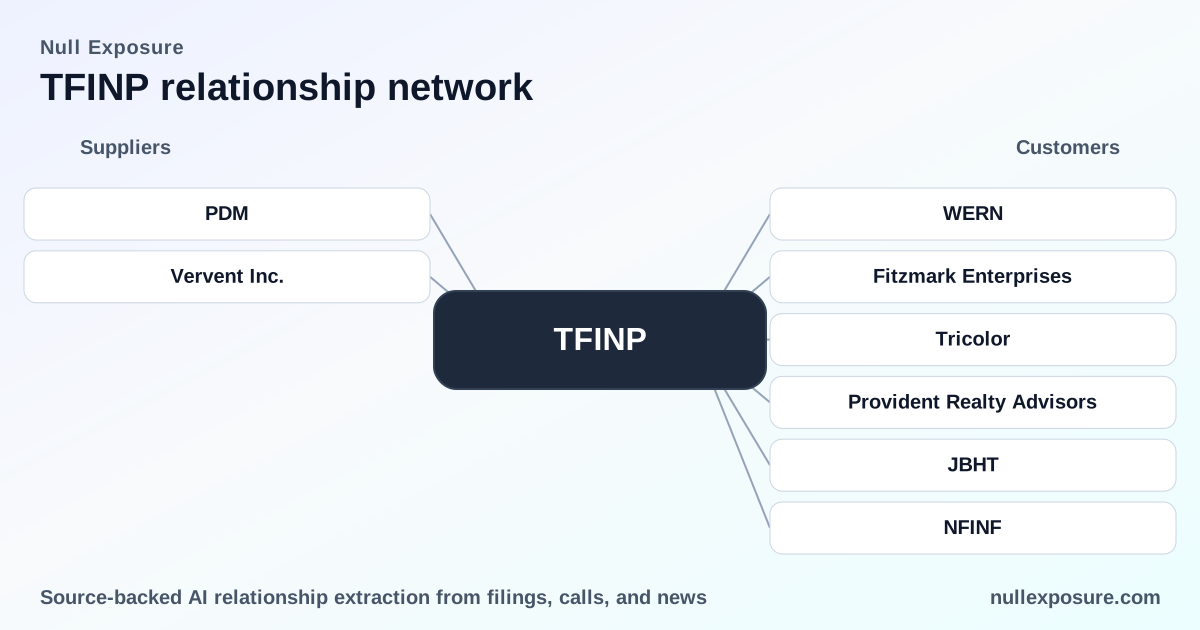
Triumph Financial (TFINP) — Customer Relationships That Drive the Payments Network
Triumph Financial Inc. operates at the intersection of banking, factoring and payments for freight and logistics companies, monetizing through interest and fee income on factoring receivables, payment processing fees and enterprise services tied to its TriumphPay network and audit solutions. The company grows revenue by onboarding large shippers and 3PLs onto its payments and audit platform, converting transaction volume into recurring fees and financing revenue while capturing spread on receivables.
For deeper relationship and customer-intelligence coverage, visit https://nullexposure.com/ to see how these commercial ties map to credit and operational risk.
How Triumph’s customer strategy converts into a financial moat
Triumph’s go-to-market is relationship-driven: it signs large freight customers and logistics providers to the TriumphPay network, then layers payment, audit and financing services. That structure produces two revenue levers — transactional fees and financing margin — and a reinforcing network effect: the more shippers and carriers on the platform, the more attractive the service becomes to new participants.
- Contracting posture: Triumph negotiates enterprise-level contracts with large shippers and 3PLs and enforces a multi-stage onboarding process for full network access, which creates switching costs for participants.
- Concentration: Triumph’s growth trajectory depends on a relatively small number of large customers (shippers and logistics platforms) for outsized transaction volume, so customer concentration is material to revenue elasticity.
- Criticality: Payment and audit services are operationally critical to logistics counterparties; these services are integrated into settlement and compliance workflows, making Triumph a consequential vendor to clients once onboarded.
- Maturity: The product is in a scale-up phase — network functionality exists and is being expanded, but profitability and margin mix are still sensitive to pricing and adoption trends.
These are company-level signals derived from public customer announcements and Triumph’s go-to-market descriptions; no contract-level constraints were provided in the sources reviewed. For a consolidated view of customer ties and their implications for earnings, see https://nullexposure.com/.
Relationship roll call — what every named customer contributes to the thesis
Werner Enterprises (WERN)
Werner Enterprises was added as a client on the full TriumphPay network and is described as a fully or partially “conforming” user, which gives Werner access to auditing and payment functions after Triumph’s lengthy onboarding process. This is a material validation of TriumphPay’s pull among large carriers. Source: FreightWaves coverage (March 10, 2026).
Fitzmark Enterprises
Fitzmark Enterprises, a third‑party logistics firm, joined the TriumphPay network as a user with access to the platform’s audit and payment capabilities, reflecting Triumph’s outreach into 3PL partners that help broaden network liquidity. Source: FreightWaves (March 10, 2026).
J.B. Hunt / JBHT
J.B. Hunt, one of North America’s largest supply‑chain providers, formally joined the Triumph Network and adopted Triumph’s automated payment solution to accelerate carrier payment cycles and improve efficiency; the company was cited across Triumph’s earnings call and multiple press reports as a near‑term catalyst for network growth. Triumph’s own earnings script confirmed the onboarding. Sources: Triumph Financial Q4 earnings call (2025 Q4) and press coverage including Investing.com and SimplyWallSt (May 2026 / March 2026).
BlueGrace
BlueGrace was cited by Triumph management as a recent addition to its roster of logistics partners, reinforcing the company’s push to aggregate mid‑market freight volume onto TriumphPay and supplement relationships with major shippers. Source: Investing.com earnings coverage (May 4, 2026).
NFI (NFINF)
NFI expanded its relationship to incorporate Triumph’s Payment and Audit solutions, reflecting a shift from point solutions to broader integration of Triumph’s platform across a major North American 3PL. This is a strategic expansion that strengthens Triumph’s position with top-tier logistics providers. Source: Triumph press release on investor relations (FY2025).
Tricolor (credit exposure context)
Triumph acted as agent on a facility to Tricolor and held a meaningful portion of the exposure; reporting indicates the bank was agent on roughly a $60.5 million facility and held about $23 million of exposure, highlighting Triumph’s role as lender/agent in freight-related credit facilities and the potential for credit‑line concentration risk. Source: BadCredit.org coverage referencing the Tricolor event (FY2025).
Provident Realty Advisors (real estate disposition)
Provident Realty Advisors acquired One Lincoln Park from Triumph Financial, with Dallas County deed records identifying Triumph as the seller — a note on Triumph’s non‑core real estate activity and balance sheet recycling rather than a core customer relationship. Source: The Dallas Morning News (December 30, 2025).
What these customer ties mean for risk and upside
Triumph’s recent wins — notably J.B. Hunt, Werner and NFI’s expanded integration — validate the product and accelerate volume, which supports fee growth and recurring financing opportunities. At the same time, Triumph’s dependence on signing large shippers introduces concentration and execution risk: a handful of large participants can move margins and volume materially. The Tricolor exposure episode underscores Triumph’s dual role as payments provider and credit intermediary, which increases counterparty credit risk on the balance sheet.
Financial implications investors should track
- Onboarding cadence for top-tier shippers (e.g., J.B. Hunt) directly influences near‑term revenue growth and margin mix because each large shipper increases transaction density and financing scale.
- Pricing power in payments and audit services will determine whether revenue scales faster than operating costs as the network grows.
- Credit exposure and facility agent roles require active capital management; watch impairments and reserve build for signs of credit stress.
- Customer concentration metrics should be disclosed in future filings; a small number of large relationships will drive earnings volatility.
Bottom line and investor actions
Triumph has converted credible logistics names into customers, which advances its network effect and revenue runway. The key thesis is executional: Triumph must continue to onboard and fully convert large shippers and 3PLs while managing credit exposure tied to lending and factoring. For investors focused on the intersection of fintech and freight, Triumph presents a high‑upside proposition with attendant concentration and credit risks.
If you want a systematic review of customer relationships and their balance‑sheet implications for fintech‑enabled banks, visit https://nullexposure.com/ for additional coverage and modeled relationship maps.