TFS Financial (TFSL): Mortgage origination plus agency distribution — a stable spread business with agency offload risk
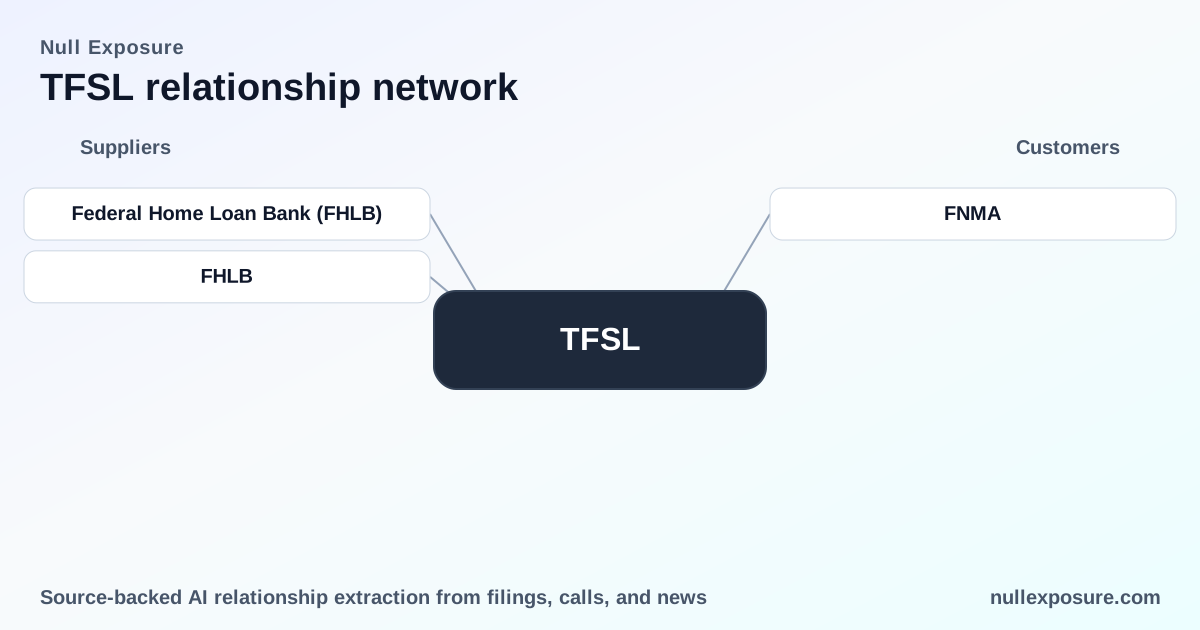
TFS Financial Corporation operates a classic retail thrift model: originate and service residential mortgages funded by a deep retail deposit base and short-to-intermediate borrowings, and monetize through net interest margin plus mortgage sales to agencies. The company supplements interest income with routine mortgage-sale proceeds (agency deliveries) that convert loans into liquidity and manage duration exposure; revenues are primarily interest-driven, with reported trailing revenue of roughly $335 million. For investors evaluating customer relationships, the active and recurring flow of agency deliveries — notably to Fannie Mae — is the critical counterparty linkage shaping liquidity and credit execution.
Explore more analysis and relationship mapping at https://nullexposure.com/.
Why the Fannie Mae relationship matters for TFSL’s business
TFS uses agency channels to offload agency-compliant, fixed-rate mortgages and thereby recycle capital into new originations. Agency deliveries reduce funding and duration risk and are a routine monetization path for TFSL’s long-term, fixed-rate production. Recent quarterly disclosures show material single-quarter deliveries that impact liquidity and margin timing.
Fannie Mae — Bastille Post (press recap of Q1 FY2026)
TFS delivered $120.8 million of residential mortgage loans to Fannie Mae on contracts settled during the quarter ended December 31, 2025, reflecting active agency sales as part of its origination and distribution workflow. Source: Bastille Post republishing TFS’s FY2026 Q1 results (published March 10, 2026) — https://www.bastillepost.com/global/article/5570793-tfs-financial-corporation-announces-first-quarter-fiscal-year-2026-results
Fannie Mae — Bastille Post (duplicate release)
The same Bastille Post item reiterates the $120.8 million delivery to Fannie Mae for the December 31, 2025 settlement date, underscoring the company’s recurring usage of Fannie Mae as a buyer for agency-compliant originations. Source: Bastille Post (March 10, 2026) — https://www.bastillepost.com/global/article/5570793-tfs-financial-corporation-announces-first-quarter-fiscal-year-2026-results
Fannie Mae — Morningstar / Business Wire (official press release)
According to the company’s business-wire release distributed via Morningstar, TFS disclosed $120.8 million of residential mortgage loans delivered to Fannie Mae on contracts settled during the quarter ended December 31, 2025, confirming the quarter’s agency-sale activity. Source: Business Wire distributed on Morningstar (Jan 29, 2026) — https://www.morningstar.com/news/business-wire/20260129022639/tfs-financial-corporation-announces-first-quarter-fiscal-year-2026-results
Fannie Mae — Morningstar / Business Wire (repeat distribution)
The Morningstar-distributed press release appears in multiple feeds and repeats the $120.8 million delivery figure, reinforcing that agency sales to Fannie Mae were a material part of the quarter’s mortgage disposition strategy. Source: Business Wire via Morningstar (Jan 29, 2026) — https://www.morningstar.com/news/business-wire/20260129022639/tfs-financial-corporation-announces-first-quarter-fiscal-year-2026-results
Operating constraints and what they say about TFSL’s relationship profile
Investors should read the relationship disclosures through the lens of TFSL’s operating constraints — these are company-level signals that explain how the bank runs its mortgage franchise and counterparty exposure.
-
Contracting posture — long-term, fixed-rate production. The firm’s core product set includes long-term fixed-rate mortgages (15–30 years) and adjustable Smart Rate products; disclosures show substantial long-term, agency-compliant fixed-rate mortgage sales (for example, $411.3 million sold or committed during the fiscal year ended September 30, 2025), which ties production to secondary-market execution. This structure makes agency counterparties functionally important for liquidity conversion and interest rate risk management. Source: Company fiscal disclosures (FY2025).
-
Counterparty mix — retail consumers dominate. TFSL’s franchise is overwhelmingly consumer-facing: about 95.9% of the $9.55 billion retail deposit base is structured under FDIC insurance limits, and origination activity targets individuals (owner-occupied mortgages and construction loans to individuals), creating a low concentration of large corporate depositors but high exposure to local housing markets. Source: Company filings (as of Sept 30, 2025).
-
Geographic concentration — regional footprint matters. The company operates from Cleveland, Ohio, with 36 full-service branches and two loan-production offices across Ohio and Florida; revenues are materially driven by economic conditions in those primary markets, concentrating credit and deposit risk regionally. Source: Company filings.
-
Materiality and revenue model. Interest on loans is the principal revenue source, with mortgage sales and investment income as complements; this makes agency sales a material operational lever for cash conversion and reported earnings. Agency counterparties therefore influence both liquidity timing and net interest margin realization. Source: Company disclosures on revenue composition.
-
Role posture — seller and servicer. TFSL originates and services residential loans, positioning it simultaneously as a seller (originator) to agencies like Fannie Mae and a service provider to retail customers, which preserves servicing income streams while transferring interest-rate and credit risk on loans sold. Source: Company business description.
-
Maturity and stage — active, ongoing origination. Filings describe an active origination and servicing platform, supported by branches, loan production offices, a call center and an internet presence; the relationship with agencies is operationally recurring, not episodic. Source: Company filings.
Explore relationship intelligence and capital-market implications at https://nullexposure.com/.
Investment implications — what to watch and key risks
-
Liquidity and execution: Regular deliveries to Fannie Mae are evidence of an effective distribution channel that converts long-duration loans into sellable, agency-backed assets; this reduces funding stress and supports origination capacity. Monitor the cadence and pricing of agency deliveries as a near-term cash-flow indicator.
-
Margin vs. valuation: The company’s business relies on net interest margin and mortgage-sale timing, while market multiples are rich (trailing P/E ~45; Price/Book ~2.19). That combination argues for careful attention to interest-rate cycles and agency execution, because valuation leaves limited error margin for execution shocks. Source: Market metrics (trailing PE 45.21; PriceToBook 2.193).
-
Concentration and credit sensitivity: Regional exposure to Ohio and Florida housing markets, paired with a retail deposit structure concentrated under FDIC limits, creates a stable funding base but concentrates credit risk geographically. Monitor local unemployment, home-price trends, and origination credit standards.
-
Operational resilience: Servicing retained on sold loans can provide fee income, but servicing obligations also require operational capacity. Continued reliance on agency buyers means counterparty access—policy, pricing, and agency requirements—remains a strategic dependency.
Bottom line
TFS Financial runs a retail mortgage origination business monetized through margin and recurring agency sales, with Fannie Mae as a visible counterparty in recent quarters (notably $120.8 million delivered for the quarter ended Dec 31, 2025). Investors should track the pace of agency deliveries, regional credit dynamics in Ohio and Florida, funding-cost trends, and agency pricing — these items drive both near-term liquidity and medium-term earnings power. For systematic relationship monitoring and capital-market context, visit https://nullexposure.com/.