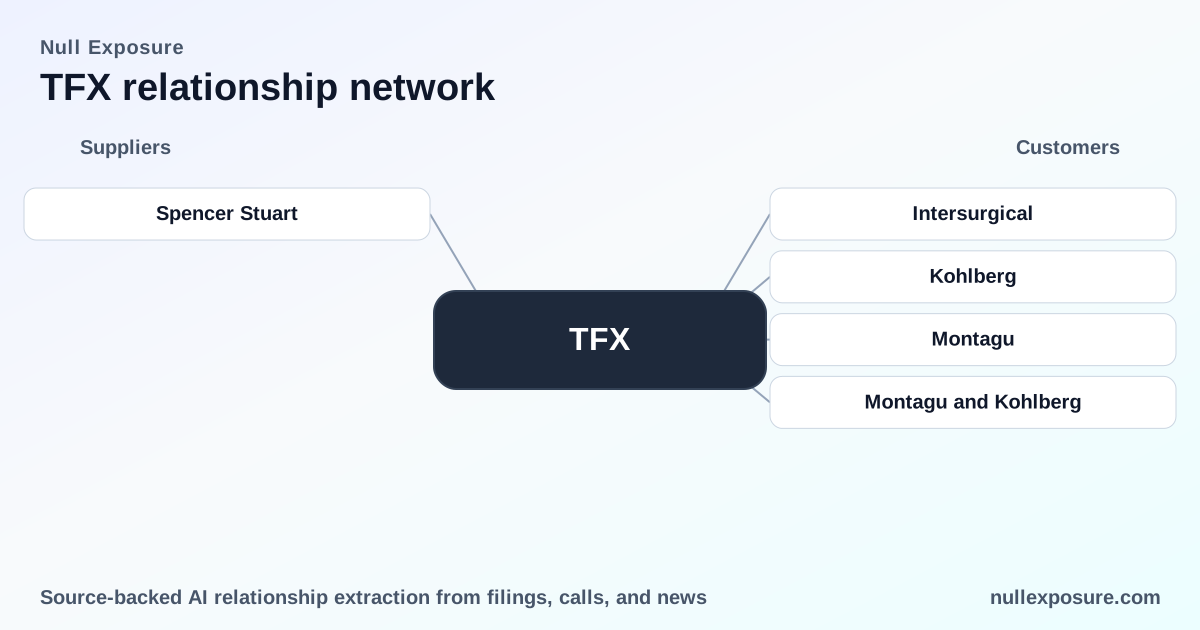
Teleflex (TFX) customer relationships: divestments, buyers, and what investors should price in
Teleflex is a specialty medical-device manufacturer that monetizes through the design, manufacture and sale of critical-care and surgical consumables and capital devices to hospitals, health systems and home-health providers. Revenue comes from a mix of direct sales and distributor channels, with a meaningful OEM business historically sold to other device makers; recent divestitures shift Teleflex toward a leaner, higher-margin commercial profile and generate near-term proceeds that materially reallocate capital. For investors evaluating counterparty risk and strategic trajectory, the buyer list for Teleflex’s announced asset sales provides a clear window into which channels and partners will replace legacy cash flows. Learn more at https://nullexposure.com/.
Market moves in March 2026 reprice Teleflex’s exposure to OEM manufacturing and acute-care respiratory/urology consumables. Below I walk through the announced counterparties, summarize each relationship in plain English, and explain the company-level operating signals investors should factor into valuation and downside scenarios.
The commercial change: what Teleflex sold and why it matters
Teleflex announced a set of asset sales that collectively total roughly $2.03 billion in headline proceeds — a sale of its Acute Care and Interventional Urology units and a separate sale of its OEM business. These transactions materially reduce Teleflex’s manufacturing-for-other-companies footprint while returning capital and simplifying the sales mix toward direct and distributor channels. That pivot compresses operational complexity and increases reliance on commercial partners to maintain reach in lower-acuity product lines. (Source: The Healthcare Technology Report, March 10, 2026.)
Who the buyers are — plain-English summaries and sources
Below are every counterparty referenced in available reporting. Each entry includes a concise summary and a source citation.
Intersurgical
Intersurgical agreed to acquire Teleflex’s Acute Care and Interventional Urology businesses for approximately $530 million, taking on the product lines and customer relationships in lower-acuity respiratory and urology consumables. Source: The Healthcare Technology Report, March 10, 2026 (https://thehealthcaretechnologyreport.com/teleflex-announces-divestment-of-acute-care-urology-and-oem-units-in-2b-deal/).
Montagu
Montagu, a private-equity buyer, purchased Teleflex’s OEM business as part of the portfolio sale that collectively totaled about $1.5 billion for the OEM assets; the deal transfers Teleflex’s contract-manufacturing and OEM supply agreements to new ownership. Source: The Healthcare Technology Report, March 10, 2026 (https://thehealthcaretechnologyreport.com/teleflex-announces-divestment-of-acute-care-urology-and-oem-units-in-2b-deal/).
Kohlberg
Kohlberg (Kohlberg & Company) joined Montagu as a purchaser of the OEM business, forming the private-equity consortium acquiring Teleflex’s OEM manufacturing portfolio and associated contracts. Source: The Healthcare Technology Report, March 10, 2026 (https://thehealthcaretechnologyreport.com/teleflex-announces-divestment-of-acute-care-urology-and-oem-units-in-2b-deal/).
Montagu and Kohlberg (combined transaction reference)
Reporting also aggregates the OEM sale to Montagu and Kohlberg together, noting that the buyers purchased the OEM business jointly for about $1.5 billion, which will remove a previously vertically integrated manufacturing line from Teleflex’s reporting. Source: Respiratory-Therapy.com and The Healthcare Technology Report, March 10, 2026 (https://respiratory-therapy.com/products-treatment/industry-regulatory-news/business-news/intersurgical-acquires-teleflex-acute-care-interventional-urology/; https://thehealthcaretechnologyreport.com/teleflex-announces-divestment-of-acute-care-urology-and-oem-units-in-2b-deal/).
Medline (MDLN)
Medline announced both its intention and subsequent completion of an acquisition of a significant portion of Teleflex’s Hudson RCI respiratory products line (reported in FY2021), transferring a set of respiratory consumables and the associated customer relationships into Medline’s distribution network. Source: Medline newsroom announcements (acquisition intent and completion, FY2021) (https://newsroom.medline.com/company-news/medline-acquiring-hudson-rci-respiratory-products/; https://newsroom.medline.com/company-news/medline-completes-acquisition-of-hudson-rci-respiratory-products/).
Why these counterparties matter to Teleflex’s investors
- Channel rebalancing: The OEM sale to private equity removes a manufacturing-for-others line and converts that revenue into cash; this lowers manufacturing concentration but increases commercial dependence on direct sales and distributors to drive growth.
- Selective de-risking: Selling the Acute Care and Interventional Urology units to Intersurgical and respiratory lines to Medline rationalizes non-core portfolios while unlocking capital for either buybacks, debt paydown, or targeted M&A.
- Private-capital ownership of OEM assets: With Montagu and Kohlberg owning the OEM operations, Teleflex reduces capital intensity but creates potential future supplier or competitive dynamics depending on transition-service agreements and retained supply terms.
Constraints and operating-model signals investors should price in
Treat the following as company-level operating signals derived from Teleflex’s disclosures and the transaction context:
- Government counterparty exposure is material outside the U.S. Teleflex notes that many non-U.S. customer relationships are with government-sponsored healthcare systems and are therefore subject to public procurement and anti-bribery laws; investors should model procurement risk and longer sales cycles for government buyers.
- Global go-to-market with APAC participation: Teleflex is a global seller; China accounted for roughly 4% of consolidated revenue in the most recent disclosure, indicating APAC is relevant but not yet dominant.
- Manufacturer and OEM heritage: Teleflex historically operated an OEM manufacturing business that designs and supplies devices to other medical-device makers; the divestment converts that role from owner to a potential outsourced-supplier dynamic.
- Active distributor strategy and channel conversion: The company actively uses both distributors and a direct sales force, and it pursues distributor-to-direct conversions as a deliberate margin and access strategy; this signals a contracting posture that can tighten pricing power but raises short-term channel risk during conversion.
- Relationship maturity and criticality: Most customer relationships are active and rooted in hospitals and home-health channels; however, the sale of manufacturing assets alters Teleflex’s criticality to OEM customers while increasing dependence on commercial partners for reach.
Investment implications and risk checklist
- Balance-sheet flexibility: The ~ $2.03 billion in proceeds provides Teleflex with cash to reduce leverage or return capital, which is positive for credit metrics and optionality.
- Margin profile shift: Expect operational margins to improve over time as lower-margin OEM manufacturing is removed and Teleflex consolidates around higher-margin, branded consumables and devices.
- Counterparty concentration risk: Shifting sales responsibility to distributors and new owners of former Teleflex businesses increases counterparty execution risk during integration and transition phases.
- Regulatory and procurement sensitivity: Continued exposure to government buyers outside the U.S. requires disciplined compliance and may lengthen cash-conversion cycles.
Bottom line for investors
Teleflex is executing a clear strategic simplification: monetize manufacturing assets, reduce operational complexity, and redeploy capital into a narrower, higher-margin commercial franchise. The buyers — Intersurgical, Montagu, Kohlberg and Medline — are all credible strategic or financial operators whose ownership of these assets changes Teleflex’s supplier and channel landscape. Investors should reweight assumptions for capital allocation, margin improvement, and counterparty execution risk over the next 12–24 months.
For a concise view of counterparties and transaction coverage, see the Teleflex customer page on NullExposure: https://nullexposure.com/.