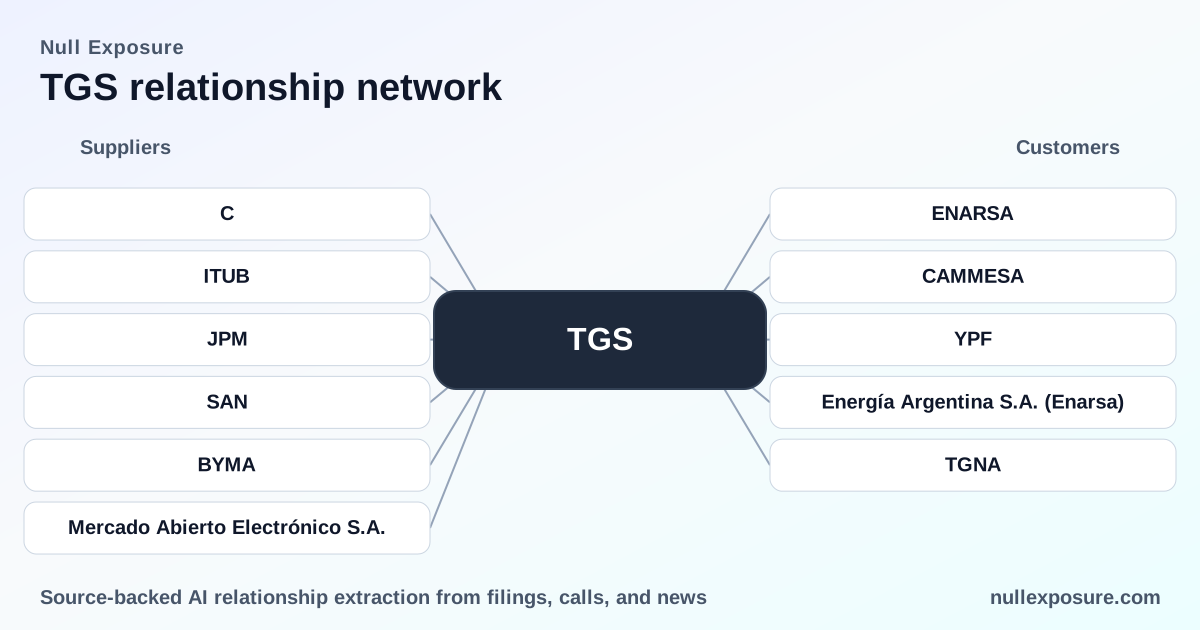
TGS customer map: who pays for Argentina’s gas pipes and what that implies for investors
Transportadora de Gas del Sur (TGS) operates and monetizes long-lived natural gas pipeline and midstream assets in Argentina by charging transport capacity fees to producers, power generators and the state, while pursuing selective capex-led expansions and EPC-style contracts for pipeline growth. Revenue is a mix of regulated transmission contracts, commercial firm-capacity sales and state-tendered expansion work, giving TGS both predictable cashflows from capacity contracts and episodic upside from construction and expansion projects.
If you evaluate counterparty risk or the competitive dynamics of Argentina’s midstream sector, this customer map identifies the immediate counterparties, the degree of state participation, and the commercial levers that will drive cash flow variability over the next 12–36 months. For a concise view of how we source and present relationship intelligence, visit https://nullexposure.com/.
How to read the customer relationships: what matters for value
TGS sells pipeline capacity and ancillary services to three types of customers: (1) national/state entities that run Argentina’s energy dispatch and infrastructure programs, (2) incumbent hydrocarbon producers that need transport out of Vaca Muerta, and (3) power generators evaluating capacity purchases. This mix creates both revenue stability and political/regulatory concentration risk because a material portion of demand and tender flow is determined by government agencies and state-owned enterprises.
Key investment implications:
- High customer criticality: TGS infrastructure is essential for moving incremental gas supply from Vaca Muerta to market.
- Contracting posture is public and competitive: TGS participates in state tenders and can be the sole bidder on projects, creating episodic award upside.
- Concentration and political risk: State counterparties and policy decisions have outsized influence on near-term capex and capacity allocation.
Explore relationship-level detail below and reach the full offering at https://nullexposure.com/ if you want deeper document-level sourcing.
Customer-by-customer read: what each relationship means for revenue and risk
ENARSA / Energía Argentina
TGS won a national/international tender called by Energía Argentina (ENARSA) to execute the expansion of the Perito Moreno gas pipeline, and press reports document TGS as the adjudicated contractor—an estimated $500 million scope that directly links TGS to state-driven capex and construction revenue. According to reporting in March–May 2026, ENARSA issued the tender and TGS was the sole offeror and eventual awardee of the GPM expansion (news reports, March–May 2026).
Source: local energy reporting on ENARSA’s tender processes and TGS’ participation (mase.lmneuquen.com and Infobae, March–May 2026).
CAMMESA
CAMMESA currently holds an allocation of 21 million cubic feet per day that ENARSA is reallocating and will release to competitive bidding, which affects the immediate availability of firm capacity and secondary-market bids for pipeline capacity. TGS referenced this reallocation on its 2025 Q4 earnings call as the triggering event for bids on remaining capacity.
Source: TGS 2025 Q4 earnings call transcript and subsequent press excerpts (TGS earnings call, March 2026; InsiderMonkey synopsis, March 2026).
YPF
TGS contracts capacity and operational services with YPF and other major producers; management confirmed active collaboration with YPF during the 2025 Q4 earnings call, reflecting the producer base that underpins firm transport demand from Vaca Muerta. This relationship anchors a portion of TGS’ regulated and contracted throughput volumes.
Source: TGS 2025 Q4 earnings call (Mar 2026) and public call summaries (InsiderMonkey, Mar 2026).
Central Puerto (CEPU)
Central Puerto is actively evaluating whether to acquire transportation capacity from TGS, which positions generators as potential incremental buyers of firm capacity and creates a secondary commercial channel beyond producers and the state. Central Puerto’s own earnings call referenced an analysis of acquiring TGS capacity, signalling demand from thermal generators for predictable gas supplies.
Source: Central Puerto Q4 2025 earnings call synopsis that mentions analysis of TGS capacity purchases (InsiderMonkey, Mar 2026).
TGN / TGNA
TGS’ network and new projects interconnect with other pipeline operators such as Transportadora de Gas del Norte (TGN / TGNA), and policymaker plans describe coordination between pipeline systems to route incremental gas into the Greater Buenos Aires and Litoral regions; this inter-operator flow is relevant for capacity allocation and system integration dynamics. Government notices about pipeline works and routing referenced the role of TGN in transferring volumes toward the Litoral and highlighted the system-level nature of expansions.
Source: reporting on government plans and inter-pipeline routing published in late 2024 and cited in coverage of transportation expansion (EconoJournal, FY2024/FY2025).
What the relationship map implies for operating model and business constraints
With no formal constraint excerpts in the relationship feed, the following are company-level signals derived from the relationship set and public reporting:
- Contracting posture: TGS competes in public tenders and submits EPC-style offers for expansions; the firm was the only bidder on at least one high-profile ENARSA tender, which demonstrates both an aggressive pursuit of state work and episodic tender concentration (news coverage, FY2025–FY2026).
- Customer concentration: A substantive share of near-term growth depends on state entities and large national producers, creating customer concentration risk that is correlated with political cycles and budget priorities.
- Criticality and pricing power: TGS controls essential transport corridors from Vaca Muerta; this gives it structural pricing leverage for firm capacity in contracts with producers and generators.
- Maturity and capex profile: Assets are long-lived and capex is episodic—expansion projects like Perito Moreno drive lumpier revenue and margin benefits versus steady regulated tolls.
- Operational reputation risk: Local reporting raised O&M concerns tied to state operational contracts, which introduces reputational and contractual performance risk that can influence future tender outcomes (Lapoliticaonline reporting, Mar 2026).
Risks and upside for investors
- Upside: Successful execution of the Perito Moreno expansion and continued firm-capacity sales to producers and generators will materially boost EBITDA and elongate contract tenors; management’s pursuit of NGLs projects and pipeline growth is a growth vector.
- Risks: Political/regulatory volatility, dependence on state tenders and reallocations (e.g., CAMMESA → ENARSA), and localized operational criticisms create near-term execution and reputational risk that directly affects contract awards and payments.
Key takeaway: TGS combines stable regulated transport cashflows with episodic, high-impact state-driven projects; investors should balance the company’s asset criticality and predictable fee base against concentrated counterparty risk and tender-driven revenue volatility.
If you want an expanded dossier with document-level sourcing and time-stamped relationship tracking, see our full platform at https://nullexposure.com/.