Target Hospitality (TH): Customer Relationships That Drive and Define the Business
Target Hospitality operates as a vertically integrated provider of specialty rental and hospitality services to industrial and government clients across North America. The company monetizes through two principal streams: multi‑year service contracts that include minimum revenue guarantees and exclusive lodge leases, and leasing of lodging facilities (Lodges) to single customers. This combination produces predictable contract cashflows when occupancy is irrelevant, while concentrating revenue risk where a small number of large counterparties dominate. For a focused, relationship‑level read on counterparties and how they connect to the company’s revenue profile, see NullExposure’s overview at https://nullexposure.com/.
Why customers are the investment lever for Target Hospitality
Target’s economics are governed by three structural dynamics: contracting posture, customer concentration, and operational criticality. Long‑term, minimum‑revenue contracts convert asset investment into recurring cash; however, when a single government client accounted for roughly half of 2024 revenue, concentration becomes the overriding investment risk. Operationally, Target is a service provider and licensor — it owns lodging assets and supplies hospitality services that large industrial projects and government programs rely on, creating a high degree of counterparty criticality where a lost contract can remove hundreds of millions in revenue overnight.
- Balance sheet and scale: Market capitalization stands around $1.51 billion with trailing EBITDA of roughly $42.6 million, underscoring a business with meaningful fixed‑asset intensity and operating leverage.
- Revenue mix: Management reported that specialty rental with vertically integrated hospitality comprised the majority of revenues, with leasing of Lodges representing the remainder.
If you want a deeper, structured feed on customer linkages, visit NullExposure’s home page: https://nullexposure.com/.
What the public record shows about named customer relationships
Below are every customer mention surfaced in the results set, each summarized in plain English with the original reporting context.
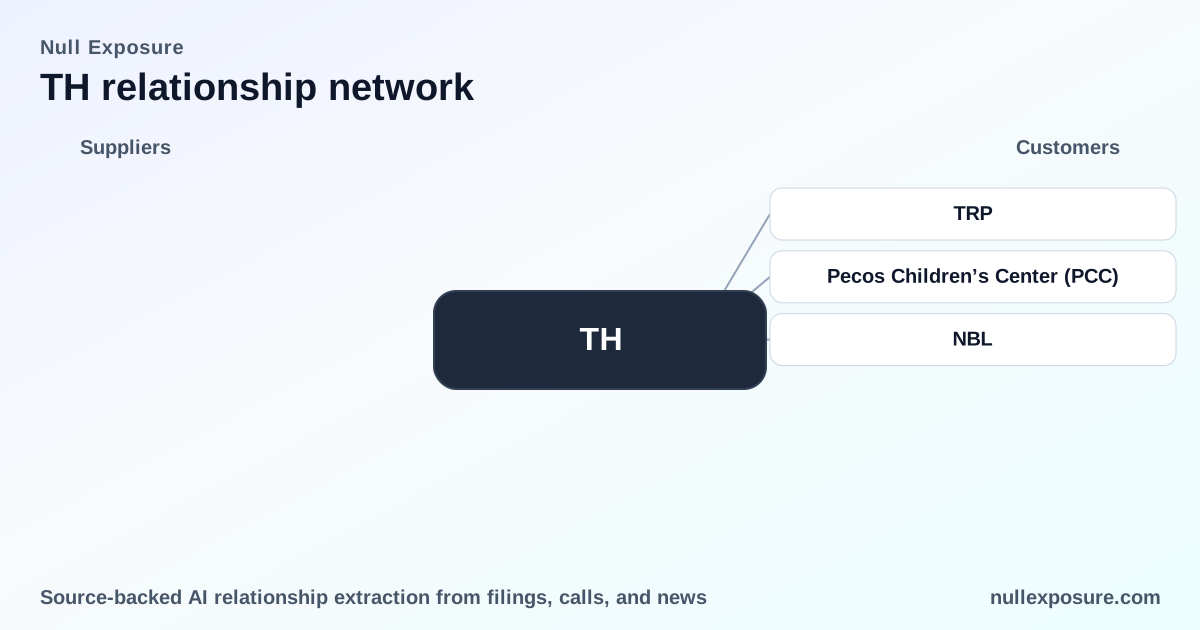
TC Energy (TRP) — construction project revenue (FY2020)
A Q2 FY2020 earnings call transcript noted that Target recognized approximately $16 million of construction fee revenue from a TC Energy pipeline project in the quarter, up from $3 million the prior year period. The detail is recorded on a public earnings‑call transcript published by The Motley Fool in 2020. (Source: Q2 2020 earnings call transcript, The Motley Fool.)
TRP — duplicate match to TC Energy mention (FY2020)
The same FY2020 earnings call transcript was matched again under the TRP ticker symbol, confirming the earlier disclosure that pipeline construction fees from TRP materially increased in that period. This is a duplicated indexing of the same Motley Fool transcript. (Source: Q2 2020 earnings call transcript, The Motley Fool.)
Pecos Children’s Center (PCC) — variable services and amortization (FY2025)
A market preview ahead of Q1 results highlighted that Target’s results reflected lower PCC variable services revenues and an absence of PCC infrastructure revenue amortization in FY2025, indicating changes to the revenue contribution profile from the Pecos Children’s Center arrangement. The observation was reported in a Barchart story summarizing expectations for Target’s Q1 earnings. (Source: Barchart, pre‑Q1 earnings preview, FY2025.)
NBL — customer mention in FY2020 call (FY2020)
In the FY2020 earnings call, management referenced Nobel (NBL) in the context of industry consolidation — noting that Chevron’s acquisition of Nobel resulted in a customer that Target had historically served. The remark was brief and situational in an investor call transcript. (Source: Q2 2020 earnings call transcript, The Motley Fool.)
Nobel — same customer reference as NBL (FY2020)
The transcript entry for “Nobel” reiterates that Nobel was a named customer and that industry M&A (Chevron’s purchase of Nobel) intersected with Target’s client base. This duplicate entry is the same earnings‑call reference captured under a slightly different name. (Source: Q2 2020 earnings call transcript, The Motley Fool.)
Company‑level operating constraints and what they imply for revenue durability
Target’s public disclosures deliver a consistent set of company signals that shape both upside and downside scenarios:
-
Long‑term contracting posture: The company reports that the vast majority of revenue is generated under multi‑year contracts with minimum revenue amounts and exclusivity; management stated that in 2024 roughly 64% of revenue derived from minimum revenue commitments and ~99% of revenue was under contract, including exclusivity. That structure converts capital investment into secured revenue streams and reduces occupancy volatility for a large share of top line.
-
Government as a material counterparty class: Target uses GSA vehicles and subcontracts with U.S. government contractors; its Government segment is material — for 2024 one government customer represented approximately 48% of consolidated revenue. This concentration is an explicit structural risk and a source of high cashflow correlation to federal contract decisions.
-
North America operational footprint: Operations are geographically concentrated in the U.S. and Canada, primarily the Southwest and Midwest U.S., which focuses demand exposure but limits geographic diversification.
-
Asset owner / licensor role: Target leases Lodges under operating leases exclusively to single customers; rental income was notable in recent years (rentals accounted for material dollars). This places Target in the dual role of asset owner/licensor and full‑service hospitality operator.
-
Service provider economics: The company delivers an integrated suite of hospitality services — catering, maintenance, housekeeping, security, health and recreation, and workforce community management — which increases switching costs for customers that need turnkey camps and support.
-
Maturity and termination signals: Management described long‑standing relationships across roughly 330 customers, indicating relationship maturity; however, the record also includes contract terminations (for example, the STFRC Contract termination effective August 9, 2024 and subsequent contract changes through early 2025), demonstrating that large government contracts can be discontinued quickly and materially affect results.
-
Large spend bands: Public excerpts show individual contract relationships or program contributions in the hundreds of millions (for example, a five‑year DIPC Contract announced in March 2025 expected to deliver over $246 million to March 2030, and a New PCC Contract that included a minimum annual revenue of approximately $168 million before its termination), which explains both the revenue concentration and the binary impacts of contract gains or losses.
Investment implications — what investors should watch next
-
Concentration is the dominant valuation lever. When one customer approaches half of revenue, earnings sensitivity to contract renewal or termination is severe. Contract renewal timelines and government procurement developments will be the primary catalysts for re‑rating.
-
Contract structure supports baseline earnings but not growth without new wins. Minimum revenue guarantees and long lease terms protect downside, but upside requires new multi‑year contracts or expansion of the existing footprint.
-
Operational execution is critical. As both owner and operator, Target’s ability to deliver turnkey services and avoid cost overruns under fixed minimum contracts is the practical margin driver.
-
Event watchlist: upcoming contract expirations/renewals, government procurement outcomes, and any new large industrial projects in the Southwest and Midwest.
For a systematic view of customer exposures and relationship signals across public filings and media, explore additional coverage at NullExposure: https://nullexposure.com/.
Bold takeaway: Target Hospitality converts asset ownership into recurring contract cashflows, but its concentrated government exposure and reliance on large multi‑year contracts create binary revenue outcomes that must be evaluated before taking a material position.