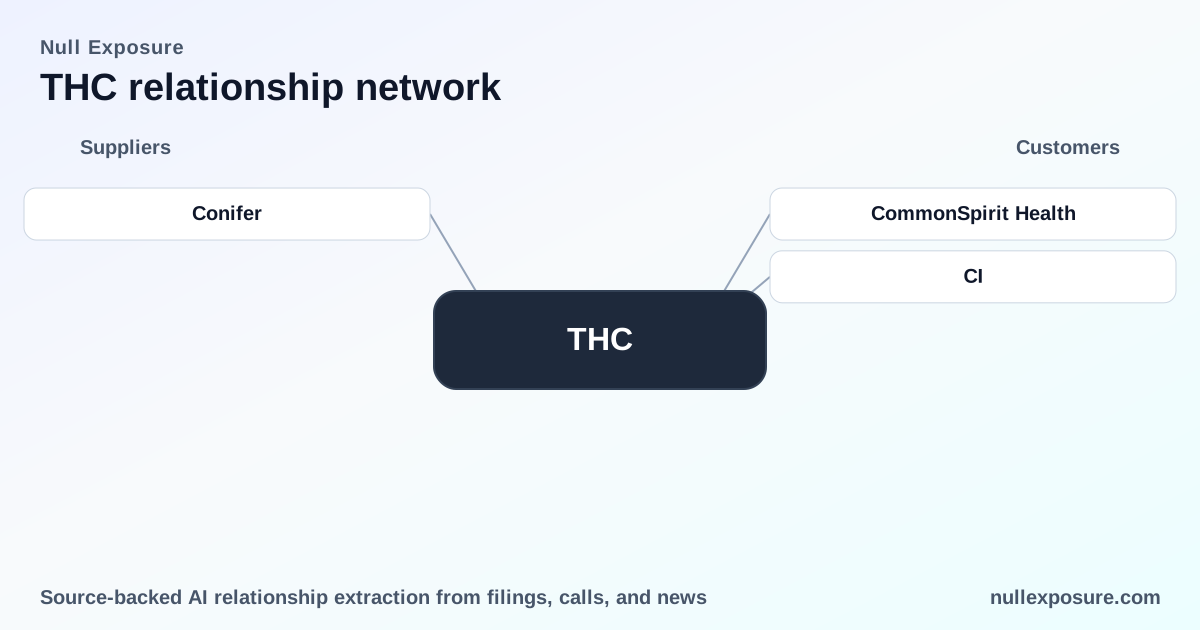
Tenet Healthcare (THC) — Customer relationships that drive revenue, cash flow and operational leverage
Thesis: Tenet Healthcare operates a diversified care-delivery and services platform that monetizes through two complementary channels — hospital and ambulatory patient-service revenues (managed care, Medicare/Medicaid and self-pay) and business‑process services (notably revenue cycle and Conifer-related arrangements). These customer relationships generate the bulk of operating revenue and create both steady recurring cash and episodic large cash events tied to contractual restructurings and asset dispositions. Investors should value Tenet as a services-integrated hospital operator where managed-care exposure, large counterparty contracts, and occasional asset sales materially shape near-term cash and long-term margin expansion. For a concise view of coverage and data, visit the Null Exposure homepage: https://nullexposure.com/
Counterparties and commercial developments worth tracking
Below I list every customer-related relationship surfaced in the available reporting, with a plain-English summary and source reference for each mention.
Medical Properties Trust — Palmetto General Hospital sale (FY2021)
Tenet sold Palmetto General Hospital in Hialeah for $315 million to Medical Properties Trust, reflecting a strategic disposition of real-estate assets affiliated with Tenet operations. This transaction was reported by The Real Deal in August 2021 and underscores Tenet’s use of asset sales to recycle capital. (The Real Deal, Aug 2021 — https://therealdeal.com/miami/2021/08/16/medical-properties-trust-buys-palmetto-general-hospital-as-part-of-900m-south-florida-expansion/)
Medical Properties Trust — Lauderdale Lakes properties sale (FY2021)
A related South Florida transaction involved properties sold to MPT that were managed by Tenet executives’ entities, reflecting a broader portfolio pruning in the region and consolidation of real‑estate ownership under REIT structures. This sale was also reported by The Real Deal in August 2021. (The Real Deal, Aug 2021 — https://therealdeal.com/miami/2021/08/13/medical-properties-trust-expands-south-florida-portfolio-with-276m-buy/)
CommonSpirit Health — Conifer transaction and multi-year payments (FY2026)
On January 27, 2026, Tenet and CommonSpirit executed an agreement involving Conifer Health Solutions that includes $1.9 billion in payments from CommonSpirit to Tenet over three years and a $540 million payment from Conifer to CommonSpirit, a large reallocation of revenue‑cycle economics between the parties. TradingView summarized the terms as disclosed in Tenet’s reporting on Q4/FY2025 results. (TradingView summary of Tenet Q4 & FY2025 results, Jan 2026 — https://www.tradingview.com/news/tradingview:3e12dbee59489:0-tenet-healthcare-corporation-reports-strong-q4-and-fy-2025-results/)
CommonSpirit Health — early severance payment tied to revenue-cycle contract (FY2026)
Tenet reported receiving more than $400 million related to the early severance of a revenue‑cycle contract with CommonSpirit, an event that produced a significant one‑time cash inflow that materially affected quarterly earnings. FierceHealthcare quantified the cash impact in its coverage of Tenet’s FY2026 results. (FierceHealthcare, May 2026 — https://www.fiercehealthcare.com/providers/tenet-healthcare-paces-ahead-earnings-despite-q1s-volume-curveballs)
Cigna (CI) — in‑network agreement with Palm Beach Health Network (FY2026)
Cigna and Tenet’s Palm Beach Health Network reached an agreement preserving in‑network status for Cigna customers, avoiding out‑of‑network cost disruptions for patients and stabilizing payer-provider flows in that market. Local reporting (WPBF) covered the resolution and its immediate patient-cost implications. (WPBF, Mar 2026 — https://www.wpbf.com/article/florida-cigna-tenet-reach-deal-avoiding-out-of-network-costs-for-patients/69894874)
What these relationships reveal about Tenet’s operating model
-
Mixed contracting posture: Tenet runs a dual-contract profile. At the patient level, most service obligations are short‑duration (patient episodes under one year), which simplifies revenue recognition for core clinical services; simultaneously, Tenet maintains multi‑year service contracts—for example, revenue-cycle arrangements through Conifer—that create longer-dated cash flows and complexity in carve-outs and restructurings. (Company filings, FY2024–FY2026 disclosures.)
-
Concentration toward managed care: Managed-care payers constitute the dominant revenue engine—roughly 70% of net patient service revenues—so payer contract economics and network access negotiations (e.g., with Cigna) directly influence utilization, pricing and collections. This is a structural revenue concentration, not a transient mix shift. (Tenet FY2024 revenue mix disclosures.)
-
Customer criticality and materiality: The Hospital Operations segment generates the majority of operating revenue (nearly 80% in recent years), meaning relationships with large payers and institutional customers are operationally critical. Large counterparty actions—terminating or restructuring a revenue‑cycle contract—produce material one‑time cash movements (the CommonSpirit payments demonstrate this). (Tenet FY2024–FY2025 segment reporting.)
-
Service-provider posture and scale: Tenet acts as a service provider both to patients and to institutional clients (providing business-process services to ~620 hospitals and other clients), giving the company recurring revenue streams with built-in operating leverage but also exposure to contract renewals and integration risk. (Tenet company descriptions and segment disclosures.)
-
Geographic footprint and market reach: Tenet operates primarily in North America with a network of hospitals across multiple states; this regional diversification cushions local market shocks but preserves exposure to state Medicaid programs and state-level reimbursement dynamics. (Tenet operating statistics, FY2024.)
-
Maturity and balance between recurring and episodic value: The company exhibits a mature services business that produces recurring margins while continuing to deploy asset sales (e.g., REIT transfers to MPT) and restructuring payments as tools to optimize the balance sheet and capital allocation.
Investment implications — opportunities and risk vectors
-
Upside from contracted cash: The Conifer/CommonSpirit arrangement and the early‑severance cash illustrate Tenet’s capacity to generate large bilateral cash settlements that are accretive to near‑term free cash flow and deleveraging. Large strategic contracts are a source of episodic balance‑sheet improvement.
-
Revenue sensitivity to payer relationships: Network agreements and managed-care contracting (like the Cigna rescission/renewal in Palm Beach) materially affect revenue capture and patient flows; sustained disputes with major payers would quickly pressure utilization and collections.
-
Capital recycling through asset sales: The MPT sales in South Florida show Tenet’s willingness to monetize real‑estate interests to redeploy capital or reduce exposure; these transactions are de‑risking levers for the balance sheet rather than core operating growth. Asset monetization is a deliberate part of Tenet’s capital strategy.
-
Operational execution risk: Service-contract renegotiations and revenue-cycle transitions create execution demands; failure to integrate or to maintain collections performance would compress operating margin in the services segment.
Bottom line for investors and operators
Tenet’s customer relationships combine stable, payer-driven patient revenue with large, negotiated commercial flows from institutional counterparties. The company’s financial profile benefits from recurring managed‑care cash while remaining exposed to concentrated payer negotiations and episodic contract re-pricings. Monitor Conifer-related cash flows, managed-care contracting outcomes, and any further asset dispositions to gauge near‑term free‑cash‑flow trajectories.
For a structured view of counterparties and signals that move Tenet’s revenue and risk profile, explore our coverage at Null Exposure: https://nullexposure.com/