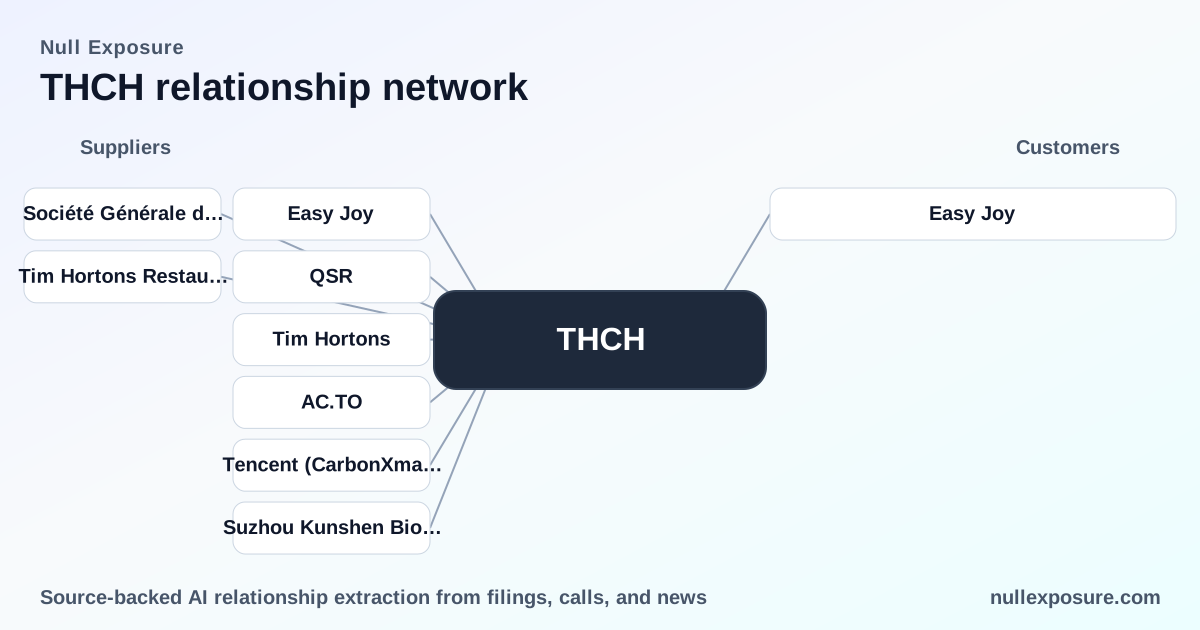
TH International (THCH) — Customer relationships driving retail reach and distribution
TH International operates and monetizes the Tim Hortons brand in mainland China, Hong Kong and Macau through retail coffee shops and branded ready‑to‑drink (RTD) products; revenue is generated from shop sales, product distribution agreements and selective asset dispositions that recycle capital into growth initiatives. Investors should treat THCH as a retail‑growth operator that blends store-level sales with channel partnerships to scale distribution while actively managing its asset base. For a centralized view of relationship intelligence and ongoing monitoring, visit https://nullexposure.com/.
Financial baseline that frames the customer picture
TH International reported approximately $1.316 billion in trailing revenue with a gross profit of $511 million, yet the company remains unprofitable at the operating level (EBITDA -$104 million and operating margin ~-28%). These economics make distribution partnerships and margin recovery pivotal: the company needs higher same-store sales or more productive non-retail channels to move to sustainable profitability. Market capitalization sits near $67.9 million, and institutional ownership is meaningful at ~61%, signaling investor interest despite financial stress. The balance between equity market size and revenue scale highlights a valuation gap that places heavy emphasis on execution of commercial partnerships rather than purely organic store rollouts.
Full list of customer and channel relationships in the public record
Below are every customer or partner relationship surfaced in available reporting for TH International. Each entry is a concise, plain‑English take on what the relationship is and why it matters.
Easy Joy — Sinopec convenience network for RTD and shop trials
Tims China announced a collaboration with Sinopec’s Easy Joy, which operates over 27,800 convenience stores, to sell ready‑to‑drink Tim Hortons coffee products and to evaluate opening Tim Hortons coffee shops inside select Easy Joy locations; this is a strategic distribution partnership aimed at scaling off‑premise reach and brand visibility across high‑traffic fuel‑retail corridors (PR Newswire, March 10, 2026). The Easy Joy relationship is a direct channel to mass retail customers and accelerates RTD roll‑out without proportional store capital, making it a high‑leverage commercial asset for revenue diversification.
PLK APAC Pte. Ltd. — asset sale and portfolio rebalancing
PLK APAC Pte. Ltd. acquired PLKC International Limited from TH International for an enterprise value of $15 million, representing an instance of THCH divesting non‑core or underperforming assets to raise liquidity and sharpen strategic focus (MarketScreener report, May 4, 2026). This transaction is evidence of active portfolio management—the company is willing to monetize holdings to redeploy capital into higher‑ROI channels or to shore up the P&L.
What these relationships reveal about the operating model
- Contracting posture: Public records show a mix of commercial partnerships and transactional asset sales rather than long‑term exclusive customer lock‑ins. The Easy Joy collab is a channel partnership for distribution; the PLK APAC transaction is a clear divestiture. This indicates TH International operates with flexible partner contracts and transactional capital allocation.
- Concentration risk: The scale of partners like Easy Joy introduces potential concentration around a few large channels if RTD becomes dependent on one major convenience operator; however, the current record lists a small number of public relationships, implying concentration is an active risk vector to monitor.
- Criticality: Channel partners that provide national reach (for example, Sinopec’s network) are strategically critical because they can materially amplify RTD volume without comparable store investment.
- Maturity of partnerships: The mixture of exploratory shop openings within convenience locations and completed asset sales reflects mid‑stage commercial development—the company is moving from pilot and distribution agreements toward scaling via partners while pruning legacy assets.
There are no customer‑specific contractual constraints publicly disclosed in the relationship records provided, which at a company level signals a preference for flexible commercial arrangements rather than long‑dated, highly restrictive customer contracts.
Why these relationships matter to investors and operators
The Easy Joy partnership is an immediate lever for volume and brand reach: RTD distribution through tens of thousands of convenience outlets accelerates revenue per square foot without the capex of opening thousands of stores, and represents a lower‑risk path to broaden customer exposure. Conversely, the PLK APAC acquisition of an entity from THCH for $15 million signals active balance‑sheet management—either recycling capital into higher‑return initiatives or correcting portfolio misallocations.
Operationally, managers should prioritize:
- Converting RTD distribution into repeatable, margin‑positive revenue streams with predictable logistics and shelf economics.
- Ensuring partnership agreements include favorable commercial terms (pricing, placement, promotional support) so distribution translates into profitable volume.
- Monitoring customer concentration and diversifying channel partners to avoid revenue shocks tied to single large distributors.
Key risks and catalysts to watch
- Profitability recovery is the central near‑term catalyst: the company must convert scale into positive operating leverage to justify current market capitalization.
- Channel concentration: reliance on a small number of large partners (e.g., convenience networks) creates execution risk if terms deteriorate or priorities shift.
- Asset optimization: further asset sales or portfolio transactions like the PLK APAC deal will materially affect liquidity and strategic flexibility.
- Retail execution: store economics and same‑store sales trends remain the core driver of long‑term value; distribution partnerships are a complementary lever, not a substitute.
For investors evaluating operational counterparties, procurement teams, or potential partnership routes, these relationship signals are actionable: prioritize partnerships that deliver measurable margin improvement and guard against single‑partner dependency. For real‑time updating and deeper relationship tracing, see https://nullexposure.com/.
Bottom line — position and next steps
TH International is a retail operator leveraging high‑scale distribution partnerships to extend brand reach while actively managing non‑core assets. The Easy Joy relationship is the primary public channel expansion story; the PLK APAC transaction is an example of portfolio rebalancing. Investors should value future upside to the extent THCH can convert distribution scale into improved margins and demonstrate repeatable, profitable RTD economics. Operators should focus on contract structure and channel diversification as the twin levers that move results from headline revenue to sustainable profits.