International Tower Hill Mines (THM): Why a $40M Strategic Placement Rewires the capital story
International Tower Hill Mines operates as an exploration-stage gold company that monetizes its value primarily through equity capital markets and asset advancement: it acquires and advances the Livengood gold project in Alaska, funds exploration and development through public offerings and private placements, and grows project optionality ahead of any mine financing or third‑party transaction. The company’s economics are financing-driven today — value realization depends on successful capital deployment and resource de‑risking rather than operating cash flow. For a concise investor briefing and relationship mapping, visit https://nullexposure.com/.
Capital inflection: what the Paulson placement delivers
In March 2026 THM executed an upsized equity financing with a concurrent private placement of US$40 million to Paulson & Co. Inc., purchased at the public offering price. According to the company press release and market coverage, the private placement was part of an equity package that produced total gross proceeds reported as US$114.8 million to the company upon closing. (Source: company press release and coverage, March 10, 2026 — Yahoo Finance / The Globe and Mail.)
This is a classic exploration-stage funding pattern: material, concentrated capital from a single institutional investor that materially strengthens the balance sheet and funds next‑stage technical, permitting, and development work at Livengood.
The relationship map: Paulson & Co. Inc.
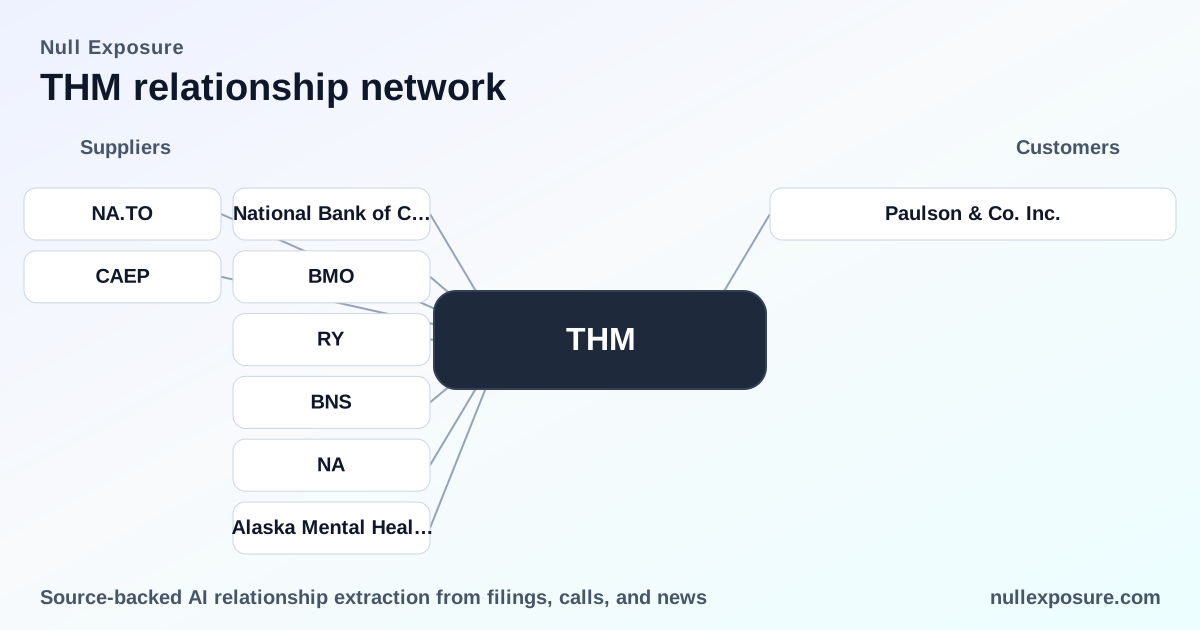
- Paulson & Co. Inc. — Paulson committed to purchase US$40 million of common shares in a concurrent private placement at the public offering price, acquiring 18,018,018 shares and contributing to total gross proceeds reported by the company in March 2026. This transaction delivered immediate liquidity to THM and positioned a single institutional backer as a major capital provider. (Source: company press release and multiple market reports, March–May 2026 — finance.yahoo.com; theglobeandmail.com; investing.com.)
This relationship is the only customer/investor interaction surfaced in the reviewed materials; coverage is consistent across multiple press outlets and the company’s offering disclosures. The transaction is purely financial — an equity placement — not a strategic operating alliance.
What the capital structure change implies for operators and investors
-
Concentration of capital: The $40 million participation is large for an exploration-stage issuer and creates investor concentration risk — a single backer supplies a meaningful share of recent funding. THM’s public filings and press releases indicate this was executed as a private placement concurrent with the public offering, a common mechanism to secure anchor institutional demand.
-
Contracting posture: THM demonstrates an opportunistic capital-raising posture: using equity markets and targeted private placements to fund development. This pattern signals preference for equity financing over debt at this stage and implies ongoing reliance on markets until project‑level cash flow becomes available.
-
Criticality to project timeline: The placement is critical to near-term project advancement. Exploration and pre‑development work at Livengood require capital; the placement reduces near‑term financing risk and extends runway for technical and permitting milestones.
-
Maturity of relationship: The Paulson interaction is a financial investor relationship, not an operational joint venture — its immediate impact is balance-sheet stabilization rather than supply-chain or construction delivery. Governance influence is possible given the scale of the investment, but the documents reviewed position Paulson as a capital provider rather than an operating partner. (Company press release and market coverage, March–May 2026.)
For more structured tracking of investor relationships and how they shift capital posture, see https://nullexposure.com/.
Risk and upside profile after the placement
-
Upside: Improved financing flexibility and an extended development runway materially increase the probability that THM can execute programmatic exploration and permitting milestones that drive valuation re‑rating if results validate resource economics.
-
Downside: Concentration and dilution risks are elevated — a large private investor can influence future capital strategy and dilutive events, and THM remains revenue‑less (Revenue TTM = 0) with negative profitability metrics listed in public data, so additional financings remain plausible.
-
Market sensitivity: THM’s valuation will remain sensitive to gold price moves and capital markets conditions, because near-term value is realized through equity events and resource re‑rating rather than operating cash generation.
How investors and counterparties should read this relationship
-
For investors: This is a balance-sheet positive event that materially reduces execution risk for near-term technical work; however, the concentration of capital means monitor subsequent governance disclosures and any rights connected to the private placement.
-
For operators and potential partners: THM’s capital-first model suggests timelines for supplier contracting and project finance will be driven by discrete capital milestones, not by steady operating cash flow; counterparties should model funding-triggered schedule risk accordingly.
Bottom line: capital-backed runway, concentrated exposure
THM’s business model is capital-dependent and the Paulson private placement is the dominant customer/investor relationship surfaced in public coverage for FY2026. That placement provides a tangible funding runway and materially de-risks near-term development, while introducing investor concentration that stakeholders must monitor for governance and future financing implications. The company remains an exploration-stage gold play whose value realization trajectory is governed by successful use of recently raised equity to advance Livengood toward de‑risking milestones.
For ongoing monitoring of investor relationships and to access structured intelligence on capital events, visit https://nullexposure.com/.