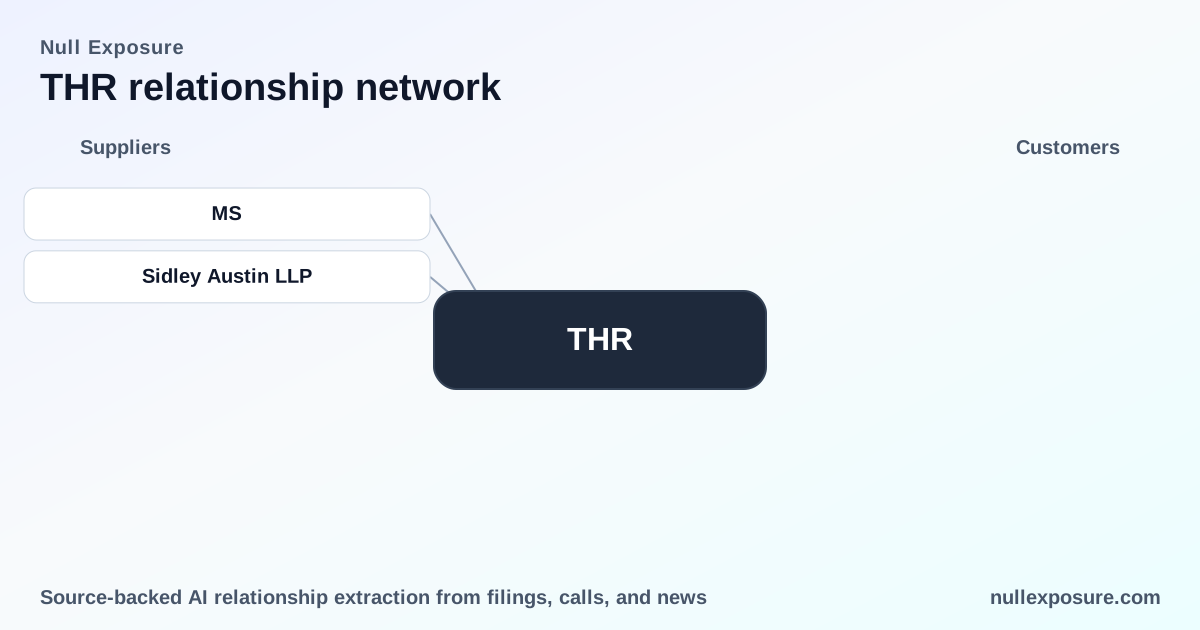
Thermon Group (THR): an investor’s guide to customer relationships and commercial constraints
Thermon Group Holdings monetizes industrial process heating through a tri-part business model: hardware sales (heating cables, boilers, assemblies), ongoing services (engineering, installation, maintenance), and software & temporary power rentals that generate repeatable service revenue. The firm recognizes revenue on transfer of control and supplements product margins with recurring income from rentals and maintenance; TTM revenue is $522.0M with a gross margin of $237.8M, positioning Thermon as a mid‑market specialty industrial supplier with a service-anchored commercial model. For a quick look at our broader coverage and data resources, visit https://nullexposure.com/.
One-line take: why customer relationships matter for THR investors
Thermon’s customer base is broad and globally distributed, which limits counterparty concentration risk but raises dependence on execution across many end markets; large strategic moves—such as the recent transaction activity involving CECO Environmental—recast revenue mix and cross-sell trajectories and therefore deserve close attention.
How reported CECO interactions change the picture
H3: CECO acquisition language in the press According to Finviz coverage dated May 4, 2026, press reporting framed Thermon in the context of a sale to CECO Environmental Corp., indicating a corporate transaction that investors need to evaluate for its impact on ownership, capital structure, and customer continuity. (Finviz news, May 4, 2026)
H3: Management commentary on operational synergies A follow-up note from SAHM Capital (March 29, 2026) emphasized management’s focus on commercial synergies—chiefly cross-selling Thermon offerings into CECO’s power and infrastructure projects—which translates directly into potential upside for recurring services and software adoption in larger project portfolios. (SAHM Capital, March 29, 2026)
Every reported customer relationship in this file — plain-English takeaways
-
The Finviz item frames Thermon as being the subject of a sale to CECO Environmental Corp., a change that will alter Thermon’s corporate ownership and could accelerate integration with a larger environmental and infrastructure-focused platform. (Finviz news, May 4, 2026)
-
SAHM Capital’s piece highlights management commentary around cross-selling Thermon’s heating and services suite into CECO’s project pipeline, a strategic rationale that supports higher recurring revenue and deeper account penetration if execution follows the rhetoric. (SAHM Capital, March 29, 2026)
These two items are complementary: one records a transactional event in the market narrative, the other describes management’s commercial rationale for unlocking value post-transaction.
Operating model and company-level constraints investors should treat as facts
Thermon’s public disclosures and evidence set a clear operating posture that drives contract economics, revenue stability, and execution risk:
-
Contracting posture — short-term for some offerings. Thermon leases temporary power products through its Thermon Power Solutions division on month-to-month short-term contracts without purchase options, creating volatile but high-margin rental flows that are sensitive to on-site project timing. (Company filing language)
-
Global footprint and market reach. The company sells and services through a network in 30+ countries with 11 manufacturing sites on two continents, underlining both diversified market access and the operational complexity of geographically dispersed manufacturing and service delivery. (Company filing language)
-
Customer concentration — immaterial at the individual level. No single customer accounted for more than 10% of revenue in fiscal 2023–2025, signaling low counterparty concentration but requiring Thermon to sustain broad commercial coverage to maintain growth. (Company filing language)
-
Seller role and full-solution positioning. Thermon acts primarily as a seller of hardware, services, and software, offering integrated packages (heating units, boilers, heating cables, control systems) that create deeper service economics and lock-in through installation and maintenance contracts. (Company filing language)
-
Business segments and revenue mix. The company’s commercial architecture spans hardware, services, and software, enabling higher lifetime customer value but also demanding cross-functional sales and after-sales capabilities. (Company filing language)
-
Maturity and market tenure. Thermon references more than 70 years of operating history and thousands of customers globally, positioning the business as mature with established sector credibility and legacy relationships. (Company filing language)
Collectively, these company-level constraints shape Thermon’s margin profile, capital intensity, and sensitivity to project cycles rather than exposing the firm to outsized customer single-point failures.
Investment implications and risk framework
-
Revenue durability versus project cyclicality. The combination of product sales and recurring service/rental revenue provides hybrid durability, but short-term rental contracts and exposure to industrial capex cycles create quarter-to-quarter volatility in top-line delivery.
-
Valuation context. Thermon trades at a trailing PE of ~35.6 and an EV/EBITDA of ~19.5, reflecting a premium for its technology-anchored services and anticipated growth; analysts show a consensus target near $51 (company data). These multiples require continued execution on cross-sell and margin expansion to be justified.
-
Integration and concentration risk from the CECO transaction. The reported sale and stated cross-sell ambitions imply near-term integration workstreams; investors should monitor customer retention metrics, changes in revenue recognition, and any shift in counterparty concentration that could arise from new ownership and go-to-market consolidation.
-
Operational execution is the gating factor. Given a global manufacturing footprint and the multi-disciplinary nature of Thermon’s offerings, execution on logistics, local service delivery, and software adoption will determine whether cross-sell synergies translate into incremental, sustainable revenue.
Bottom line and recommended focal points for analysts
-
Thermon is a hardware-and-service company with global scale, immaterial single-customer risk, and an established path to recurring revenue through services and rentals. Financial metrics show mid-single-digit returns on assets and equity consistent with a capital-light service tilt inside an industrial envelope.
-
Near-term event risk centers on the CECO transaction and integration outcomes. Track customer retention, consolidated revenue disclosures, and the cadence of cross-sell wins. For continued monitoring and research resources, see our coverage hub at https://nullexposure.com/.
If you want an investor-focused briefing that tracks integration updates and customer-level revenue disclosures post-transaction, we publish targeted note updates and relationship maps that cut to the commercial implications.