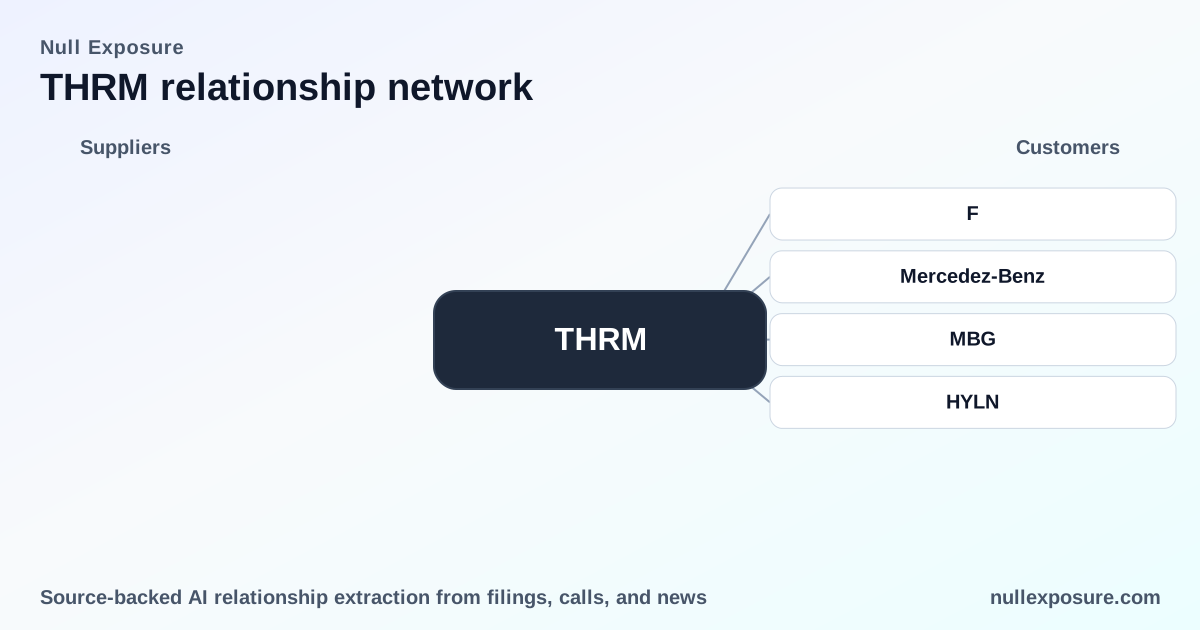
Gentherm (THRM): Customer Map and What It Means for Investors
Gentherm designs, manufactures and sells thermal management technologies—primarily climate-controlled and comfort seating systems—to global automotive OEMs and select non-automotive customers. The company monetizes through product sales tied to long-term supply agreements and per-platform content on high-volume vehicle programs, plus aftermarket and new-home furniture channels as it diversifies beyond traditional auto content. For investors, revenue growth is driven by successful program wins on volume platforms, content-per-vehicle expansion (e.g., massage, pulse-based systems), and geographic footprint across NA, EMEA and APAC.
If you want a concise customer-risk brief for portfolio or vendor diligence, see more at https://nullexposure.com/.
How to read the relationship list
Below is a one-by-one account of every customer relationship captured in public reporting and media; each item has a short plain-English summary and the cited source. Together these items explain where Gentherm is winning business, which platforms drive scale, and where concentration and diversification risk live.
Detailed relationship log (every reported hit)
-
Mercedes‑Benz — Gentherm reported a strategic conquest win on one of Mercedes‑Benz’s highest‑volume platforms that includes the S‑Class, GLS, GLE and CLS, indicating meaningful content penetration on premium Mercedes platforms. Source: company remarks in an earnings‑call transcript cited on Investing.com (Q3 2025 / reported May 2026) (https://www.investing.com/news/transcripts/earnings-call-transcript-gentherm-q3-2025-boosts-revenue-outlook-93CH-4304859).
-
GM — Gentherm won business with GM for its Comfort Scale integrated thermal and pneumatic hardware solution, marking adoption of next‑generation seat comfort systems at a major North American OEM. Source: same Q3 2025 earnings transcript on Investing.com (https://www.investing.com/news/transcripts/earnings-call-transcript-gentherm-q3-2025-boosts-revenue-outlook-93CH-4304859).
-
KUKA Home — Gentherm delivered its first home and office solutions to KUKA Home in Asia, representing a deliberate extension of automotive thermal platforms into the furniture market. Source: company press reporting summarized by The Manila Times / GlobeNewswire press release (FY2026) (https://www.manilatimes.net/2026/04/23/tmt-newswire/globenewswire/gentherm-reports-2026-first-quarter-results/2326889/amp).
-
Ford (Ford F‑Series) — Gentherm highlighted awards tied to the Ford F‑Series as a high‑volume win for its pulse‑based solution, reinforcing exposure to one of the largest light‑truck programs in North America. Source: Q4 2025 earnings‑call transcript summarized on InsiderMonkey (FY2026 commentary, March 2026) (https://www.insidermonkey.com/blog/gentherm-incorporated-nasdaqthrm-q4-2025-earnings-call-transcript-1699749/).
-
Stellantis — Gentherm reported that Stellantis introduced a vehicle in Europe with Gentherm content and that wider regional launches with that content were imminent, signaling platform‑level penetration in the Stellantis program suite. Source: earnings‑call transcript on Investing.com (Q3 2025 / May 2026) (https://www.investing.com/news/transcripts/earnings-call-transcript-gentherm-q3-2025-boosts-revenue-outlook-93CH-4304859).
-
Honda — The company secured an award to supply climate‑controlled seats for a Honda platform targeted to the Indian market, marking continued APAC program wins. Source: Q3 2025 earnings‑call remarks on Investing.com (https://www.investing.com/news/transcripts/earnings-call-transcript-gentherm-q3-2025-boosts-revenue-outlook-93CH-4304859).
-
Mercedes‑Benz (alternate mention) — Management reiterated that Mercedes‑Benz represented one of the high‑volume platform awards for the year, again emphasizing Mercedes as a key OEM customer for Gentherm’s pulse and lumbar systems. Source: Q4 2025 earnings transcript captured on InsiderMonkey (FY2026 / March 2026) (https://www.insidermonkey.com/blog/gentherm-incorporated-nasdaqthrm-q4-2025-earnings-call-transcript-1699749/).
-
Mercedez‑Benz (press variant) — Gentherm announced Automotive New Business Awards totaling $745 million, highlighted by a conquest lumbar and massage award with Mercedes (including the Puls.A™ pulsating massage solution), underlining the dollar scale of recent wins. Source: QuiverQuant news summary of company results (FY2025 / March 2026) (https://www.quiverquant.com/news/Gentherm+Reports+Record+Quarterly+Revenue+of+%24387+Million+and+Strategic+Growth+in+Automotive+Business).
-
Li Auto — Gentherm supplied thermal solutions for Li Auto’s i6 platform as part of broader engagement in China, contributing to above‑market performance in that region. Source: Q3 2025 earnings transcript on Investing.com (https://www.investing.com/news/transcripts/earnings-call-transcript-gentherm-q3-2025-boosts-revenue-outlook-93CH-4304859).
-
Xiaopeng — Gentherm noted thermal solutions with Xiaopeng among the China OEM customers referenced as contributors to improved growth in China. Source: Q3 2025 earnings transcript on Investing.com (https://www.investing.com/news/transcripts/earnings-call-transcript-gentherm-q3-2025-boosts-revenue-outlook-93CH-4304859).
-
Lear Corporation — Lear and Gentherm collaborated on an intelligent seating solution (INTU Thermal Comfort with ClimateSense), reflecting Tier‑1 partnerships that embed Gentherm technology into larger seating systems. Source: trade coverage on Pulse2 reporting the joint solution (FY2020 announcement, cited in 2026 collection) (https://pulse2.com/lear-gentherm-launch-new-intelligent-thermal-comfort-seating-solution/).
-
Hyliion — Historical reporting shows Gentherm’s battery system was an important component in Hyliion’s hybrid solutions, illustrating legacy non‑automotive product applications and technology transfers. Source: Fleet Equipment Magazine coverage of Hyliion’s acquisition of Gentherm’s battery division (FY2018) (https://www.fleetequipmentmag.com/hyliion-acquires-gentherm-battery-division-partners-toshiba-dana/).
-
HYLN (alternate Hyliion hit) — Same Hyliion reference captured under the HYLN ticker string acknowledging Gentherm battery system importance to a specific hybrid vehicle solution. Source: Fleet Equipment Magazine (FY2018) (https://www.fleetequipmentmag.com/hyliion-acquires-gentherm-battery-division-partners-toshiba-dana/).
-
Jaguar Land Rover (JLR) — Management noted the JLR cyber incident had weighed on Q3 shipments but that JLR volumes were ramping back up, implying short‑term operational sensitivity tied to customer disruptions. Source: Q3 2025 earnings transcript on Investing.com (https://www.investing.com/news/transcripts/earnings-call-transcript-gentherm-q3-2025-boosts-revenue-outlook-93CH-4304859).
-
Subaru — Gentherm’s climate‑controlled seat solution is included on Subaru’s high‑volume Forester, confirming another volume program carrying Gentherm content. Source: Q3 2025 earnings transcript on Investing.com (https://www.investing.com/news/transcripts/earnings-call-transcript-gentherm-q3-2025-boosts-revenue-outlook-93CH-4304859).
What the relationship set implies about Gentherm’s operating model
Gentherm’s customer list and company disclosures together create a coherent operating profile:
-
Contracting posture and maturity: Gentherm commonly operates under long‑term supply agreements with OEMs; management explicitly ties production to platform lifecycles (typically five to ten years). That elevates revenue visibility once a design win converts to production revenue, but also ties future growth to new program awards.
-
Counterparty type and concentration: The customer universe is concentrated in large automotive OEMs and Tier‑1 partners, consistent with the company’s disclosure that its Automotive segment sells to major OEMs. This structure benefits Gentherm through scale and defensibility but introduces counterparty concentration risk when high‑volume platforms dominate product revenue.
-
Geographic footprint and diversification: Revenue is materially distributed across North America, EMEA and APAC, with disclosed country‑level shipments (e.g., U.S., Germany, China) reflecting true global exposure. That global mix dilutes single‑market shocks but creates multi‑currency, logistics and regional product‑approval complexity.
-
Materiality and criticality: Public filings indicate customer exposures that cross materiality thresholds (examples show >10% of net sales for certain customers historically), so individual OEM program disruptions are consequential to reported product revenue and accounts receivable.
-
Role breadth: Gentherm acts primarily as a seller to OEMs and as a supplier into Tier‑1 systems, while also supplying aftermarket distributors and pursuing adjacent channels (home furniture via KUKA Home). That mix increases optionality but changes margin and working‑capital dynamics across channels.
-
Spend band signal: Management disclosed new business awards in the hundreds of millions ($745M noted in press) and historical customer sales bands ($231M and $157M line items), indicating meaningful per‑customer spend when large platform awards convert to production.
Risks, upside and what to watch next
-
Key upside: Continued conquest wins on Mercedes‑Benz, Ford F‑Series and other high‑volume platforms materially lift revenue and operating leverage; the extension into furniture (KUKA Home) is a high‑leverage pathway to non‑auto revenue. High‑value program awards announced in 2025–2026 are the primary near‑term upside driver.
-
Key risk: Customer concentration and platform dependence make Gentherm sensitive to OEM production cycles, program delays and discrete disruptions (for example, the JLR cyber incident). Materiality of individual customers amplifies the P&L impact of any OEM slowdown.
-
Operational watch items: Monitor conversion of announced awards to production shipments, the cadence of new LTAs, margin trajectory as content mix shifts (pulse/massage vs. basic climate seats), and regional shipment trends across NA/EMEA/APAC.
If you want a structured customer‑risk report or a quick comparative brief versus peers, find tailored analyses at https://nullexposure.com/.
Conclusion: Gentherm’s revenue profile is platform‑driven, OEM‑anchored and geographically diversified, with meaningful upside from recent high‑value awards and strategic moves into adjacent markets, balanced by concentration and program‑timing risk that investors must track closely.