Tiger Brokers (UP Fintech, TIGR) — Underwriting Relationships and What They Mean for Investors
UP Fintech Holding Limited (Tiger Brokers) operates an online brokerage platform that targets Chinese retail and cross-border investors and monetizes through trading commissions, net interest income on client cash and margin lending, and fee income from capital markets services including IPO underwriting and placement. The company’s recent disclosures and press mentions show a deliberate push into IPO underwriting in Hong Kong and the U.S., turning transactional issuer relationships into an incremental revenue stream alongside its core execution business. For a focused read on relationship signals and deal flow, visit https://nullexposure.com/.
How these customer relationships shape the investment thesis
Tiger Brokers is asset-light and fee-driven: execution and custody generate predictable margins while underwriting and capital-markets work create episodic but high-margin upside. The firm reported Revenue TTM of $538.7M and a 31.7% profit margin, indicating core platform economics are profitable enough to fund expansion into investment-banking style services. Underwriting activity observed in news sources is not a random byproduct: it is an explicit commercial channel that complements brokerage volume and enhances client acquisition through IPO access and allocation.
- Contracting posture: Tiger operates as a commercial counterparty on standard underwriting and distribution agreements — an opportunistic sponsor/underwriter rather than an incumbent bank with long-tenured syndicate dominance.
- Concentration: Relationship evidence points to a broad roster of small-to-mid cap issuers across Hong Kong and U.S. listings rather than reliance on a small number of marquee deals.
- Criticality: Underwriting is strategically important for revenue diversification and client acquisition but is episodic relative to recurring trading and interest income.
- Maturity: The firm is scaling capital-markets capabilities (co-managers, sole bookrunner roles, Hong Kong digital-asset IPOs), demonstrating a move from trading platform to a hybrid brokerage-and-capital-markets operator.
For more context on how we source and present these relationship signals, see https://nullexposure.com/.
Observed issuer relationships — every reported name, explained
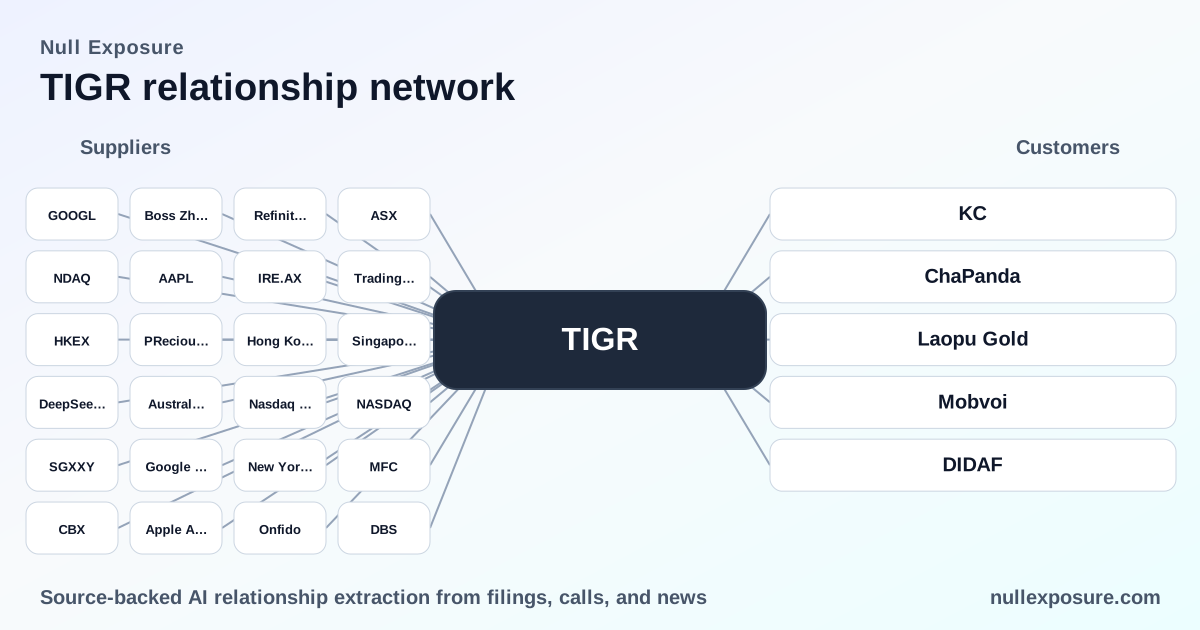
Below are all customer relationships referenced in the collected results, with a concise description and source attribution.
Yimutian (YMT)
Tiger Brokers acted as sole bookrunner on Yimutian’s U.S. IPO. This indicates the firm took lead underwriting responsibility and distribution risk for this FY2025 deal, positioning Tiger as a principal capital-markets counterparty. Source: Renaissance Capital IPO coverage (FY2025).
TRSG
Chinese reporting noted Tiger Brokers served as an underwriter for TRSG’s offering, reflecting the company’s participation in domestic Chinese issuer listings and syndicates reported in FY2023. Source: QQ News (FY2023).
FRLA (FRLAU)
Tiger Brokers and EF Hutton (Benchmark Investments) served as the underwriters for FRLA’s IPO, evidence of Tiger’s role in U.S.-listed transactions where it partners with established underwriters. Source: MarketBeat instant-alert (FY2021).
HashKey Group
Tiger Brokers completed one of the Hong Kong IPOs that quarter, with HashKey Group reported as the sole digital-asset IPO Tiger managed in Hong Kong in FY2026, underscoring the firm’s willingness to take on niche, regulated crypto-related listings. Source: Finance Magnates reporting on FY2026 results.
Pony.ai
Tiger Brokers included Pony.ai among 20 Hong Kong IPOs completed in the referenced quarter; Pony.ai was described internally as a marquee autonomous-driving IPO in FY2026. This highlights Tiger’s participation in larger-tech listings in Hong Kong. Source: Finance Magnates (FY2026).
Kingsoft Cloud (KC)
Tiger is credited with facilitating cross-border listing communications and marketing for Kingsoft Cloud, enabling U.S. roadshow connectivity and the bell-ringing ceremony during the COVID period—an early example of the firm supporting issuer logistics and distribution. Source: China Daily feature on listing support (FY2020).
ChaPanda
Tiger Brokers participated as an underwriter in IPOs alongside other underwriters (ranked fourth among underwriters in reporting), including ChaPanda, reflecting repeated small-cap underwriting participation in FY2024. Source: Finance Magnates (FY2024).
Laopu Gold
Tiger is listed among underwriters for Laopu Gold’s offering, again showing repeated underwriting activity across multiple small issuers in FY2024. Source: Finance Magnates (FY2024).
Mobvoi
Tiger participated in Mobvoi’s IPO underwriting syndicate, demonstrating repeated presence across growth-tech and consumer-tech listings in FY2024. Source: Finance Magnates (FY2024).
Agroz (AGRZ)
Tiger Brokers acted as sole bookrunner on Agroz’s Malaysian vertical-farming IPO and is listed repeatedly in Renaissance Capital coverage as the underwriter setting terms and pricing in FY2025; this is further evidence of Tiger taking lead roles on smaller international placements. Source: Renaissance Capital IPO Center (FY2025).
ChowChow Cloud International (CHOW)
Renaissance Capital cites Tiger Brokers as sole bookrunner on ChowChow Cloud International’s U.S. IPO, another example of Tiger leading cross-border transactions in FY2025. Source: Renaissance Capital IPO Center (FY2025).
Oriental Rise (ORIS)
Renaissance Capital reported Tiger acted as sole bookrunner on Oriental Rise’s downsized U.S. IPO in FY2024, illustrating Tiger’s recurring role as lead manager on smaller U.S.-listed offerings. Source: Renaissance Capital IPO Center (FY2024).
Dida (DIDAF)
Tiger Brokers ranked among underwriters (fourth position in reporting) for Dida’s IPO activity, again showing a pattern of syndicate participation on growth-oriented listings in FY2024. Source: Finance Magnates (FY2024).
EHang (EH)
For EHang’s ADR activity, Morgan Stanley led underwriting while Tiger Brokers (NZ) Limited served as a co-manager alongside Needham & Company and Prime Number Capital, indicating Tiger’s role as a syndicate participant on larger, cross-border deals in FY2026. Source: MarketBeat (FY2026).
Investment implications and tactical checklist
- Growth vector: Underwriting provides high-margin episodic revenue and distribution advantages for retail clients seeking IPO allocations. This adds diversification to a business otherwise anchored in trading volumes and financing spreads.
- Risk profile: Underwriting is transactional and reputation-sensitive; material underwriting losses are unlikely but reputational or regulatory exposures can be asymmetric. Tiger’s mix of sole-bookrunner and co-manager roles spreads syndicate risk but increases exposure to deal execution.
- Concentration signal: The universe of observed relationships is broad and skewed toward small-to-mid cap issuers, implying deal-flow scale rather than dependence on a few marquee clients.
- Operational stance: The company is executing an asset-light, distribution-focused expansion into capital markets rather than building a full-service investment bank.
Key items for investors and operators to monitor: deal pipeline quality, mix of sole bookrunner versus co-manager roles, regulatory feedback on cross-border underwriting, and the translation of underwriting fees into normalized earnings.
For a deeper, relationship-level intelligence view and to track new issuer activity, visit https://nullexposure.com/.
Tiger Brokers is transforming from a pure brokerage into a hybrid execution-and-capital-markets platform; the underwriting relationships documented here are a deliberate strategic lever to capture distribution economics and to feed retail acquisition through IPO allocations.