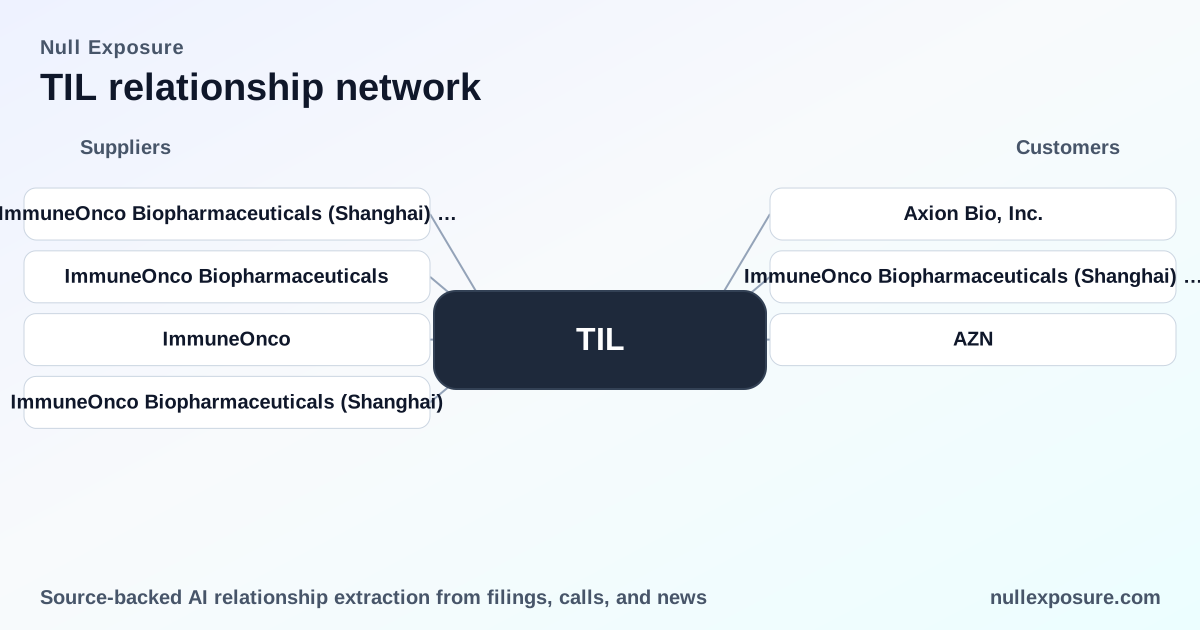
Instil Bio (TIL) — Customer Relationships That Signal a Small Biotech with Active Partnering and Non‑core Real‑Estate Revenue
Instil Bio operates as a clinical‑stage biopharmaceutical company that advances engineered T‑cell therapies and related assets through internal development, subsidiary vehicles and external collaborations, while supplementing its cash runway through selective real‑estate leasing. The company monetizes primarily via milestone and license economics from collaborations and by exploiting non‑core assets (for example, leasing a Tarzana facility to AstraZeneca), with recent partner activity driving both operational risk and short‑term share volatility. For institutional investors and operators evaluating customer counterparty exposure, the mix is straightforward: developmental partnerships determine clinical value, while one-off commercial arrangements for property serve as tactical liquidity management.
Visit https://nullexposure.com/ for additional coverage and tools.
What the recent relationship moves mean for investors
Instil is a small, R&D‑intensive issuer with essentially no product revenue and a reliance on collaboration terms to create shareholder value. The company’s recent transactions fall into two buckets: a termination of a China collaboration tied to clinical discontinuation (Axion/ImmuneOnco) and a leasing arrangement that converts an underused facility into cash flow (AstraZeneca). Both dynamics are decisive for valuation: collaborations drive upside or downside in the pipeline, while property monetization constrains near‑term liquidity risk.
- The termination with ImmuneOnco removes optionality on two partnered candidates and compressed near‑term development pathways. Multiple press releases and market reports recorded the termination in early 2026.
- The AstraZeneca lease is an explicit, active service relationship and a sign that Instil will pursue asset sales or leases to extend runway; the company disclosed the lease in its FY2024 10‑K and is evaluating a sale of the Tarzana site.
Relationship snapshots — clear, concise and sourced
Below are plain‑English summaries of every customer or partner relationship cited in the public record provided.
Axion Bio, Inc.
Axion Bio is a wholly‑owned Instil subsidiary that historically acted as the vehicle to pursue partnered clinical trials in China for AXN‑2510 and AXN‑27M. According to Instil’s Form 10‑K for the fiscal year ended December 31, 2024, Axion was party to a collaboration with ImmuneOnco to pursue those trials in China. (Instil 10‑K, FY2024)
ImmuneOnco Biopharmaceuticals (Shanghai) Inc. / ImmuneOnco Biopharmaceuticals
Instil’s subsidiary Axion and ImmuneOnco executed a license and collaboration covering AXN‑2510 and AXN‑27M, but Axion discontinued clinical development of AXN‑2510 and the parties executed a termination agreement in January 2026; the termination was reiterated in Instil’s March 27, 2026 corporate update and has been widely reported in market outlets. (Instil press release and Form 10‑K references; GlobeNewswire corporate update, March 27, 2026; AccessWire and RTTNews reports, January–May 2026)
AstraZeneca Pharmaceuticals LP (AZN / AstraZeneca)
Instil owns a facility in Tarzana, California, which it leased to AstraZeneca effective July 10, 2024; the lease is active and the company is evaluating opportunities for a potential sale of the facility as part of its capital allocation plan. (Instil 10‑K, FY2024 — lease disclosure; company filing language describing sale evaluation)
How these relationships characterize Instil’s operating model
The mix of counterparties produces several structural signals for investors and operators:
-
Contracting posture — collaborative and asset‑light for R&D, service‑provider for real estate. Instil operates like a small biotech that outsources risk and cost through licensing and collaborations (for example, AXN‑series agreements) while acting as a landlord when assets are non‑strategic (Tarzana lease). The 10‑K explicitly describes the Tarzana facility as leased to AstraZeneca, supporting a service‑provider role for that asset. (Instil 10‑K, FY2024)
-
Concentration and counterparty impact. Pipeline value is concentrated in a small number of programs and partners; termination of a single collaboration materially alters runway and valuation, as the ImmuneOnco termination demonstrates. Conversely, the AstraZeneca lease is a concentrated but low‑complexity revenue source from a single tenant.
-
Criticality to operations. Collaborative partners are critical for clinical progression and ultimate commercial success; real‑estate tenants are tactical for cash. The Axion/ImmuneOnco termination reduces development optionality, while the AstraZeneca lease reduces near‑term cash pressure.
-
Maturity of relationships. The AstraZeneca lease is mature and active as of July 2024 and is being actively managed (company is evaluating sale), whereas the ImmuneOnco relationship has been contractually unwound following the January 2026 termination. (Company 10‑K FY2024; Instil corporate update and press releases, January–March 2026)
Risk and opportunity implications for investors
-
Pipeline risk is now more visible and concentrated. The termination of the China collaboration eliminates potential upside from AXN‑2510 and AXN‑27M under that partnership; investors should treat future partner announcements as primary drivers of value. (Instil March 27, 2026 corporate update; press releases January 2026)
-
Non‑operating assets can extend runway but are one‑time. The Tarzana lease to AstraZeneca converts a fixed asset into recurring rent and an optional sale value, but proceeds from any sale will be finite and do not substitute for sustainable product revenues. The company’s own 10‑K language notes the property sale evaluation is ongoing and not guaranteed. (Instil 10‑K, FY2024)
-
Market sensitivity to partner news. The market reacted sharply to the pipeline discontinuation; share moves and press coverage in May 2026 underscore how partner decisions translate into immediate valuation changes. (RTTNews and AccessWire reporting, May 2026)
Tactical takeaways for due diligence and engagement
-
Focus diligence on remaining partnered programs and the legal termination terms with ImmuneOnco to quantify any residual indemnities, reacquisition rights or data access that could preserve program value. (Termination reported in Instil press materials, January 2026; GlobeNewswire corporate update, March 27, 2026)
-
Monitor any definitive sale process for the Tarzana facility and assess whether sale proceeds will be earmarked for R&D spend, debt reduction or general corporate uses; the 10‑K explicitly frames the property transaction as an active consideration. (Instil 10‑K, FY2024)
-
Evaluate counterparty concentration: a small number of partners now determine both near‑term liquidity (via property transactions) and long‑term upside (via collaborations).
For a structured view of these relationships and comparable counterparty signals across small biotechs, visit https://nullexposure.com/.
Bottom line
Instil’s partnership landscape is binary: collaboration outcomes determine pipeline value while the AstraZeneca lease converts a fixed‑asset liability into tactical cash. The company has transitioned one partnered program to termination and retains an active service relationship with AstraZeneca for the Tarzana facility; both moves materially shape runway, capital allocation choices and investor risk. Investors should underwrite valuation scenarios around partner‑driven development outcomes and one‑time property monetizations rather than recurring product revenues.