Tiptree Inc (TIPT): Customer Relationships and What They Signal for Investors
Thesis: Tiptree underwrites and distributes specialty insurance and related services while operating mortgage origination and servicing businesses; it monetizes through insurance premiums and fee-based services (warranty, motor clubs, administration fees), mortgage origination/sale/servicing economics, and occasional asset divestitures that crystallize value. Investors should view customer and counterparty linkages as a mix of recurring fee streams tied to service businesses and strategic, high-value transactional exits (for example, the Fortegra sale). For deeper company-level relationship mapping visit https://nullexposure.com/.
How Tiptree actually makes money and why relationships matter
Tiptree’s revenue mix is materially hybrid: insurance underwriting and premiums sit alongside service-fee streams (vehicle and home service contracts, motor clubs, administration fees) that generate recurring, ASC 606‑scoped revenue. The mortgage arm originates and sells loans into agency channels while servicing retained portfolios for fee income. The company also pursues portfolio and subsidiary sales to redeploy capital—transactions that can materially change capital intensity and earnings volatility. This blend creates both recurring operating leverage and episodic, transaction-driven value realization that make the profile of counterparties (insurers, government agencies, strategic acquirers) a primary determinant of financial stability and exit optionality.
Full roster of customer relationships (one-by-one)
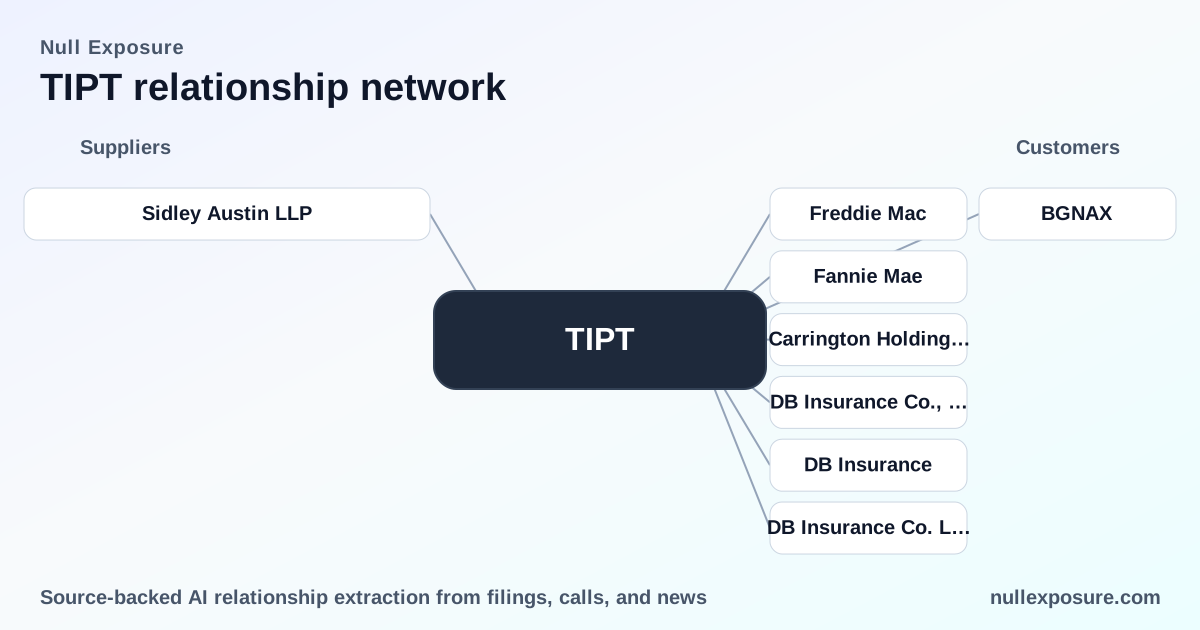
Below are every relationship flagged in the source results, with a plain-English summary and source citation for each entry.
-
Fannie Mae — Tiptree is an approved seller/servicer for Fannie Mae, giving the mortgage subsidiary access to agency channels for selling and servicing conforming loans. Source: Tiptree 2024 Form 10‑K (FY2024).
-
Freddie Mac — Tiptree is an approved seller/servicer for Freddie Mac as well, enabling the company to originate and place conforming loans into Freddie Mac programs. Source: Tiptree 2024 Form 10‑K (FY2024).
-
Carrington Holding Company — Carrington entered into an agreement to acquire Reliance First Capital LLC from Tiptree, indicating Tiptree’s willingness to divest mortgage assets and simplify its operating footprint. Source: National Mortgage Professional report on the Carrington–Reliance transaction (reported March 2026).
-
DB Insurance Co., Ltd. — Tiptree, alongside Warburg Pincus, signed an agreement for DB Insurance to acquire The Fortegra Group for approximately $1.65 billion in cash, a major exit from Tiptree’s specialty insurance holding. Source: Latham & Watkins announcement and transaction coverage (September 2025) and related disclosures (reported March 2026).
-
DB Insurance — Reuters and other outlets reported that South Korea’s DB Insurance will acquire Tiptree’s specialty-insurance unit (Fortegra) for about $1.65 billion, confirming the buyer and deal economics in market reporting. Source: Reuters coverage published March 2026 (via Yahoo Finance syndication).
-
DB Insurance Co. Ltd. — Tiptree publicly disclosed shareholder approval for the $1.65 billion sale of The Fortegra Group to DB Insurance Co. Ltd., formalizing the strategic divestiture timeline. Source: Jacksonville Daily Record coverage of Tiptree shareholder vote (Dec 3, 2025; reported in March 2026 aggregation).
-
BGNAX — The company filing also associates an inferred symbol “BGNAX” with the statement that Tiptree is an approved issuer and servicer for Ginnie Mae, reflecting its engagement with government-guaranteed mortgage securities. Source: Tiptree 2024 Form 10‑K (FY2024).
-
Ginnie Mae — Tiptree confirms it is an approved issuer and servicer for Ginnie Mae, which supports FHA/VA/USDA loan channels and links the company directly to government‑guaranteed mortgage markets. Source: Tiptree 2024 Form 10‑K (FY2024).
What these relationships tell investors about operating posture and risk
-
Contracting posture — a mix of subscription-like services and transactional sales. Tiptree explicitly reports recurring revenue from monthly membership dues (motor clubs) and administration fees (ASC 606), indicating predictable fee streams alongside underwriting volatility and one-off sales such as Fortegra. This hybrid contracting posture supports baseline cash flow while allowing management to crystallize value via divestitures.
-
Counterparty concentration and type — diversified across individuals, agencies, and strategic corporate buyers. The company originates mortgages directly to consumers across 39 states, while also relying on large agency buyers (Fannie Mae, Freddie Mac, Ginnie Mae) for loan placement and liquidity; strategic acquirers like DB Insurance and Carrington are proof points of external demand for Tiptree’s subsidiaries.
-
Geographic footprint and exposure — North America core with meaningful EMEA and APAC exposure through insurance operations. Filings call out growth in Europe and expansion in the Asia‑Pacific region; investors should treat international operations as a source of both growth and FX/political risk rather than a marginal afterthought.
-
Relationship criticality and maturity — institutional agency ties are mission‑critical; transactional acquirers are value creators. Approved seller/servicer status with Fannie, Freddie and Ginnie Mae is a core operational capability that underpins mortgage origination economics and servicing revenue. Conversely, relationships with strategic acquirers (DB Insurance, Carrington) are execution channels for recapitalization and portfolio reshaping.
-
Segment mix signal — services are a material, growing part of revenue. Tiptree reports that a significant portion of revenue comes from fee‑based, non‑underwriting service lines (motor clubs, warranties, administration), which reduces pure underwriting sensitivity and creates recurring cash flows.
Risks and considerations from the relationship map
-
Episodic capital events change the operating baseline. The Fortegra sale for ~$1.65 billion reduces underwritten premium exposure but shifts capital deployment needs; investors must model fewer underwriting earnings and more capital‑allocation returns.
-
Agency dependence shapes liquidity and margins. Approved seller/servicer status is essential for originating and monetizing mortgage production; any change in agency eligibility or underwriting standards would have immediate distribution and margin implications.
-
International expansion raises operational complexity. EMEA and APAC activity increases top-line diversification but introduces currency, regulatory, and credit risks that are different from U.S. E&S insurance lines.
Bottom line for investors
- Tiptree combines stable, fee‑based services with mortgage agency channels and opportunistic M&A exits. This mix supports mid‑cycle resilience while allowing management to realize large balance-sheet value through dispositions.
- Key dependencies are agency distribution (Fannie/Freddie/Ginnie Mae) and the company’s ability to execute strategic sales (e.g., Fortegra to DB Insurance). Both elements materially influence capital allocation and earnings trajectory.
For a structured view of customer exposures and transaction history, see the company’s full filings and aggregated relationship reporting at https://nullexposure.com/. If you want a tailored relationship risk brief for TIPT’s next earnings cycle, visit https://nullexposure.com/ to request deeper analysis.