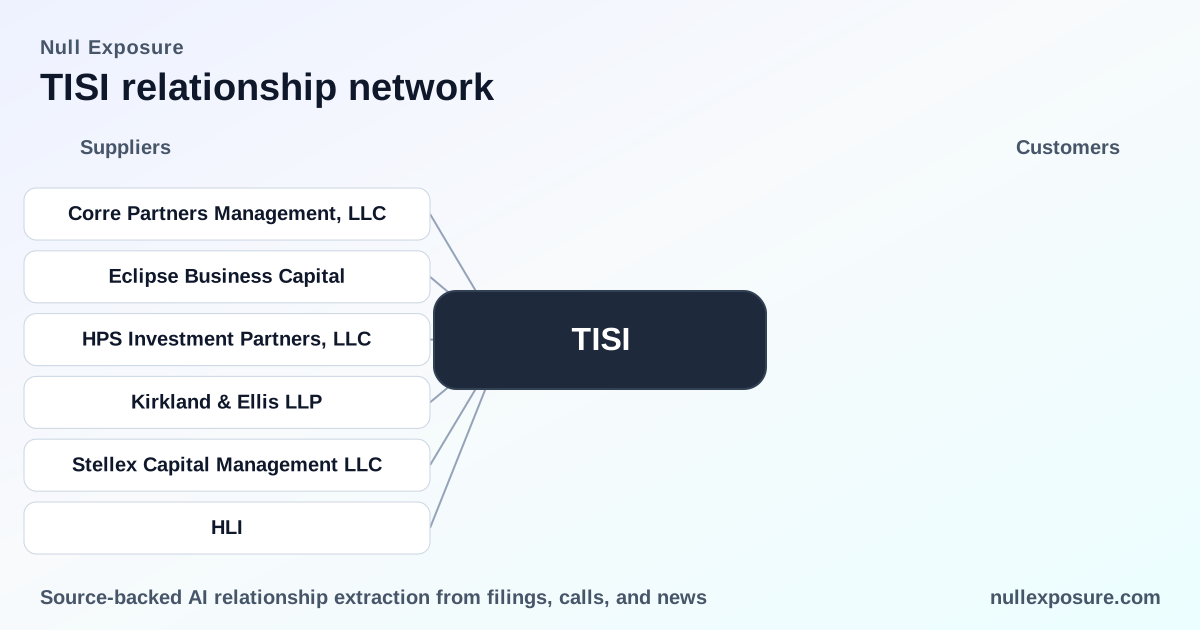
Team Inc (TISI) — customer relationships that define revenue predictability and operational risk
Team Inc delivers specialty industrial services—mechanical, heat-treating, and non‑destructive inspection—primarily to energy and heavy industry customers, and monetizes through time-and-materials work, fixed‑price projects and multi‑site service arrangements, supplemented historically by asset sales and occasional capital transactions. With roughly $896 million in trailing revenue and a compact public market capitalization (~$79 million), Team’s revenue base is broad but operationally exposed to short‑term contracts and regional industrial demand. For a concise, research‑grade view of these customer dynamics, visit https://nullexposure.com/.
How Team sells services and why that matters to investors
Team operates as a field‑deliverable service provider: crews, heat‑treat furnaces, and inspection teams work on client facilities and the company invoices as work completes. The company’s public disclosures emphasize that most revenue is billed on a time‑and‑materials basis and many contracts are short‑term, although the business also uses regional or national framework agreements that cover multiple sites. This mix creates a trade‑off investors should track closely:
- Predictability is limited by the short‑term billing model, which constrains forward revenue visibility quarter‑to‑quarter.
- Framework contracts provide pockets of stability where multi‑site or national relationships exist, supporting utilization and pricing leverage.
- No single customer dominates revenue, so counterparty concentration risk is low, but the company’s organic topline is directly tied to industrial activity cycles.
These characteristics mean Team’s revenues track end‑market volumes and utilization more than long‑dated contractual cashflows; investors should value the company with a focus on operational execution, margin management and capital structure rather than contract amortization.
The constraints shaping Team’s customer book
The company’s public filings and disclosure language surface a coherent set of operating signals that bear on customer risk and revenue durability:
- Contracting posture — predominantly short‑term: filings state most agreements can be terminated on short notice and are billed T&M, which reduces visibility but increases flexibility to reprice and redeploy resources.
- Framework relationships exist alongside short engagements: Team explicitly runs multi‑site regional and national contracts, which act as stabilizers within an otherwise transactional model.
- Geography — North America is the revenue base, with global capability: revenue disclosure for 2024 shows the United States as the main market, with Canada and other countries contributing meaningfully; Team positions itself as a global specialist provider.
- Materiality — customer concentration is immaterial: no single client represented 10% or more of consolidated revenues in 2023–2024, lowering headline counterparty concentration risk.
- Role — service provider delivering over time: most performance obligations are recognized over time because Team performs work on customer assets, directly linking revenue to on‑site execution.
- Relationship maturity — active, operational: customer relationships are ongoing and billed as work is performed, rather than front‑loaded contract receivables.
- Segment focus — services: the business is fundamentally a services operator, not a product or licensing company, which concentrates capital and working capital needs in people and equipment.
These constraints should be treated as company‑level signals that define how customer wins convert to cash and how resilient that cashflow is across cycles.
Counterparty snapshots: public evidence of two notable relationships
Below are the relationships surfaced in available public material, summarized plainly for investors.
Baker Hughes (FY2022): disposal of Quest Integrity for ~$279 million
Team completed the sale of its Quest Integrity business unit to Baker Hughes in 2022 for approximately $279 million, a strategic divestiture that materially reshaped Team’s operating footprint and liquidity profile at the time. This transaction is documented in news coverage of the sale (BizJournals, 2022): https://www.bizjournals.com/houston/news/2022/11/04/team-inc-closes-sale-business-unit-baker-hughes.html.
Stellex Capital Management LLC (FY2025): $75 million private placement of preferred stock and warrants
In FY2025 Team closed a private placement of preferred stock and warrants with affiliates of Stellex Capital Management for $75 million of gross proceeds, a capital‑markets transaction intended to strengthen the company’s balance sheet and fund operations or strategic initiatives. The transaction and advisory role were reported in legal and press notices (Latham & Watkins announcement, 2025): https://www.lw.com/en/news/latham-advises-on-team-inc-private-placement-of-preferred-stock-and-warrants-to-stellex.
What these relationships tell investors about strategic direction
The Baker Hughes sale signals that Team is willing to monetize non‑core assets to reallocate capital or reduce leverage, while the Stellex placement demonstrates reliance on private capital partners to underwrite near‑term balance sheet needs. Together, these events reflect a company actively managing portfolio and capital structure rather than locking into long‑duration customer contracts.
Investment considerations and risk profile
For investors and operators evaluating Team’s customer relationships, the key factors are straightforward and actionable:
- Revenue volatility is an inherent feature due to T&M billing and short‑term contract termination rights; model earnings with scenario‑based utilization assumptions.
- Framework contracts are the primary path to smoothing cash flows; the more Team converts spot work into regional or nation‑wide agreements, the more free cashflow stability improves.
- Low single‑customer concentration reduces counterparty credit risk, but the overall business is cyclical and tied to industrial capex and maintenance cycles.
- Capital structure sensitivity is material—the FY2025 private placement to Stellex underscores the importance of access to capital during periods of weak cash generation.
- Operational execution is the clearest value lever: margin expansion and utilization gains directly improve EBITDA given the services business model.
Use observable multiples and company metrics—Team reports ~$896 million revenue TTM, EBITDA ~$48 million, and market metrics such as EV/Revenue ~0.46 and EV/EBITDA ~12.8—to triangulate relative valuation in the industrial services peer set.
For a deeper counterparty and contractual analysis, including framework‑level exposure and service mix, see more at https://nullexposure.com/.
Bottom line
Team’s customer franchise is built on transactional field services with selective framework relationships, producing a business that is operationally sensitive but commercially diversified. Strategic divestitures and private capital injections in recent years have reshaped balance‑sheet flexibility; going forward, investors should prioritize tracking framework contract wins, utilization trends and capital access as primary drivers of upside or downside in the equity.