Teekay Corporation (TK): Customer relationships that shape cashflow and strategic optionality
Teekay Corporation operates as a marine energy transportation company that monetizes through vessel charters, ship management, and selective asset sales and spin‑offs. The company’s revenue base is tied to long‑term charters and management contracts for tankers, FPSOs and LNG carriers, supplemented by opportunistic disposals of regional operations; these relationship dynamics drive both recurring cashflow and episodic balance‑sheet events. For investors tracking counterparty concentration and sponsor‑related flows, customer and affiliated relationships are a primary lens on Teekay’s operating leverage and capital allocation. Learn more about relationship signals at https://nullexposure.com/.
What Teekay does and how that converts into investor value
- Teekay is a Bermuda‑headquartered marine energy transporter with TTM revenue of $949.5m and EBITDA of $271.6m, supporting a market capitalization around $1.16bn and a dividend yield near 10% (company overview, latest quarter 2025‑12‑31).
- The firm’s economics are driven by long charters and fleet operations (which stabilize cashflow) and by periodic asset sales or intra‑group transactions (which can be material to liquidity and capital returns).
- Institutional ownership is meaningful (about 51.6%), and insider ownership is substantial (~36.9%), creating a governance and related‑party profile investors must factor into counterparty analysis.
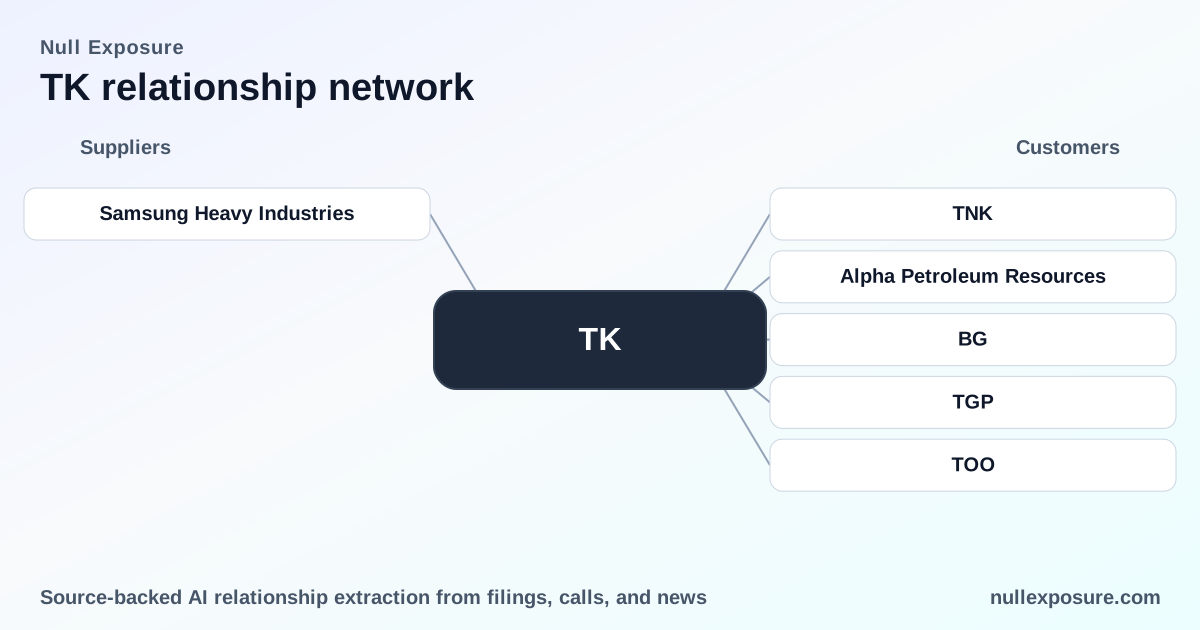
Customer and partner relationships: what the record shows Below I cover every relationship flagged in the available results and the commercial implications for Teekay’s revenue and risk profile.
Teekay Tankers (TNK) — sale of Australian operations (FY2024)
Teekay agreed to sell its Australian operations, including ship management entities that primarily serviced the Government of Australia, to Teekay Tankers for $65 million in cash, shifting those service revenues and government contracts out of the corporate parent. According to Shipping Telegraph (March 10, 2026), the transaction completed as an intra‑group, cash‑sale that reduces corporate operating scope and transfers operational responsibility to TNK. (Shipping Telegraph, 2026)
Teekay Tankers (TNK) — scale of managed tanker fleet (FY2026)
Teekay highlighted the scale of the roughly 56‑vessel tanker fleet it manages and operates, a material operational footprint that underpins fee‑based revenue and charter exposure. Sahm Capital noted this fleet scale in its February 2026 commentary on TNK’s dividend and profitability profile, reinforcing the operational importance of the Tankers entity to sponsor cash generation. (Sahm Capital, Feb 19, 2026)
Alpha Petroleum Resources — terminated FPSO deployment (FY2019)
Teekay Offshore Partners terminated an agreement with Alpha Petroleum Resources to deploy the FPSO Petrojarl Varg for the Cheviot redevelopment in the UK North Sea, returning the FPSO back to market availability. Offshore Magazine reported this development, which removes an expected charter revenue stream tied to that specific field redevelopment and reflects commercial repositioning of an FPSO asset. (Offshore Magazine, 2026)
Teekay Offshore Partners (TOO) — sale of operating interest (FY2011)
Teekay completed the sale of the remaining 49% interest in Teekay Offshore Operating L.P. to Teekay Offshore Partners for $390 million, a divestiture that increased distributions to the offshore partner and crystallized value for the seller. MarineLink recorded this 2011 transaction and the accompanying 5.3% increase in cash distribution from the offshore operator, underlining how asset sales and structuring among legacy affiliates have been a recurring capital‑allocation tool. (MarineLink, FY2011)
Teekay LNG Partners (TGP) — reallocation of Angola LNG carrier interests (FY2011)
Teekay agreed to sell a 33% interest in four Angola LNG carrier newbuildings to Teekay LNG Partners, shifting part of the LNG shipping exposure into the partner entity upon vessel delivery in 2011–2012. MarineLink documented the arrangement, which demonstrates Teekay’s historical use of partner vehicles to finance and distribute shipbuilding and charter risk. (MarineLink, FY2011)
BG Group (BG) — long‑term charter for Petrojarl Knarr (FY2014)
Teekay’s FPSO Petrojarl Knarr departed the yard to commence a 10‑year charter for BG Group, a long‑dated contract expected to provide durable revenue once in service. gCaptain reported the Knarr sailaway and the December 2014 start of the long‑term charter, illustrating Teekay’s reliance on decade‑scale charters to stabilize offshore earnings. (gCaptain, FY2014)
How these relationships read across Teekay’s operating model
- Contracting posture: Teekay’s record shows a mix of long‑term charters (e.g., BG Group, FPSO contracts) and transactional asset transfers to affiliated partners (e.g., TNK sale of Australian ops), indicating a hybrid posture that balances contractually stable cashflows with opportunistic balance‑sheet actions.
- Concentration: Multiple flagged relationships are with affiliated or spin‑off entities (Teekay Tankers, Teekay Offshore Partners, Teekay LNG Partners), signaling meaningful related‑party flows and concentration of commercial activity within the Teekay family of companies.
- Criticality: Long‑term charters and FPSO/LNG deployments are revenue‑critical because they underpin recurring cash; termination or transfer of these contracts (as with Alpha Petroleum Resources and the Australian ops sale) has immediate implications for reported revenues and asset utilization.
- Maturity and vintage of contracts: The relationships span more than a decade (FY2011–FY2026), demonstrating longstanding partner engagement and recurring structuring patterns that investors can model when projecting cashflows from charters, fees, and sale proceeds.
Contractual constraints and disclosure signals No exceptional contractual constraints were reported in the provided relationship records, which is a company‑level signal that no unusual restrictive covenants or third‑party claims were flagged against customer contracts in these sources. Investors should treat that absence as an informational input—useful but not exhaustive—and continue to watch formal filings for any sponsor or affiliate covenants that could alter capital flexibility.
Investment implications and risk checklist
- Positive: Long‑dated charters (e.g., BG Group) and a large managed tanker fleet provide stable fee income and optionality to monetize non‑core regional operations.
- Structural risk: Heavy related‑party activity and intra‑group transfers create counterparty concentration and governance risk, which affect how free cashflow converts to dividends or deleveraging.
- Operational volatility: FPSO redeployments and terminated agreements (Alpha Petroleum Resources) reveal demand sensitivity to field redevelopment outcomes and contract awards.
- Capital returns: The firm’s history of asset sales (e.g., $65m Australian ops sale; $390m sale to TOO in 2011) demonstrates a playbook for generating discrete liquidity events beyond operating cashflow.
Conclusion: read relationships as both anchor and option Teekay’s customer and affiliate relationships function both as anchors of predictable cashflow (long charters, fleet management fees) and as sources of strategic optionality (asset sales, intra‑group reallocation). For investors, the critical questions are governance of related‑party flows, the stability of long charters, and management’s propensity to monetize assets versus return capital. For a concise relationship risk report and ongoing monitoring, see the full coverage at https://nullexposure.com/.
Key takeaways
- Related‑party concentration is material; several key revenue and asset transactions flow through affiliated vehicles.
- Long‑term charters provide durable cash, but contract terminations or redeployments can quickly alter utilization and earnings.
- No extraordinary contractual constraints were flagged in the supplied relationship records, leaving governance and concentration as the primary relationship risks.