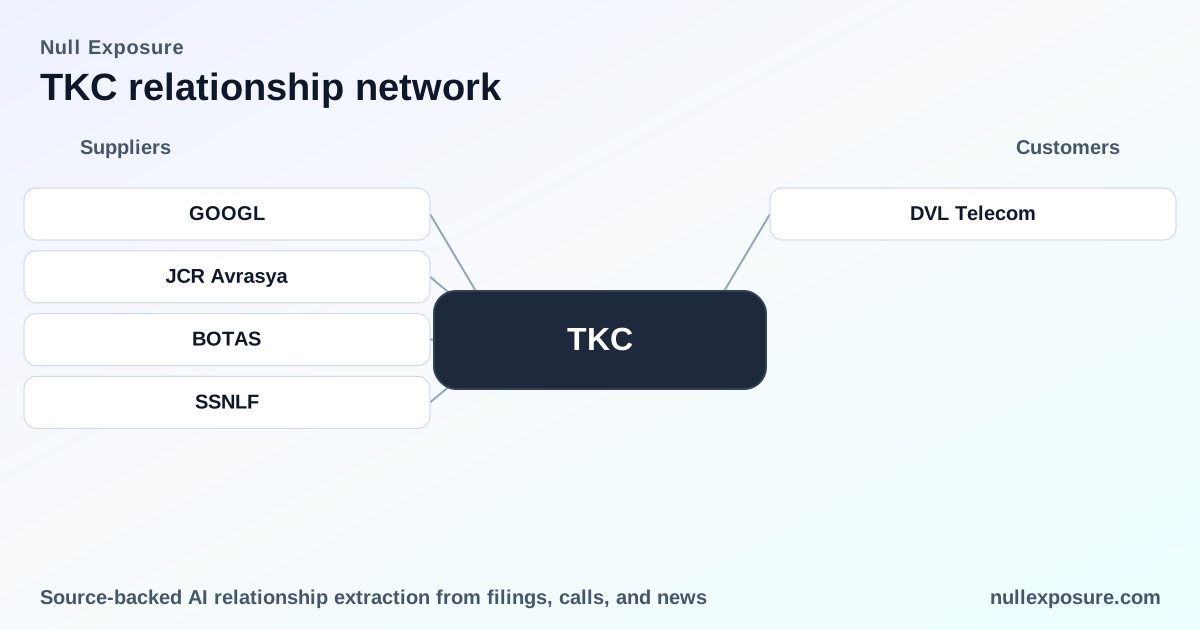
Turkcell (TKC) — Customer relationships that reframe the growth story
Turkcell is a regional telecom and digital-services operator that monetizes through mobile subscriptions, fixed and enterprise connectivity, and an accelerating data-center/cloud services business. Recent corporate actions — a strategic divestiture of Ukrainian assets and a hyperscaler partnership with Google Cloud — reallocate capital and focus management on higher-margin cloud and data-center revenue streams while reducing exposure to lower-margin, geopolitically sensitive markets. Investors should view Turkcell as pivoting from traditional telco cash flows toward platform and infrastructure monetization, funded in part by asset sales. For additional relationship intelligence, visit https://nullexposure.com/.
Sell the non-core to fund the next phase
Turkcell executed a clear capital-allocation move in 2025 by selling its Ukrainian subsidiaries and simultaneously locking in a commercial route to scale data-center revenues through a hyperscaler partner. The cash proceeds improve balance-sheet optionality and fund an aggressive data-center roll-out that management projects will materially contribute to EBITDA starting in 2026. These are deliberate, binary strategic choices — divest to de-risk and redeploy into a faster-growing, higher-ROI segment.
Company-level signals on operating model and business characteristics:
- Contracting posture: Turkcell is transitioning from vertically integrated operator to a hybrid model that combines owned infrastructure, third-party hyperscaler partnerships, and selective asset monetization to finance growth.
- Concentration: The firm is diversifying revenue concentration away from regional mobile subscribers toward enterprise and cloud customers; this reduces single-market concentration risk but increases dependence on a small number of large hyperscaler relationships for cloud demand.
- Criticality: Data-center assets become strategically critical to future EBITDA; infrastructure uptime and hyperscaler SLAs will rise in importance for investors tracking operational risk.
- Maturity: Turkcell’s core telco business is mature and cash-generative; the data-center/cloud initiative is in growth phase with long lead times to full capacity monetization.
DVL Telecom — execution of the Ukrainian exit
Turkcell finalized the sale of its Ukrainian subsidiaries — Lifecell LLC, LLC Global Bilgi, and LLC Ukrtower — to DVL Telecom (part of NJJ Holding) for approximately $5,387 million, completing a strategic divestiture that crystallizes value and reduces geopolitical exposure. The transaction converts operating scale in a higher-risk market into liquidity to support the company’s cloud and data-center push. Source: press release reported by The Globe and Mail, August 4, 2025 (https://www.theglobeandmail.com/investing/markets/stocks/TKC/pressreleases/33916361/turkcell-finalizes-sale-of-ukrainian-subsidiaries-for-5387-million/).
Key takeaway: The sale materially reduces exposure to Ukraine and provides a significant capital buffer to accelerate infrastructure investments.
Google Cloud partnership — hyperscaler demand as a revenue accelerator
Management stated in its FY2026 commentary that Turkcell expects data-center and cloud revenues to increase roughly sixfold in U.S. dollar terms by 2032, underpinned by a new hyperscale-region partnership with Google Cloud that opens large, enterprise-grade demand channels and supports meaningfully higher EBITDA contributions starting in 2026. This is an operational pivot: Turkcell is shifting strategic emphasis from subscriber ARPU expansion to infrastructure monetization at scale. Source: Turkcell earnings highlights reported via TipRanks/markets news and summarized by The Globe and Mail, March 9, 2026 (https://www.theglobeandmail.com/investing/markets/markets-news/Tipranks/617312/turkcell-earnings-call-highlights-growth-data-center-push/).
Key takeaway: The Google Cloud relationship converts Turkcell’s data-center capacity into addressable hyperscaler and enterprise demand, underpinning long-term revenue growth trajectories.
What investors should monitor next
Turkcell’s recent actions create a clear monitoring checklist for both investors and operators assessing customer risk and growth traction:
- Track the deployment and commissioning schedule for new data-center capacity and any public announcements of Google Cloud region launches or SLAs.
- Monitor use of proceeds from the DVL Telecom sale: capex vs. debt paydown vs. dividend/special returns.
- Watch quarterly guidance and EBITDA mix for signs that cloud/data-center revenue is moving from contribution to scale (management projected meaningful EBITDA contributions starting in 2026).
- Follow commercial traction: hyperscaler contracts, enterprise colocation bookings, and colocation utilization trends.
- Maintain attention to geopolitical and regulatory developments in Turkey and any markets where Turkcell retains assets, which can affect operating conditions and profitability.
Valuation and risk context for decision-makers
Turkcell’s public metrics signal a company in transition: trailing P/E around 14.1 and forward P/E near 31.1 reflect the market pricing a near-term earnings step-up and growth uncertainty, while EV/EBITDA of 2.73 and Price/Book near 0.96 suggest an attractively valued asset base relative to its growth narrative. The company’s balance of mature telco cash flow and funded capex for cloud expansion supports an investment case that combines yield and optionality, but execution on hyperscaler integration and data-center commercialization is the critical next stage.
For research teams evaluating counterparties or counterpart risk, the Google Cloud relationship raises counterparty concentration risk in reverse: Turkcell is less dependent on consumer ARPU but more exposed to the commercial success of a small set of large cloud partners. The DVL sale removes one geopolitical exposure but does not eliminate regional regulatory risk inherent to cross-border telecom operations.
See full coverage and relationship mapping at https://nullexposure.com/ to track upcoming catalyst dates, management commentary, and deal close milestones.
Bottom line for operators and investors
Turkcell’s dual actions — monetizing a geopolitically risky asset base and formalizing a hyperscaler partnership — recast the company from regional incumbent to infrastructure growth platform funded by disciplined asset realization. The success of this strategy hinges on execution: speed of data-center monetization, commercial traction with Google Cloud and enterprise customers, and transparent use of sale proceeds. For investors and operators, the next 12–24 months will resolve whether Turkcell’s strategy delivers the projected EBITDA uplift or whether execution risk compresses expected returns.