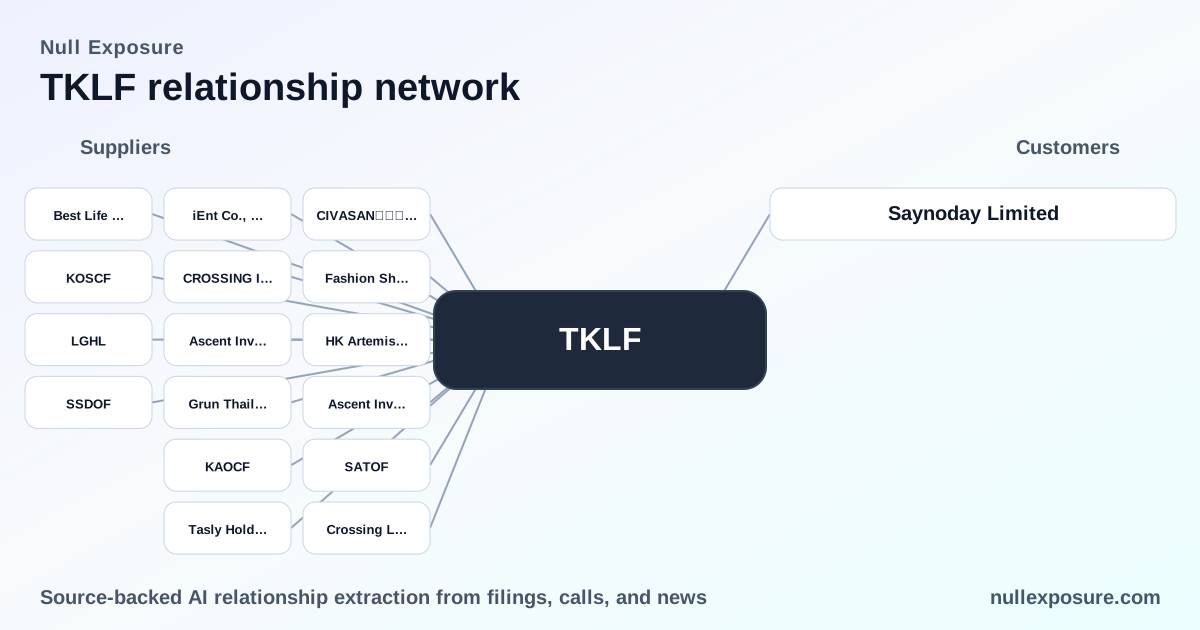
TKLF (Yoshitsu Co., Ltd ADR) — Customer relationships, commercial strategy, and investor takeaways
Yoshitsu Co., Ltd (TKLF) operates as a Japan-headquartered retailer and wholesaler of beauty, health and daily-consumer products, monetizing through direct retail, wholesale distribution, trademark licensing and strategic partner agreements that extend the company’s brands into Hong Kong and broader Asian markets. Revenue is generated from product sales and licensing arrangements, with recent partner agreements structured to drive regional distribution and recurring procurement commitments. For a concise signal feed and ongoing coverage of these commercial relationships, visit https://nullexposure.com/.
How the partner ecosystem maps to Yoshitsu’s commercial model
Yoshitsu’s disclosed customer relationships form a coherent playbook: expand product reach through local partners, lock in procurement volumes via multi-year deals, and monetize brand assets through licensing and platform transfers. The company’s TTM revenue of roughly $302.5 million and thin operating margin (about 0.96%) show a high-topline, low-margin retail profile that depends on scale and distribution efficiencies to convert partner volume into meaningful earnings.
Key commercial characteristics emerging from the relationship set:
- Contracting posture: Yoshitsu executes a mix of one-year outright sales agreements and longer strategic cooperation agreements that include multi-year procurement commitments, licensing rights and deferred payment mechanics. This structure emphasizes recurring channel revenue while introducing payment-collection and credit exposure dynamics.
- Customer concentration and geography: Partners in Hong Kong and adjacent Asian markets are focal points of the company’s growth push; this creates geographic concentration in channel risk that simultaneously concentrates scale where Yoshitsu seeks revenue expansion.
- Criticality and maturity: Agreements range from short-term outright sales to five-year strategic cooperation, indicating a portfolio of both mature, long-term commitments and tactical, annual commercial arrangements.
For a structured signal feed built for investors evaluating customer concentration and contractual terms, see https://nullexposure.com/.
Full list of disclosed customer relationships (one-line takeaways)
Below are every customer-related item surfaced in the results, each presented with a plain-English summary and source citation.
-
HK Artemis Limited — Tokyo Lifestyle (a Yoshitsu subsidiary/brand) agreed to transfer ownership of its mobile App to HK Artemis with payment to be made in installments over three years and an ownership transfer deadline of January 1, 2026; this transaction creates receivables and deferred-payment exposure. (GlobeNewswire, Oct 20, 2025: https://www.globenewswire.com/news-release/2025/10/20/3169289/0/en/tokyo-lifestyle-co-ltd-announces-cooperation-with-hk-artemis-limited-to-enhance-online-sales-in-hong-kong.html)
-
HK Artemis Limited (duplicate report) — The same GlobeNewswire release was captured in a separate instance confirming the App transfer and installment payment structure, reinforcing that the vendor financing element is part of the commercial package. (GlobeNewswire, Oct 20, 2025: https://www.globenewswire.com/news-release/2025/10/20/3169289/0/en/Tokyo-Lifestyle-Co-Ltd-Announces-Cooperation-with-HK-Artemis-Limited-to-Enhance-Online-Sales-in-Hong-Kong.html)
-
Saynoday Limited — Yoshitsu signed a five-year strategic cooperation agreement under which Saynoday commits to procuring a total of HK$500 million (approximately US$64.3 million) of cosmetics and daily necessities over the next two years, following an earlier HK$100 million procurement; this represents a large, contractually-backed channel purchase commitment. (GlobeNewswire, Oct 25, 2024: https://www.globenewswire.com/news-release/2024/10/25/2969420/0/en/Yoshitsu-Co-Ltd-Signs-Five-Year-Strategic-Cooperation-Agreement-with-Saynoday-Limited-to-Expand-Reiwatakiya-Brand-Across-Hong-Kong-and-Key-Asian-Markets.html)
-
Saynoday Limited (secondary coverage) — A parallel report on Yahoo Finance highlights that Yoshitsu deepened trademark licensing and product supply cooperation with Saynoday, granting rights to use the “Reiwatakiya” brand as part of the expanded cooperation. (Yahoo Finance, Mar 10, 2026: https://finance.yahoo.com/news/yoshitsu-co-ltd-signs-five-120000922.html)
-
TASLY (HONG KONG) INTERNATIONAL HOLDING COMPANY LIMITED — Yoshitsu’s Tokyo Lifestyle entered a one-year sale and purchase agreement to sell premium health products, cosmetics and liquors to TASLY Hong Kong beginning March 1, 2026, which formalizes B2B product supply into a sizable regional distributor. (GlobeNewswire, Mar 31, 2026: https://www.globenewswire.com/news-release/2026/03/31/3265391/0/en/Tokyo-Lifestyle-Enters-Health-Product-Cosmetics-and-Liquors-Sale-and-Purchase-Agreement-with-TASLY-HONG-KONG-to-Expand-Presence-in-China.html)
-
TASLY HONG KONG (earlier store announcement) — A prior GlobeNewswire release records a sale-and-purchase agreement in mid-2025 tied to an expansion plan that included opening a new directly operated store in Hong Kong; this shows both wholesale and retail-channel engagement with the same partner universe. (GlobeNewswire, Jun 24, 2025: https://www.globenewswire.com/news-release/2025/06/24/3104172/0/en/Tokyo-Lifestyle-Co-Ltd-to-Open-a-New-Directly-Operated-Store-in-Hong-Kong.html)
-
TASLY HONG KONG (linked financing mention) — Coverage captured a related press release in March 2026 that was distributed alongside other corporate financing items; the disclosure set includes TASLY Hong Kong as a purchaser counterparty in Tokyo Lifestyle’s regional distribution program. (GlobeNewswire, Mar 5, 2026: https://www.globenewswire.com/news-release/2026/03/05/3250075/0/en/tokyo-lifestyle-enters-into-us-1-92-million-subordinated-unsecured-loan-agreement-with-tokushin-g-k.html)
-
SeihinKokusai Co., Ltd — Market reporting indicates SeihinKokusai acquired a 40% stake in Palpito Co., Ltd from Yoshitsu for ¥40 million, a divestiture that reduces a non-core asset holding and converts equity into cash. (Simply Wall St, FY2024 summary captured online: https://simplywall.st/stocks/us/retail/nasdaq-tklf/tokyo-lifestyle)
What these relationships imply for investors and operators
- Revenue diversification through regional partners: The relationship set demonstrates a deliberate push into Hong Kong/Greater China channels using a mix of licensing, wholesale procurement commitments and retail openings; this drives top-line growth but centralizes collection and counterparty risk in that geography.
- Receivables and credit exposure are elevated: Several agreements include installment payments and multi-year procurement commitments, which increase the company’s exposure to partner credit quality and collection cycles.
- Asset-light brand monetization: Licensing rights and an app transfer show Yoshitsu monetizing intangible assets alongside classic product sales; this reduces fixed-cost intensity but increases dependency on partner execution to realize license-related revenue.
- Capital allocation signal: The sale of a 40% stake in a subsidiary for cash indicates management willingness to monetize holdings to fund core expansion or working capital.
Key investor risk indicators to monitor
- Insider ownership of ~63.85% and institutional ownership at ~1.6% signal concentrated control and limited institutional oversight; investors should monitor related-party transactions and governance disclosures.
- Profitability ratios are compressed (profit margin ~1.47%, operating margin ~0.96%), so scalability and margin improvement from channel expansion are critical to convert partner volume into EPS gains.
- Geographic concentration in Hong Kong/Asia amplifies exposure to regional regulatory, tariff and retail-cycle risks.
Bottom line and next steps for due diligence
Yoshitsu’s customer relationships document a clear Asia-first distribution strategy executed via multi-year supply contracts, licensing arrangements and platform transfers that will lift reported revenue but introduce counterparty credit and collection complexity. Investors focused on premium finance and trade exposure should prioritize monitoring contract terms, payment schedules, and partner creditworthiness; operators should treat the partner-driven rollout as a working-capital intensive expansion requiring tight receivables discipline.
For continuing coverage and signals tailored to investor-grade commercial relationships, visit https://nullexposure.com/.