Teknova (TKNO) — Customer relationships and what investors need to know
Alpha Teknova sells high‑quality biological reagents and supplements to life‑sciences organizations, monetizing through direct sales and a smaller distributor channel across two product categories—Lab Essentials and Clinical Solutions—with most revenue recognized at shipment and short payment terms. The business generates recurring cash flow from a concentrated base of customers: one distributor alone accounted for 18% of revenue in both 2023 and 2024, underscoring both a durable channel partnership and a material single‑counterparty exposure that investors must price into valuation and risk models. For further background on Teknova’s customer relationships and commercial posture visit https://nullexposure.com/.
How Teknova actually sells and gets paid
Teknova’s commercial model is straightforward: it manufactures reagents from Hollister, California, and sells primarily through purchase orders that result in immediate shipment recognition of revenue. The 2024 Form 10‑K states that sales are made directly to end customers or through distributors and are generally recorded when products ship from Teknova’s warehouse. Payment terms are short — typically under 90 days and never exceeding one year — and the company explicitly reports that its contracts do not contain a significant financing component.
This operating posture creates a revenue base that is:
- Transaction‑oriented and order driven (spot purchase orders, shipment recognition).
- Short duration in receivables, compressing working capital timelines.
- Dependent on repeat purchasing rather than long‑dated supply contracts, which makes retention and customer service central profitability levers.
The single material customer every investor should know
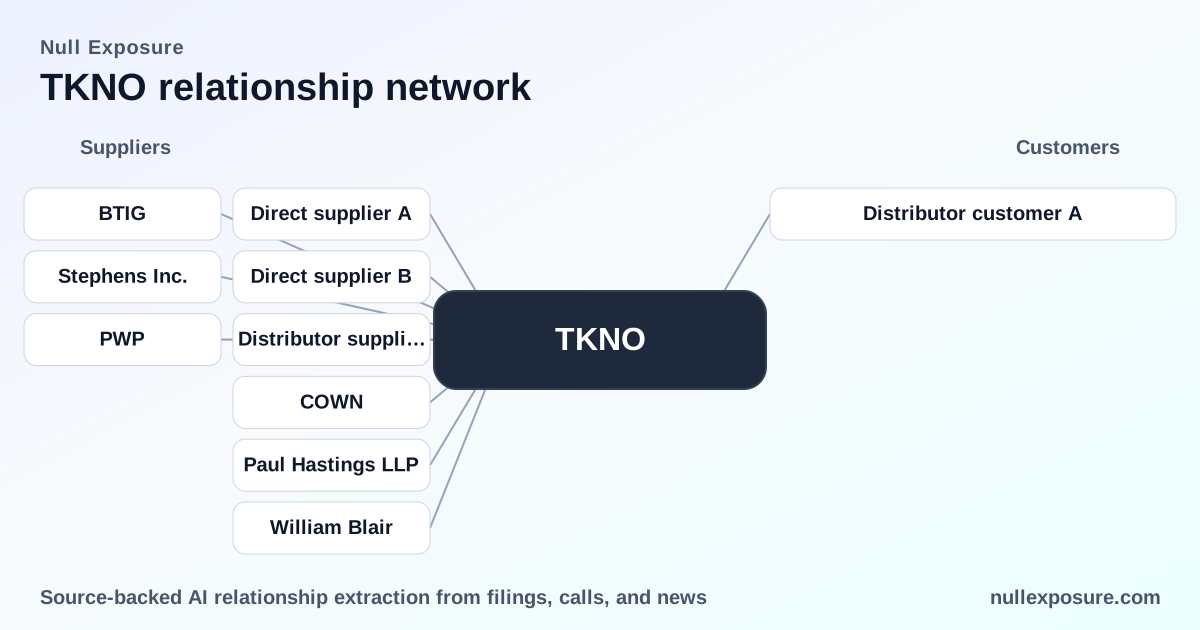
- Distributor customer A accounted for 18% of Teknova’s revenue in 2024 and also 18% in 2023, making this relationship materially significant for the company’s top line and accounts receivable presentation; this concentration is disclosed in Teknova’s Form 10‑K for the year ended December 31, 2024.
According to Teknova’s 2024 Form 10‑K, Distributor customer A is presented among customers that accounted for 10% or more of revenues and outstanding receivables for the year ended December 31, 2024.
Takeaway: Distributor customer A is not an incidental reseller; it is a meaningful revenue anchor that reduces growth concentration risk on one hand (stable volume) and raises single‑counterparty risk on the other (pricing leverage, collection, and contract renewal dependency).
Customer mix, geography and counterparty profile — what the filing signals
Teknova serves roughly 3,000 customers spanning pharmaceuticals, biotechnology, contract manufacturers, in vitro diagnostics, academic and government research institutions. The company reports that:
- U.S. customers dominate revenue, with only 4.8% of 2024 revenue generated outside the U.S., making the business effectively a North American play.
- Counterparties include large enterprises, government and non‑profit research institutions, which diversify buyer types across the life sciences ecosystem while concentrating geography.
These are company‑level signals from the 2024 Form 10‑K and shape how investors think about commercial durability: the presence of large enterprise and government buyers supports stable demand for high‑quality reagents, but the near‑term revenue is tightly tied to U.S. market dynamics.
Contracting posture, retention and implications for predictability
Teknova reports a ~95% annual retention rate for customers spending more than $10,000 per year; that cohort represented ~15% of customers but ~90% of annual revenue in 2024. The filing also explains that Teknova ships products pursuant to purchase orders and recognizes revenue at shipment.
From an investor and operator perspective:
- High retention among mid‑to‑large buyers drives recurring revenue and reduces churn risk in the most valuable segment.
- The spot, purchase‑order nature of most sales introduces more short‑term visibility risk into top‑line forecasting than multi‑year supply agreements would.
- Short payment terms support tighter working capital but leave Teknova exposed to any distributor credit stress or abrupt order cancellations.
Financial context that frames customer risk
Teknova’s TTM revenue is reported at $40.52M, with gross profit of $13.44M and negative EBITDA of $10.13M. The stock has a market capitalization of roughly $192M. These figures show a business with solid unit economics at gross margin level but current operating losses that require continued revenue scale or margin improvement to justify higher valuation multiples.
Operators should focus on:
- Converting high retention into incremental wallet share within existing large buyers.
- Mitigating concentration by diversifying distributors and expanding international reach beyond the current ~95% U.S. revenue footprint.
Operational and investor risks to watch
- Customer concentration risk: One distributor at 18% of revenue is material and represents a single point of failure for a meaningful chunk of sales. This exposure should be a core factor in scenario modeling.
- Channel dependency: A smaller distributor channel implies both upside (scale distribution) and downside (distributor negotiation power).
- Spot sales cadence: Purchase‑order sales make quarter‑to‑quarter results more volatile versus long‑term contracts.
- Profitability trajectory: Negative EBITDA requires either sustained top‑line acceleration or operating leverage to convert gross margin into net profitability.
All of these points are supported by Teknova’s public disclosures in the 2024 Form 10‑K and the company’s reported financials for the trailing twelve months.
What investors and operators should do next
- For investors: stress‑test valuation scenarios with and without the Distributor customer A concentration, and monitor quarterly order trends from large buyers to detect early signs of churn.
- For operators: prioritize distributor diversification and push deeper account penetration in the top 15% of customers that currently produce ~90% of revenue.
For a concise investor brief and ongoing monitoring tools that track customer concentration and counterparty signals for companies like Teknova, visit https://nullexposure.com/.
Bottom line: Teknova’s business model is order‑driven, US‑centric, and retention‑anchored, with material exposure to a single distributor that both stabilizes revenue today and concentrates risk tomorrow. Investors should value the company with careful attention to customer concentration and the company’s ability to convert gross margin into sustainable operating profitability, while operators should focus on balancing distributor scale with diversification.