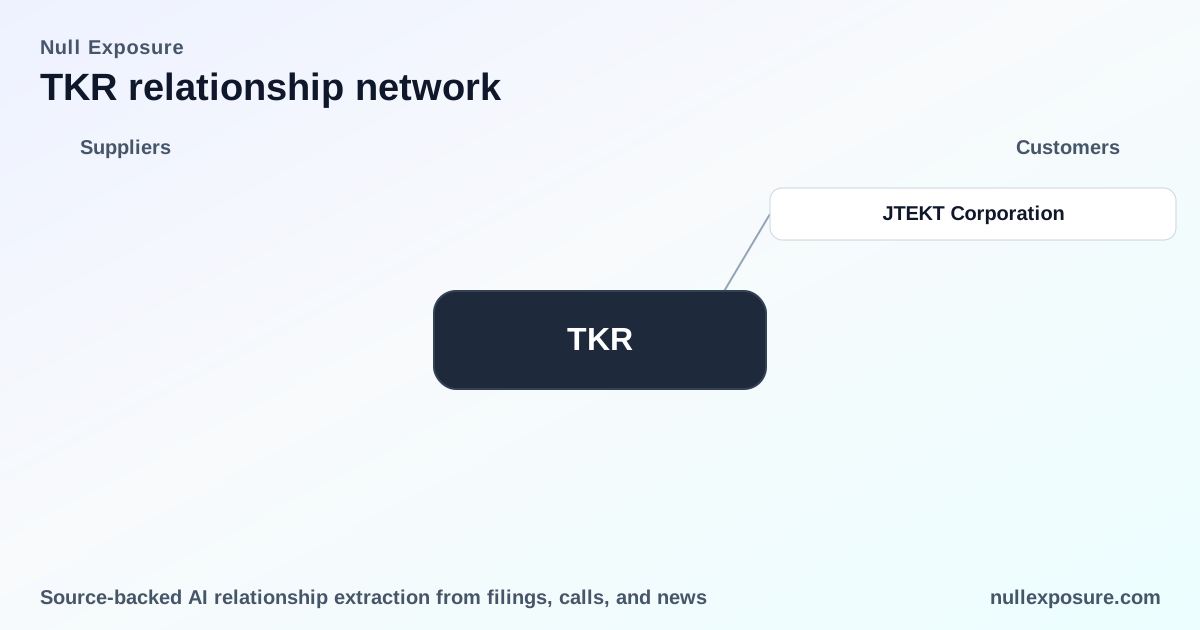
Timken (TKR): Customer relationships shaped by portfolio pruning and global OEM exposure
The Timken Company designs, manufactures and sells engineered bearings and power transmission products and generates revenue through product sales to OEMs, distributors and end users, plus services such as repair and drivetrain maintenance. Timken monetizes a global installed-base via aftermarket services while actively reshaping its product portfolio through strategic divestitures to concentrate on higher‑margin industrial markets. For primary reporting and relationship signals on Timken, see https://nullexposure.com/.
Recent headline transaction activity that changes customer counterparty maps
Timken’s customer landscape for premium motion products is being altered not by large new contracts but by asset sales that transfer customer relationships and manufacturing assets to competitors. The most visible change in May 2026 is the sale of Timken’s belts business to Gates Industrial, while a separate divestiture of the needle‑roller bearings unit to JTEKT was reported earlier in 2026. These transactions reallocate product‑level customer exposures away from Timken and shrink its addressable portfolio in commodity belt and certain bearing niches.
If you want a consolidated view of buyers and counterparties Timken is handing business to, NullExposure maintains a running hub at https://nullexposure.com/.
Gates Industrial Corporation plc (GTES) — buyer for Timken’s belts business
Timken has entered a definitive agreement to sell the assets of its belts business to Gates Industrial Corporation plc, transferring select manufacturing assets and customer channels for power‑transmission belts to Gates. The transaction was announced publicly in early May 2026 and positioned as a portfolio optimization move to focus Timken on higher‑margin industrial markets (PR Newswire; CityBiz; CantonRep, May 2026).
Source: PR Newswire announcement and multiple industry reports, May 2026.
JTEKT Corporation — purchaser of Timken’s needle‑roller bearings business
Timken signed an agreement to sell its Needle Roller Bearings business to JTEKT Corporation, shifting another discrete product line and its related customers out of Timken’s direct servicing and manufacturing footprint. This sale was reported in March 2026 and represents a continuation of Timken’s strategy to rationalize lower-margin or non‑core product lines (TruckingInfo, March 2026).
Source: TruckingInfo report, March 2026.
What the relationship moves imply about Timken’s operating model
These buyer transactions are not isolated; they underline a deliberate operating posture and several company‑level constraints that shape customer risk and revenue quality:
- Contracting posture: Timken holds a mix of short‑cycle sales and longer‑term negotiated contracts, particularly with defense and government contractors — the company reported approximately $153 million of remaining performance obligations on contracts longer than one year as of December 31, 2024. That indicates a stable base of multi‑year revenue for specific product lines and customers.
- Counterparty composition: The U.S. government and its contractors account for roughly 7% of sales, representing a material but not dominant government revenue stream that brings steady, long‑duration work and associated compliance burdens.
- Geographic footprint: Sales are truly global — North America, EMEA and Asia‑Pacific are all material revenue regions, with Europe / Middle East / Africa and Asia‑Pacific each contributing meaningfully to net sales. This geography profile provides diversification but also exposes Timken to region‑specific cycles and trade/anti‑dumping dynamics.
- Customer concentration: No single customer exceeds 6% of total net sales, a corporate control that reduces client concentration risk and improves negotiating leverage relative to critical single‑buyer exposures.
- Channel mix and criticality: The company sells both directly to OEMs (55% of 2024 sales) and through distributors/end users (45%), meaning product availability and service quality across distributor networks remains strategically important.
- Portfolio maturity: Timken is a manufacturer and service provider, operating both production facilities and an aftermarket maintenance business; this creates recurring revenue opportunities from repairs and field services while also requiring capital and operational investment in factories and supply chains.
- Backlog and activity: The firm reports an active backlog with ~92% scheduled for delivery within 12 months, signaling predominantly near‑term demand and modestly low structural backlog risk.
Together these signals show a company transitioning from breadth to depth — shrinking commodity lines while preserving engineered-bearing and industrial‑motion positions that offer higher margins and recurring aftermarket service revenue.
What investors should watch next
Timken’s divestitures alter revenue composition and competitive dynamics. Focus on these near‑term indicators to assess the impact:
- Track reported proceeds and use of proceeds from the Gates and JTEKT transactions and whether proceeds fund reinvestment into higher‑margin segments or balance‑sheet repair.
- Monitor OEM vs. distribution gross margin trends as Timken shifts its product mix and potentially scales aftermarket services.
- Watch government and contractor order flow given the multi‑year performance obligations; any regulatory or defense spending shifts will flow directly into that ~7% bucket.
- Observe regional sales performance—order book and growth in EMEA and APAC are critical as Timken concentrates core engineering product lines there.
Key risk tradeoffs: portfolio pruning improves margin focus but cedes customer relationships and channel access to acquirers (Gates, JTEKT), which could accelerate competitor aftermarket capture in those product families. Distributor and OEM channel relationships remain essential for Timken’s go‑forward growth.
Final assessment: focused industrial franchise with lower customer concentration
Timken is executing a credible repositioning toward engineered bearings and industrial motion, supported by a global sales footprint, balanced OEM/distributor channels, and a modest base of long‑term government contracts. The company’s customer concentration profile is conservative — no single customer >6% — while divestitures will reduce product‑line complexity at the cost of transferring some customer relationships to competitors. For analysts, the immediate questions are how the divestitures affect near‑term revenue and margin mix, and whether proceeds accelerate investment in services and higher‑value bearing platforms.
For an ongoing, investor‑grade view of Timken’s customer and counterparty flows, visit our hub at https://nullexposure.com/ for curated relationship intelligence and transaction tracking.