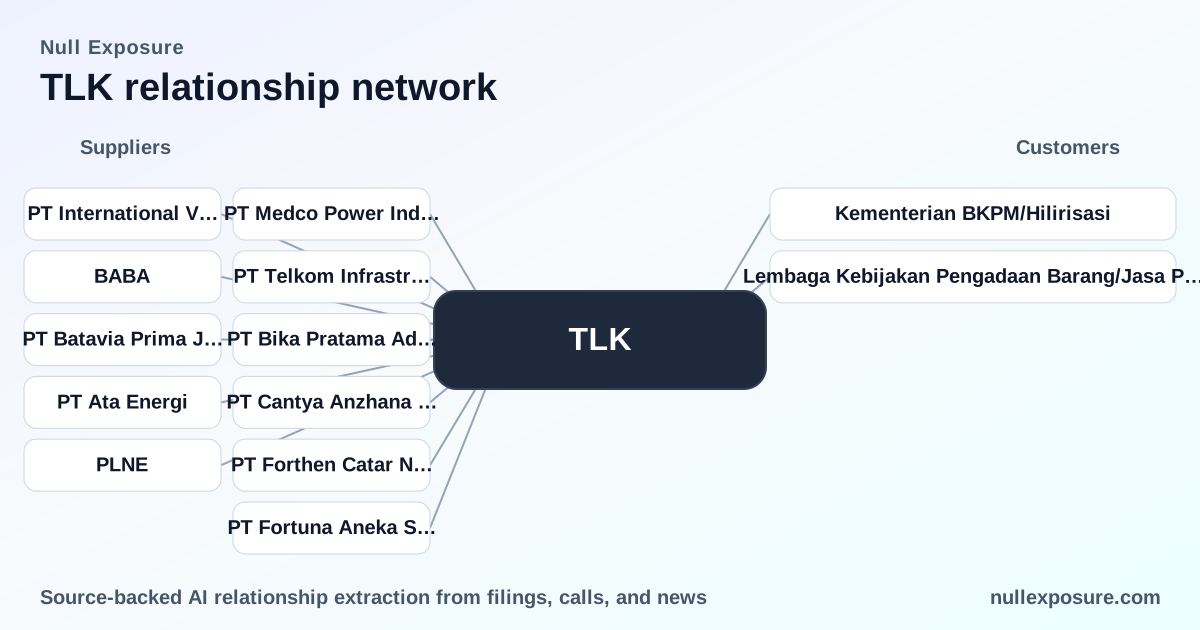
TLK Customer Relationships: Strategic divestments and government platform wins reshape Telkom’s commercial footprint
Telkom Indonesia monetizes a national monopoly-grade asset base through core connectivity services, enterprise and government contracts, and an expanding suite of B2B digital products; revenue is dominated by recurring telecom services while strategic disposals and platform initiatives reallocate capital and sales focus toward higher-margin digital offerings. Investors should view customer relationships as both revenue drivers and strategic levers: large government platform placements drive recurring scale, while selective divestments crystallize value and simplify the operating model. For more structured visibility into counterparty relationships and concentration, see https://nullexposure.com/.
How Telkom’s customer posture defines its commercial model
Telkom operates like a classic incumbent telecom with a growing posture as a systems integrator and platform provider for enterprise and public-sector customers. The company’s scale—reflected in trailing revenue of roughly IDR 147 trillion and a healthy profit margin—supports long-term, contract-backed cash flows, while digital initiatives create higher-margin upsell opportunities. Key operating characteristics that frame customer risk and opportunity are:
- Contracting posture: Telkom pursues multi-year, high-touch agreements with government agencies and large enterprises, positioning itself as an integrator rather than a series vendor relationships.
- Concentration and criticality: Government platforms and national systems are strategic customers that create concentrated revenue pockets but also raise political and operational dependencies.
- Maturity and evolution: The core telecom business is mature and cash-generative; growth and valuation upside increasingly depend on scaling digital services, platform deals, and selective portfolio rationalization.
These are company-level signals derived from Telkom’s commercial behaviour and the recent relationship activity summarized below.
What the observed relationships tell investors
Below are the relationships extracted from recent reporting. Each entry is concise, with source attribution for verification.
Fullerton Health — buyer of AdMedika (TelkomMetra divestment)
TelkomMetra (a Telkom subsidiary) signed a Conditional Share Purchase Agreement to divest PT Administrasi Medika (AdMedika) and its subsidiary TelkoMedika to the Fullerton Health group, marking a strategic step toward exiting noncore healthcare administration assets. According to Telkom’s press release (FY2026), the CSPA was executed on 4 March 2026; Korean press coverage also reported the transaction timeline and buyer details (Korea Herald, FY2026).
Sources: Telkom press release (telkom.co.id, FY2026); Korea Herald report (2026-05).
Kementerian BKPM / Hilirisasi — sovereign AI placement on OSS
Telkom is embedding its sovereign AI initiative into government platforms, specifically citing integration with the Online Single Submission (OSS) system operated by the Ministry for Investment/BKPM as part of a B2B/government push to institutionalize AI capabilities. The move signals Telkom’s pursuit of platform-level engagements with government ministries that carry scale and recurring service economics (SWA, March 2026).
Source: SWA coverage of Telkom’s sovereign AI initiative (swa.co.id, 2026-03-10).
LKPP — sovereign AI to be integrated with E-Katalog procurement platform
Telkom’s sovereign AI initiative will also be attached to the LKPP’s E-Katalog procurement platform, positioning the company as a supplier of AI-enabled services to Indonesia’s centralized procurement ecosystem and potentially unlocking catalog-based sales to public buyers. This placement underscores Telkom’s strategy to convert platform integrations into broad government sales opportunities (SWA, March 2026).
Source: SWA coverage of Telkom’s sovereign AI initiative (swa.co.id, 2026-03-10).
Constraints and how they shape the business model
No explicit constraint excerpts were provided in the materials; however, the relationship signals and company profile imply a set of operating constraints that affect monetization and execution:
- High-touch contracting and long sales cycles: The government platform engagements imply multi-stakeholder procurement dynamics and protracted implementation timelines, which increases execution risk but also raises switching costs and revenue visibility once contracts are live.
- Concentration and political exposure: Integration into OSS and E‑Katalog links Telkom’s revenue growth to public-sector budgets and policy choices, which raises concentration risk but also cements Telkom as a strategic national provider.
- Asset-light digital expansion vs. legacy capital intensity: The firm retains a capital-heavy connectivity franchise while investing in asset-light software and AI products; the dual model requires disciplined capital allocation and may accelerate portfolio pruning (as evidenced by the AdMedika divestment).
- Maturity of the core business: With sizable trailing revenue and solid margins, the core telecom operation funds digital initiatives but limits rapid topline expansion without meaningful migration into higher-margin enterprise and platform sales.
These company-level signals are central to assessing counterparty exposure, expected revenue stickiness, and the risk profile of new product-led government contracts.
Strategic implications for investors and operators
- Divestments sharpen focus: The sale of AdMedika to Fullerton Health is a clean example of Telkom monetizing a tangential business to redeploy capital into core digital and platform ambitions—this improves capital efficiency and reduces noncore complexity.
- Government platform wins can be durable: Placements into OSS and E‑Katalog are not ad hoc deals; they signal platform-level relationships that can generate recurring revenue and ecosystem lock-in, but they also increase political and procurement concentration.
- Execution risk is implementation risk: Success depends on Telkom’s ability to operationalize AI services across government systems—winning the contract is the start; scaling to meaningful revenue contribution requires successful rollouts and ongoing support.
- Valuation levers: Investors should value Telkom’s stock not only on steady connectivity cash flows but increasingly on the optionality and scale of platform deals and the company’s ability to convert government integrations into broader enterprise monetization.
For a consolidated view of counterparty exposure and to track how these relationships evolve into revenue, visit the NullExposure homepage for ongoing updates: https://nullexposure.com/.
Bottom line: strategic repositioning with concentrated upside and execution risk
Telkom is executing a clear strategic pivot: monetize noncore assets, embed proprietary AI into national platforms, and convert incumbent network scale into higher-margin B2B and government platform revenue. That dual strategy reduces operational clutter and creates meaningful upside if Telkom successfully operationalizes government platform contracts at scale. Investors should balance the promise of platform-driven growth against concentration and delivery risk—both are elevated but transparent from the current relationship flow.