Talphera (TLPH): customer relationships that define commercial optionality and concentration risk
Talphera is a small-cap specialty biotech that builds value by licensing, supplying and servicing peptide-based therapeutics while relying on partner channels to reach clinical and commercial end users. The company monetizes through a mix of licensing / securities transactions, manufacturing and supply arrangements, and services fees tied to partner sales (notably for DSUVIA sales to the Department of Defense). Institutional investors should evaluate Talphera as a partner-dependent operator with measurable revenue optionality but meaningful counterparty concentration and low current commercial scale.
For a concise view of Talphera’s coverage and relationship analytics, see Null Exposure’s research portal: https://nullexposure.com/
How Talphera sells its products — the operating model in plain English
Talphera does not operate primarily as a classic field sales pharmaceutical. Instead its commercial model is partner-led:
- The company expects pre-filled syringe and other specialty presentations to be sold through hospital contracting networks, wholesalers and group purchasing organizations rather than a large internal sales force, per the company’s disclosures.
- A meaningful portion of current revenue is service fees tied to partner sales—the company explicitly records revenue for services on DSUVIA sales to the DoD that are executed by a partner.
- Manufacturing posture is hybrid: the company supplies bulk or semi-finished product and relies on contract partners to produce finished dosage forms under specified arrangements.
These patterns create a set of constraints investors must treat as structural: concentration on a small number of commercial partners and on government channels (DoD), limited direct customer relationships, and supplier/partner dependency for finishing and distribution. The FY2025 commercial footprint is still small in absolute dollar terms (Talphera reported $28,000 of revenue for the most recent 12 months), which amplifies the impact of partner-level operational issues on company-level performance.
Signals from the company’s own constraints (what the filings reveal)
The firm’s regulatory and earnings disclosures make several company-level characteristics explicit:
- Government counterparty: Talphera continues to market DSUVIA to the Department of Defense, signaling dependence on federal contracting dynamics and procurement cycles.
- Buyer behavior: Hospitals are described as the ultimate purchasers of ready-to-use, pre-filled products, indicating reliance on institutional purchasing decisions at the hospital level.
- Distribution model: Talphera expects finished pre-filled syringe products to be sold through contracting with hospital networks, wholesalers and GPOs rather than via a large internal sales force—this reduces fixed commercial cost but raises partner concentration risk.
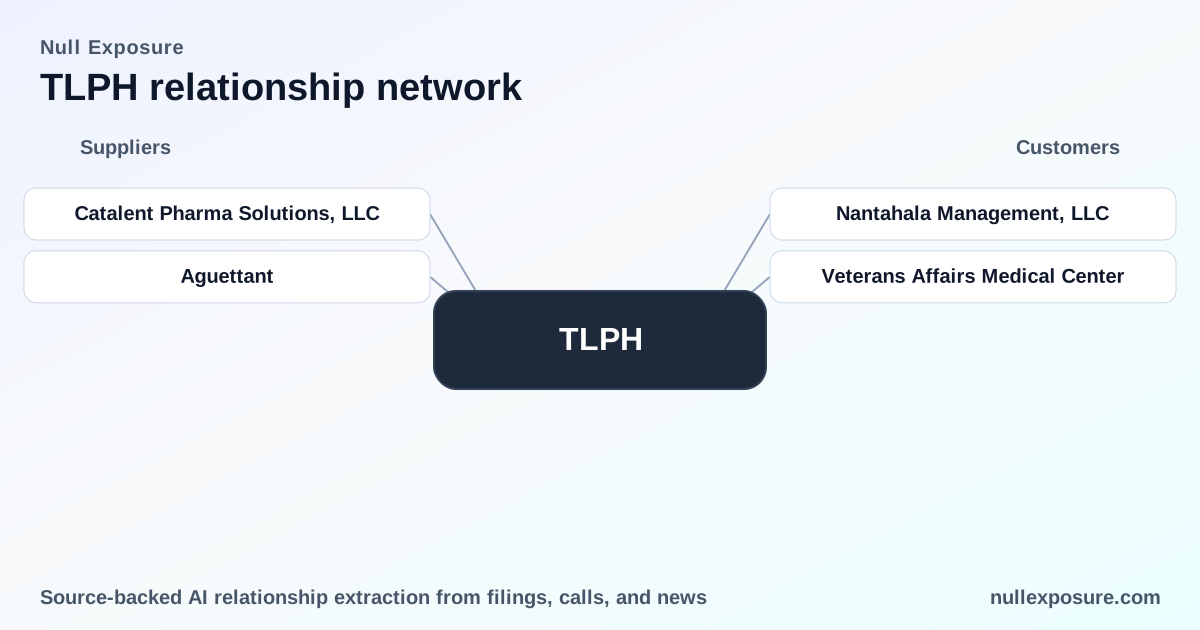
- Manufacturing and supply relationships: The company has contractual arrangements where it supplies bulk or semi-finished product to partners (Aguettant is named in the filing), and partners assume responsibility for finished product packaging and commercialization in certain stages.
- Service-revenue linkage: Talphera records service fees for sales of DSUVIA executed by a partner named Alora, making a portion of revenue directly dependent on that partner’s go-to-market activity.
Collectively, those constraints point to a light-touch commercial organization that is highly dependent on a small set of external counterparties and on government channels—a profile that compresses upside absent material partner-led scale events.
Relationship-by-relationship: the counterparties investors should track
Nantahala Management, LLC
Talphera executed a securities purchase agreement with entities affiliated with Nantahala Management dated January 17, 2024, indicating capital or strategic financing activity between the parties. This is documented in Talphera’s FY2024 10‑K filing, which includes the form of that securities purchase agreement. (Source: FY2024 10‑K)
Veterans Affairs Medical Center
On the Q3 2025 earnings call management flagged the Veterans Affairs Medical Center as a clinical site that experienced personnel reductions earlier in the year, a factor that materially influenced site performance and enrollment/operational cadence. The comment suggests government hospital sites can introduce execution variability for Talphera’s clinical and contracted activities. (Source: Q3 2025 earnings call)
Alora Pharmaceuticals
Alora acquired a relevant product from the legacy AcelRx business and is the named partner through which Talphera records service fees tied to DSUVIA sales to the DoD; the company’s filings state that all revenue relates to services fees earned on DSUVIA sales to the DoD by Alora, establishing a direct commercial linkage. Separately, FiercePharma reported on the corporate reorganization that included Alora’s earlier acquisition activity. (Sources: FY2024 company disclosures; FiercePharma reporting)
XOMA
Talphera reported $28,000 of revenue for the year that management recognized as non-cash revenue under an agreement with XOMA, and the company posted a net loss for the fiscal year consistent with early-stage commercial and R&D investment. That treatment indicates the company records certain partner transactions as non-cash consideration under licensing or collaboration terms. (Source: TradingView summary reporting Talphera’s 2025 10‑K / FY2025 disclosures)
For a deeper dataset and relationship timelines, visit Null Exposure’s coverage: https://nullexposure.com/
What this means for investors — risks and upside drivers
Key takeaways for investment due diligence:
- Revenue scale is negligible today. Talphera reported $28k revenue TTM and deep operating losses, so any valuation hinge rests on pipeline outcomes, partner commercialization, or material licensing/capital transactions.
- Dependence on partners is structural. The business model intentionally outsources finishing, distribution and, in at least one case, the front-line commercialization to partners (Alora, Aguettant referenced in filings). That reduces fixed cost but creates execution risk concentrated in a few counterparties.
- Government channels add both demand and complexity. Marketing to the DoD provides a potentially large account, but federal purchasing cycles, procurement rules and site-level staffing (e.g., VA personnel changes) create variability and timing risk.
- Non-cash commercial consideration is being used. Recognition of non-cash revenue under arrangements such as the XOMA agreement requires investors to separate cash generation from accounting revenue when modeling near-term liquidity and runway.
Practical checklist for monitoring the story:
- Track Alora’s DSUVIA sales to DoD and the cadence of service-fee recognition in quarterly filings.
- Watch manufacturing handoffs and any escalation of Aguettant’s role in finished-product production.
- Monitor clinical site stability at government hospitals (VA and DoD-affiliated centers).
- Reconcile cash receipts vs. non-cash revenue from partner agreements when assessing runway.
Bottom line
Talphera’s commercial model is partner-centric, government-exposed and still immaterial in dollar terms. The company’s near-term value is a function of partner execution (Alora, contract packaging partners) and upstream R&D progress. For investors and operators, the primary risks are counterparty concentration and the timing uncertainty associated with government procurement and partner manufacturing transitions. For an at-a-glance relationship map and ongoing updates, see Null Exposure’s profile hub: https://nullexposure.com/
Bold, targeted monitoring of partner performance and a clear separation of cash vs. accounting revenue are the most important lenses through which to view Talphera’s next 12–24 months.