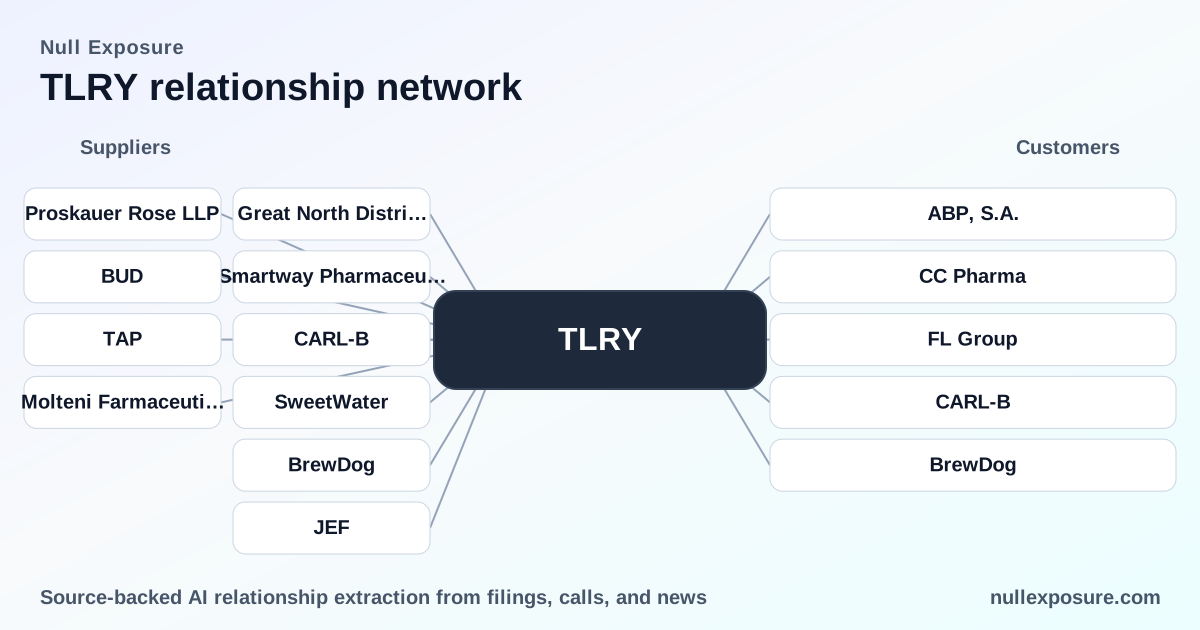
Tilray (TLRY) customer map: how distribution, licensing and retail deals drive revenue
Tilray monetizes through a diversified set of consumer-facing businesses: cultivation and manufacture of medical and adult‑use cannabis, branded alcoholic beverages and hemp food products, plus advisory and co‑manufacturing services. Revenue flows from wholesale sales into three‑tier distribution channels in the U.S., direct‑to‑patient and government supply agreements in Canada and medical markets, and branded licensing/acquisition deals that extend Tilray’s shelf presence and margins across new channels. Tilray reported approximately $858 million in trailing‑twelve‑month revenue and a global footprint spanning North America, EMEA and Latin America, which shapes how its customer relationships translate into cash flow.
Learn more about how we map corporate customer exposure and partner risk at https://nullexposure.com/.
What the relationship map shows in plain English
Tilray’s public filings and contemporaneous press coverage make clear that the company combines wholly‑owned local distributors with commercial licensing and retail exclusives to move product to market. Below are the specific relationships disclosed in the record, followed by concise takeaways and source references.
CC Pharma — German importer and distributor
Tilray uses CC Pharma, a wholly‑owned subsidiary, as its importer and distribution arm for pharmaceuticals in Germany and is leveraging that network for medical cannabis distribution. Source: Tilray FY2025 10‑K (filed May 31, 2025).
FL Group — Italian distribution platform
In Italy, FL Group (a wholly‑owned subsidiary) manages distribution of Tilray’s medical cannabis across the country, giving Tilray direct access to regulated medical channels in Italy. Source: Tilray FY2025 10‑K (filed May 31, 2025).
ABP, S.A. — Argentina medical distributor under national law
Tilray owns ABP, S.A., which distributes medical cannabis in Argentina under the country’s Compassionate Use legislation, anchoring Tilray’s Latin American patient market access. Source: Tilray FY2025 10‑K (filed May 31, 2025).
Carlsberg / CARL‑B — U.S. licensing and production deal
Press reports in March 2026 confirm a multi‑year U.S. licensing agreement with Carlsberg, giving Tilray Brands the right to brew, market and distribute certain Carlsberg beer brands (including Carlsberg and 1664) in the United States beginning in 2027. This is a strategic brand licensing move that converts Tilray’s beverage infrastructure into an expanded CPG play. Sources: Just‑Drinks and Ad‑Hoc‑News coverage (March 2026).
BrewDog — targeted acquisition of brand and U.K. operations
Tilray completed an acquisition of selected BrewDog global platform assets — including the BrewDog brand IP, U.K. brewing operations and 11 strategic brewpubs — for £33 million, strengthening Tilray’s international beer footprint and direct retail outlets. Source: BevIndustry report (March 2026).
Sprouts Farmers Market — grocery exclusive for Manitoba Harvest products
Tilray’s Manitoba Harvest (a wholly‑owned arm) launched new Superfood Smoothie Boosters exclusively at Sprouts Farmers Market nationwide, representing a grocery‑channel distribution execution for its hemp‑food portfolio. Multiple press releases in April–May 2026 document the exclusive roll‑out. Sources: GlobeNewswire (Apr 28, 2026) and InvestingNews/other reports (Apr–May 2026).
HEXO — debt and strategic cooperation deal
Earlier cooperation between Hexo and Tilray included Tilray acquiring Hexo’s debt in exchange for an option on equity and a framework for shared services, indicating Tilray’s use of balance sheet and operational scale to consolidate market positions within the Canadian cannabis sector. Source: MJBizDaily (coverage referencing FY2022 deal; reporting in 2026).
Operating constraints and what they signal about Tilray’s business model
Tilray’s customer map generates clear company‑level signals about how the business contracts, concentrates risk and matures:
- Government counterparty exposure is material and structural. Tilray discloses significant revenue from supply contracts with Canadian provinces and territories for adult‑use cannabis, which provides recurring demand but links revenue to public procurement cycles and regulatory shifts.
- Direct‑to‑patient channel exists alongside wholesale. Tilray Medical operates a direct online patient distribution model in Canada, giving it first‑party customer data and higher margin potential on medical products versus pure wholesale.
- Global geography is core to revenue scaling. The firm reports sales across North America, EMEA, Australia and Latin America; the company’s operating model therefore requires multi‑jurisdictional compliance, local distribution partners and country‑specific go‑to‑market subsidiaries.
- Distribution is a primary commercial role. Tilray operates as manufacturer and reseller: it manufactures cannabis and beverages, then sells into independent distributors (three‑tier model in the U.S.) and retail chains, creating mixed margin profiles across channels.
- Services and advisory revenue exist but are small. Advisory and co‑manufacturing revenues are disclosed at a modest level relative to product sales, suggesting services are strategic adjuncts rather than core revenue drivers today.
These constraints imply a contracting posture that blends long‑term government supply agreements with flexible commercial deals (retail exclusives and licensing) — a hybrid that reduces some top‑line volatility but raises exposure to regulatory and retail execution risk.
Investment implications: upside drivers and principal risks
- Upside: Licensing deals (Carlsberg) and targeted acquisitions (BrewDog) convert production capability into higher‑margin beverage and hospitality revenue streams and expand branding leverage in U.S. retail and international markets. Grocery exclusives (Sprouts) accelerate CPG penetration for Manitoba Harvest products and provide predictable retail velocity.
- Risk: Heavy reliance on provincial government contracts and multi‑jurisdictional compliance creates policy sensitivity; distribution concentration and dependence on third‑party wholesalers in the U.S. expose Tilray to execution risk at the retail level. The HEXO arrangement signals an active M&A posture that can be accretive but also raises integration execution risk.
- Capital and margin profile: With trailing‑twelve‑month revenue near $858M and a complex mix of product and licensing margins, Tilray’s path to consistent profitability rests on scaling beverage licensing income and tightening distribution economics in key markets.
For a structured view of Tilray’s partner exposures and how they translate into revenue concentration and counterparty risk, visit https://nullexposure.com/.
Bold, diversified customer relationships — from provincial government supply to Carlsberg licensing and grocery exclusives — are Tilray’s leverages for growth; the trade‑off is regulatory complexity and distribution execution risk that investors must price into any valuation or operational due diligence.