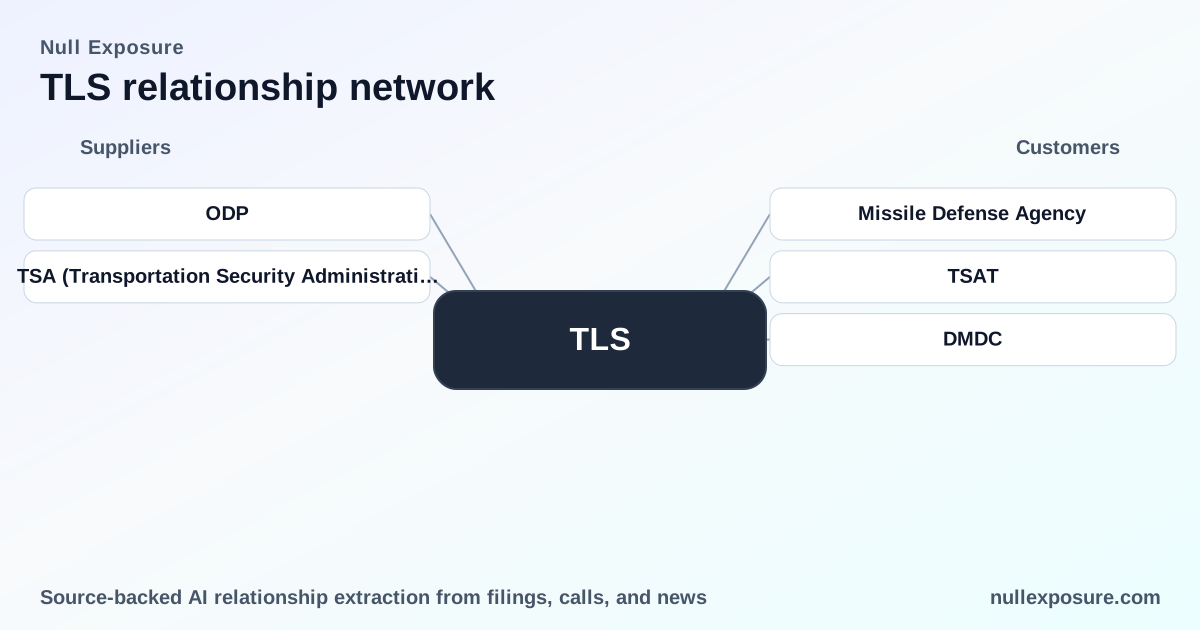
Telos Corporation (TLS): Customer Relationships and Commercial Footprint
Telos runs a government-focused cybersecurity and secure-communications business that monetizes through a mix of long-term services contracts, software licensing (notably Xacta®), and value-added enrollment services such as TSA PreCheck. Revenue is concentrated in U.S. federal work and recurring services, supported by IDIQ and multi‑year contract structures that create high customer stickiness and predictable backlog. For investors evaluating TLS’s customer relationships, the following breakdown catalogs every relationship mentioned in public reporting and press during the 2025–2026 cycle and interprets what those ties mean for revenue stability and growth potential. Learn more at https://nullexposure.com/.
Business model at a glance
- Telos sells services and software primarily to U.S. government agencies and large enterprises, with services comprising the bulk of revenues and software including identity and GRC products.
- The company pursues prime and subcontractor roles on framework/IDIQ vehicles and multi-year contracts, which concentrates revenue but increases contract durability and collection certainty.
- Geographic concentration is domestic, and a small number of large contracts drive a material portion of future revenue.
Key customer relationships (each entry corresponds to a discrete public mention)
University of Central Florida — Globenewswire (Apr 15, 2026)
Telos launched an on‑campus TSA PreCheck enrollment site at UCF’s student services hub, The SPOT, expanding its campus-based channel for consumer enrollment services. According to a Globenewswire press release on April 15, 2026, the UCF site is part of Telos’s broader network of enrollment locations.
Office Depot — Yahoo Finance (May 2026)
Telos operates TSA PreCheck enrollment across a national retail footprint that includes 500 Office Depot stores, providing a large retail channel for enrollment and renewals. A Yahoo Finance coverage of Telos’s TSA PreCheck expansion notes the program’s scale through Office Depot/OfficeMax outlets.
Missile Defense Agency — Globenewswire (Dec 19, 2025)
Telos disclosed award participation on the Missile Defense Agency’s SHIELD IDIQ contract, described with an overall ceiling figure; this positions Telos to compete for homeland-defense task orders under a large government framework. The company referenced this award in a December 19, 2025 press release announcing contract scope and ceiling.
Elko Regional Airport — Yahoo Finance (May 2026)
Telos opened a TSA PreCheck enrollment center at Elko Regional Airport, extending the enrollment network into regional airports and airport‑adjacent traffic. A Yahoo Finance article reporting the TSA PreCheck expansion quoted airport officials on the partnership.
University of Central Florida — Globenewswire French release (Apr 15, 2026)
The French-language Globenewswire posting reiterates the same UCF campus launch, confirming the company issued multi‑market press on the enrollment site. The duplicate press release validates Telos’s communication cadence for the UCF initiative.
OfficeMax — Yahoo Finance (May 2026)
Telos’s enrollment footprint explicitly includes OfficeMax locations alongside Office Depot, reinforcing the company’s retail distribution strategy for TSA PreCheck services. Yahoo Finance’s piece lists both banners as part of the 500-location network.
University of Central Florida — SimplyWall (2026 summary)
Independent investor commentary highlighted UCF as part of Telos’s network of over 500 enrollment locations, underscoring the company’s strategy to add convenient consumer touchpoints that complement federal and enterprise revenue streams. A SimplyWall.St summary captured the UCF expansion as a key development in 2026.
Office Depot — Globenewswire French release (Apr 15, 2026)
A French-language Globenewswire version again references Office Depot/OfficeMax as enrollment outlets, further confirming the company’s explicit retail partnerships for PreCheck services. This mirrors the English press release distributed the same period.
TSA PreCheck — Globenewswire (Mar 2, 2026)
Telos lists TSA PreCheck enrollment services as a named business line alongside its cyber, identity, and secure communications offerings, signaling an ongoing commercial product that drives recurring transaction revenue and consumer-facing scale. The March 2, 2026 Globenewswire financial-results notice cites PreCheck as a core capability.
Elko Regional Airport/EKO — InsiderMonkey (Apr 2026)
Investor commentary noted the Elko / EKO site opening on April 22, 2026, as part of Telos’s ongoing rollout of enrollment centers, reiterating the company’s push into smaller markets and airport locations. An InsiderMonkey write‑up referenced this specific site opening.
TSAT — InsiderMonkey transcript (Q3 2025 earnings discussion)
In earnings-call coverage, management discussed continuing evaluation of the enrollment location network and working with the TSA to ensure attractive offerings for customers; the transcript was captured by InsiderMonkey and indexed under the label TSAT in that report. The transcript reflects Telos’s commercial planning and channel optimization for enrollment services.
TSA — InsiderMonkey transcript (Q3 2025 earnings discussion)
During the same earnings discussion, Telos described ongoing coordination with the Transportation Security Administration to expand and refine enrollment coverage, indicating a direct operational relationship with the federal agency that governs the PreCheck program. InsiderMonkey’s Q3 2025 earnings coverage recorded these remarks.
DMDC — InsiderMonkey transcript (Q3 2025 earnings discussion)
Management referenced DMDC funding and program allocations as part of contract discussions, noting quantifications (e.g., $50–$75 million) in the context of programmatic funding for identity-related initiatives; this was reported in the Q3 2025 earnings transcript coverage. The DMDC mention underscores Telos’s exposure to specific government program funding flows.
OfficeMax — Globenewswire French release (Apr 15, 2026)
A second French‑language release reiterates OfficeMax inclusion in Telos’s retail network, corroborating other press coverage that places OfficeMax alongside Office Depot as strategic distribution partners for enrollment services.
What the relationship map tells investors
- Government-first revenue mix, material concentration. Telos generates most revenue from U.S. federal agencies; this produces predictable receivables and creditworthiness but concentrates downside on federal spending cycles and appropriation changes.
- Framework/IDIQ posture and long-term contracting. Management emphasizes prime and subcontract positions on IDIQ and multi‑year programs, which explains why a small number of contracts are material and why revenue visibility skews toward services and recurring task orders.
- Services-led monetization with software leverage. The company’s reported split shows services as the dominant revenue stream with software and products as strategic, higher-margin enablers (for example, GRC and identity platforms).
- Domestic geographic concentration and operational maturity. Most revenues come from U.S. customers, reflecting a mature federal contractor profile rather than an international services push.
- Retail consumer channel as diversification. The TSA PreCheck enrollment network—anchored by Office Depot/OfficeMax and expanded into campuses and airports—provides a complementary, transactional revenue stream and customer‑facing brand presence that reduces pure federal-contract concentration risk.
Risk and upside highlights
- Risk: High revenue concentration in federal programs increases sensitivity to budget shifts and to a small number of large contracts. Telos’s reliance on IDIQ and multi‑year vehicles concentrates counterparties and execution risk.
- Upside: Continued expansion of the TSA PreCheck footprint into retail, campuses, and regional airports demonstrates a scalable consumer channel and cross‑sell potential into identity and biometrics services.
If you want a concise mapping of Telos’s customer exposure and contract posture for due diligence or model inputs, visit https://nullexposure.com/ for tailored relationship intelligence and in‑depth signal analysis.
Key takeaway: Telos combines a structurally sticky federal-services base with a growing consumer enrollment network; investors should value the stability of long‑term IDIQ exposure while monitoring appropriation risk and the monetization path for its software products.