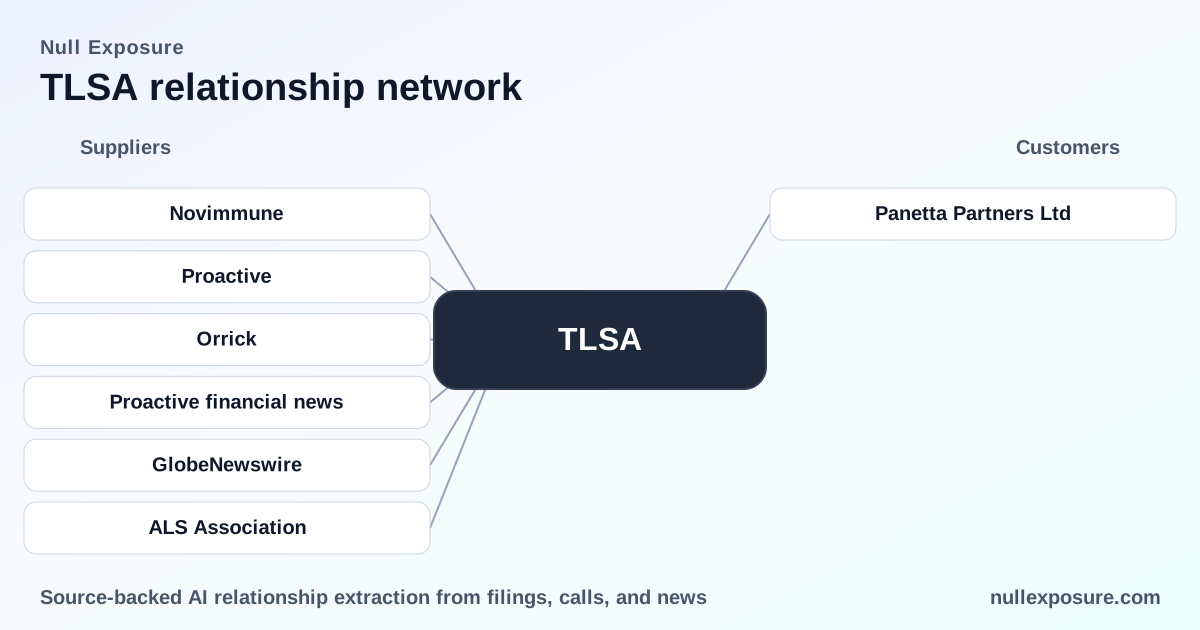
Tiziana Life Sciences (TLSA): Licensing-led commercial pathway, equity-dependent funding
Tiziana Life Sciences operates as a clinical-stage biotechnology company that discovers and advances therapeutic molecules in oncology and immunology and monetizes primarily through licensing and collaboration agreements that yield upfront payments, milestone payments and royalties, supplemented by equity financings to fund ongoing development. This profile positions Tiziana as a partner-centric, development-driven biotech where near-term value realization depends on partner execution and milestone triggers rather than product sales.
If you want a concise ledger of counterparties and commercial linkages for TLSA, jump to the relationships section below or visit https://nullexposure.com/ for broader coverage.
How Tiziana turns science into cash: the licensing-first commercial model
Tiziana’s operating model is textbook for a clinical-stage biotech: it focuses internal resources on early discovery and proof-of-concept development while transferring the high-cost phases of late-stage development and commercialization to partner organizations under license agreements. Under that arrangement Tiziana captures value through structured payments—upfront fees at signing, development and regulatory milestones tied to partner progress, and downstream royalties on sales—rather than relying on product revenues today.
Financial signals confirm the stage and posture of the business: the company is reporting operating losses and negative revenue in recent TTM figures, reflecting a pre-commercial cost structure and dependence on external capital. Market capitalization and balance-sheet dynamics indicate a small public float, significant insider ownership and low institutional penetration, factors that influence liquidity, governance and the company’s ability to raise capital on favorable terms.
Counterparties recorded in the customer feed
This section lists every customer or partner relationship surfaced in the provided results and summarizes the commercial facts.
-
Tiziana — license of Foralumab to Precision Biosciences (listed in the feed under DTIL). According to an RTTNews report on March 9, 2026, Tiziana executed a license agreement that assigns Precision responsibility for development and commercialization of Foralumab, with Tiziana to receive an upfront payment, specified milestone payments and royalties on future sales. Source: RTTNews, March 9, 2026.
-
Panetta Partners Ltd — related-party share purchase in a registered direct offering. MarketScreener reported on March 10, 2026 that Executive Chairman Gabriele Cerrone acquired 1,600,000 ordinary shares in a registered direct offering through Panetta Partners Ltd, an entity in which he has a beneficial interest, increasing his total holdings to 44,974,830 ordinary shares. Source: MarketScreener, March 10, 2026.
What each relationship means for cash flow and governance
The Precision/Foralumab license is a revenue-enabler: it shifts late-stage cash burn and execution risk off Tiziana’s balance sheet while substituting milestone-based and royalty-based upside. That structure accelerates potential non-dilutive receipts if development and commercial milestones are achieved. The Panetta Partners transaction is a capital-market reality check: insider participation in a registered direct offering signals that primary capital raises remain a core funding mechanism for operations and that management is active in maintaining control via concentrated insider stakes.
Operating model characteristics and company-level signals
No customer-side contractual constraints were flagged in the relationships feed, so the following are company-level assessments drawn from the overall profile and observed partner activity:
- Contracting posture: Out-licensed, partner-led commercialization is the dominant posture; Tiziana trades direct commercialization for milestone and royalty economics.
- Concentration: High insider ownership (approx. 44%) and low institutional ownership (<4%) create concentrated equity control and limited institutional liquidity. These patterns affect governance dynamics and the market’s price discovery.
- Criticality: Current revenue generation is non-recurring and contingent—payments are milestone-dependent rather than sustained product sales—so the company’s near-term cash profile is highly event-driven.
- Maturity: Tiziana is a clinical-stage, pre-commercial biotech, with operating losses and negative TTM revenue reflecting an R&D-heavy cost base and reliance on external capital raises to fund operations.
Key investment risks and value drivers
- Value drivers: milestone receipts from licensing agreements (e.g., the Foralumab deal), successful clinical readouts, and well-timed, disciplined fundraising that limits dilution.
- Risks: partner execution risk (if licensees fail to progress programs, milestone flow stops), concentrated insider ownership which can reduce market float and price discovery, and the routine need to access capital markets for working capital.
Actionable monitoring items:
- Track milestone announcements and payment schedules tied to the Foralumab license.
- Watch insider buying/selling activity and future registered offerings that could dilute holders.
- Monitor any changes in institutional ownership or new strategic partnerships that broaden commercialization capacity.
For a broader look across counterparties and to monitor evolving relationship intelligence, visit https://nullexposure.com/.
Tactical outlook for investors and operators
Tiziana’s model is attractive for investors who value binary, milestone-driven upside and are comfortable with event-driven returns and equity financing cadence. Operators evaluating TLSA as a partner should view the company as a licensor that brings early-stage assets and is prepared to transfer late-stage cost and execution responsibility to sublicensees. Governance dynamics—driven by concentrated insider holdings—need scrutiny in strategic negotiations, and counterparties should price in the likelihood that Tiziana will use capital markets to fund near-term development.
Bottom line
Tiziana Life Sciences is a license-and-fund biotech: it leverages partner execution to monetize research through upfronts, milestones and royalties while relying on equity raises for operational financing. The Precision/Foralumab license and the Panetta Partners-directed share purchase are two discrete signals of that model in action—one commercial, one capital-market—and together they define the company’s path to value realization and its principal near-term risks.