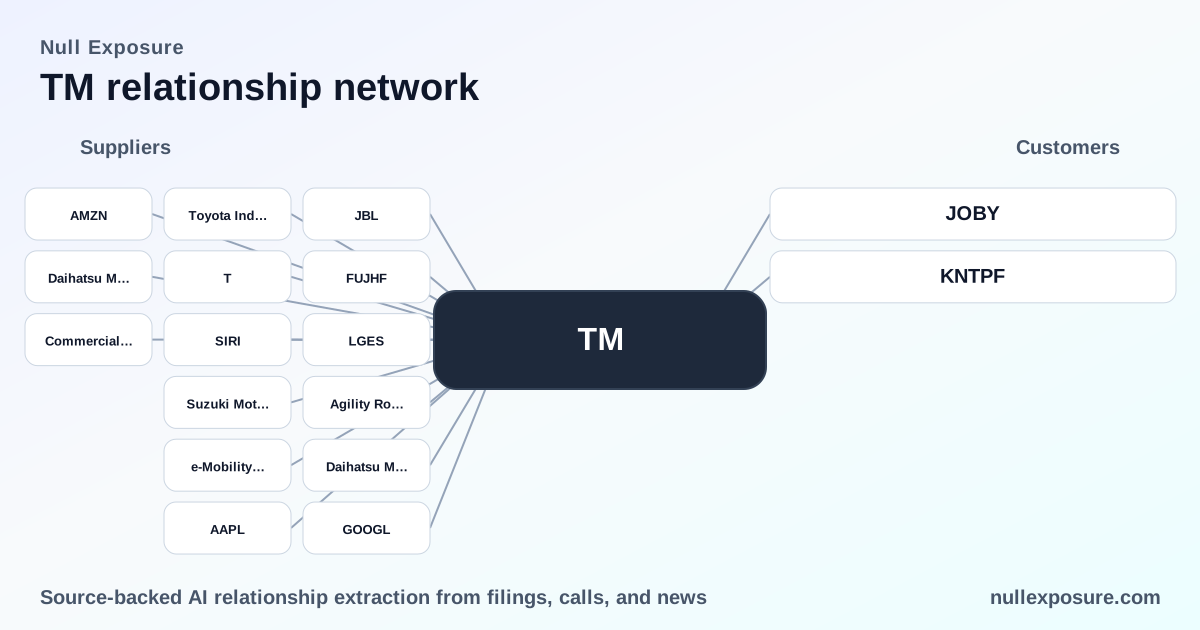
Toyota (TM) — the customer map that explains where revenue and strategic optionality come from
Thesis: Toyota monetizes a global mobility platform through vehicle sales, parts and service, captive finance, and strategic industrial partnerships that convert engineering into recurring cash flows; its revenue mix is anchored by dealer networks and Toyota Financial Services while strategic alliances (autonomous, fuel-cell, new air mobility) expand high-margin technology and manufacturing revenue streams. Investors should read Toyota not only as an automaker but as a systems integrator that sells hardware, software-enabled services, and licensed powertrain technology.
If you want a structured feed of Toyota’s partner relationships and disclosures, review our coverage at https://nullexposure.com/.
How Toyota’s operating model shapes cash flow and risk
Toyota’s commercial posture combines long-term strategic contracting with high-volume transactional distribution. Dealership and captive-finance channels drive stable unit-level margins and working-capital cash conversion, while alliances with technology partners create optionality and concentrated operational exposure.
- Contracting posture: a mix of long-term strategic OEM partnerships (powertrain licensing, equity stakes) and transactional dealer relationships.
- Concentration: overall customer concentration is low by unit volume, but specific strategic partners (autonomy, air taxis, fuel-cell OEMs) represent concentrated revenue opportunity and execution risk.
- Criticality: dealers, Toyota Financial Services, and key component partners are critical to retail throughput and captive-finance yield.
- Maturity: core ICE/hybrid manufacturing is mature and cash generating; mobility and autonomy ventures are early-to-growth stage and influence medium-term margin expansion.
The relationships that matter — one-by-one investor briefings
Below is a concise, source-cited summary for every customer/partner referenced in the results.
Polar Power (POLA)
Polar Power integrates Toyota 1KS propane/natural-gas engines into off-grid DC generators and reported purchase orders and inventory relationships that included Toyota engines during FY2025. Source: Polar Power press release and related coverage, Nov 2025 (GlobeNewswire / FinViz / Yahoo Finance).
Isuzu Motors Limited
Isuzu announced a joint development program that will incorporate Toyota’s third-generation fuel cell system into next‑generation trucks, signaling Toyota’s fuel-cell IP commercialization outside the Toyota group. Source: IndexBox analysis on Isuzu–Toyota fuel-cell collaboration, FY2026.
Joby Aviation (JOBY)
Toyota signed a long-term agreement to supply powertrain and actuation components and support production, with targets reported for low-rate aircraft production (Toyota-manufactured components and assembly). Source: Joby Aviation press release on Japan air-taxi flight and MarketBeat reporting, FY2026.
Pony.ai (PONY)
Toyota is a shareholder and manufacturing partner for Pony.ai’s bZ4X-based robotaxi program in China, with mass production and commercial rollout underway alongside a joint venture with GAC Toyota. Source: South China Morning Post / Automotive News reporting on Pony.ai–Toyota robotaxi production, FY2026.
Root (ROOT)
Root leverages real-time telematics from Toyota and Lexus vehicles to price and issue insurance products instantly, illustrating Toyota’s role as a data and telematics feed for embedded insurance offerings. Source: ad-hoc-news coverage of Root’s collaboration with Toyota/Lexus, FY2026.
Toyota Mobility Tokyo Inc. (Toyota Mobility Tokyo)
Toyota will sell the US-made Tundra and Highlander in Japan through the Toyota Mobility Tokyo network beginning in April, reflecting internal retail channel deployment for globally sourced models. Source: Toyota global newsroom and industry press, FY2026.
Penske Automotive Group (PAG)
Penske acquired multiple Toyota and Lexus dealerships and invested in state‑of‑the‑art service facilities configured for next‑generation Toyota/Lexus hybrid and fuel‑cell powertrains, reinforcing the brand’s premium retail footprint. Source: Penske Q4 2025 commentary and sector reporting, FY2026.
Group 1 Automotive (GPI)
Group 1’s recent acquisitions included three Toyota and one Lexus dealership in the UK, demonstrating continued third-party dealer consolidation around Toyota franchises. Source: Group 1 earnings call transcript summarizing acquisition activity, FY2026.
AutoNation (AN)
AutoNation’s core new-vehicle brands list cites Toyota (including Lexus) among the leading brands representing a large share of volume for its retail operations, underscoring Toyota’s distribution scale in the U.S. retail channel. Source: AutoNation referenced in company filings / TradingView coverage, FY2025.
Stephen Cadillac GMC (dealership)
Toyota Motor Credit Corporation filed suit alleging an audit found 16 vehicles (over $1.4m) unaccounted for at Stephen Cadillac GMC, highlighting counterparty and trust-risk in dealer financing. Source: Carscoops coverage of Toyota Credit lawsuit, FY2026.
Asbury Automotive Group (ABG)
Dealership buy-sell activity included Asbury’s sale of a Toyota store, reflecting ongoing portfolio optimization among public dealer groups with Toyota franchises. Source: Automotive News dealership buy-sell database updates, FY2026.
Stellantis (STLA)
Stellantis will use a two‑motor hybrid transmission developed by Toyota’s Blue Nexus division in the Jeep Cherokee, which is evidence of Toyota’s powertrain licensing and cross‑OEM monetization of hybrid technology. Source: Intellectia.ai reporting on Stellantis using Toyota Blue Nexus tech, FY2026.
Toyota Financial Services reference (TBBB / SEC filing)
An SEC filing referenced Toyota Financial Services transportation equipment terms, underlining the captive finance arrangements and securitization activity that support dealer and retail penetration. Source: SEC Edgar filing, FY2026.
MillerKnoll (MLKN)
MillerKnoll’s commentary that it has successfully worked with Toyota for three decades points to long-term supplier–OEM operational relationships Toyota sustains in manufacturing and design. Source: InsiderMonkey earnings call transcript referencing MillerKnoll–Toyota collaboration, FY2026.
KINTO (KNTPF)
The bZ4X Touring will be available through KINTO car-subscription services starting in April, indicating Toyota’s direct-to-consumer subscription channel use for new EV products. Source: Toyota global newsroom and ACN Newswire on KINTO availability, FY2026.
What these relationships collectively signal for investors
- Diversified commercialization model: Toyota captures value across direct retail, captive finance, subscription (KINTO), and licensing (powertrains/fuel cells) — a balanced set of cash engines.
- Strategic platform monetization: Partnerships with Pony.ai, Joby and Isuzu demonstrate Toyota’s strategy to monetize vehicle platforms and powertrain IP beyond core vehicle sales.
- Dealer and finance tail risk: The Toyota Credit lawsuit versus Stephen Cadillac GMC is a tangible example of operational risk in dealer financing and inventory controls that can impact receivables and reputation.
- Execution concentration: High‑value growth vectors (autonomy, air taxis, fuel cell commercialization) are concentrated bets whose success will materially affect Toyota’s margin trajectory.
No relationship-level constraints were recorded in the dataset provided — this is a company-level signal indicating the feed did not flag contractual constraints for the listed relationships.
If you want an investor-ready roster of Toyota’s partner exposures and up-to-the-minute signals, explore our platform at https://nullexposure.com/.
Bottom line
Toyota’s customer and partner footprint combines stable retail and finance cash flows with targeted, high-leverage partnerships that extend its powertrain and manufacturing franchise into autonomy, air mobility and cross‑OEM licensing. Investors should value Toyota as a diversified industrial platform: low single-customer concentration at scale, but with concentrated execution risk in strategic technology alliances and dealer finance operations.