TMC The Metals Company: who buys the nodules and how that shapes value
TMC The Metals Company extracts polymetallic nodules from the Clarion‑Clipperton Zone and monetizes through onshore processing and metal sales to industrial partners under structured commercial arrangements. The business model is built on securing long‑dated offtakes and strategic processing partners that convert nodules into marketable nickel, copper, cobalt and rare earth streams; near‑term value realization depends on partner integration, processing tests and the timing of commercial production. For a concise corporate relationship map and ongoing monitoring, visit https://nullexposure.com/.
Executive snapshot: how revenue will flow and where the leverage sits
TMC’s core monetization pathway is straightforward: recover nodules offshore, process onshore (or through partners), then sell refined products under commercial contracts. Key value drivers are the existence of life‑of‑area offtake commitments, the credit and processing capacity of partners, and the company’s ability to scale production without incurring prohibitive environmental or capital cost overruns. Negative earnings today reflect development status rather than commercial revenue; counterparties and processing alliances will determine when those losses convert into cash flows.
The customer relationships on TMC’s public record
BC — a material buyer in 2025
BC recorded purchases from TMC of $99.6 million in 2025, up from $79.6 million in 2024 and $80.2 million in 2023, indicating a material commercial relationship already reflected in TMC’s filings. This level of purchases signals a meaningful onshore demand channel for TMC’s product slate. According to TMC’s FY2025 10‑K filing, BC’s purchases are explicitly quantified in the company’s reported purchasing history.
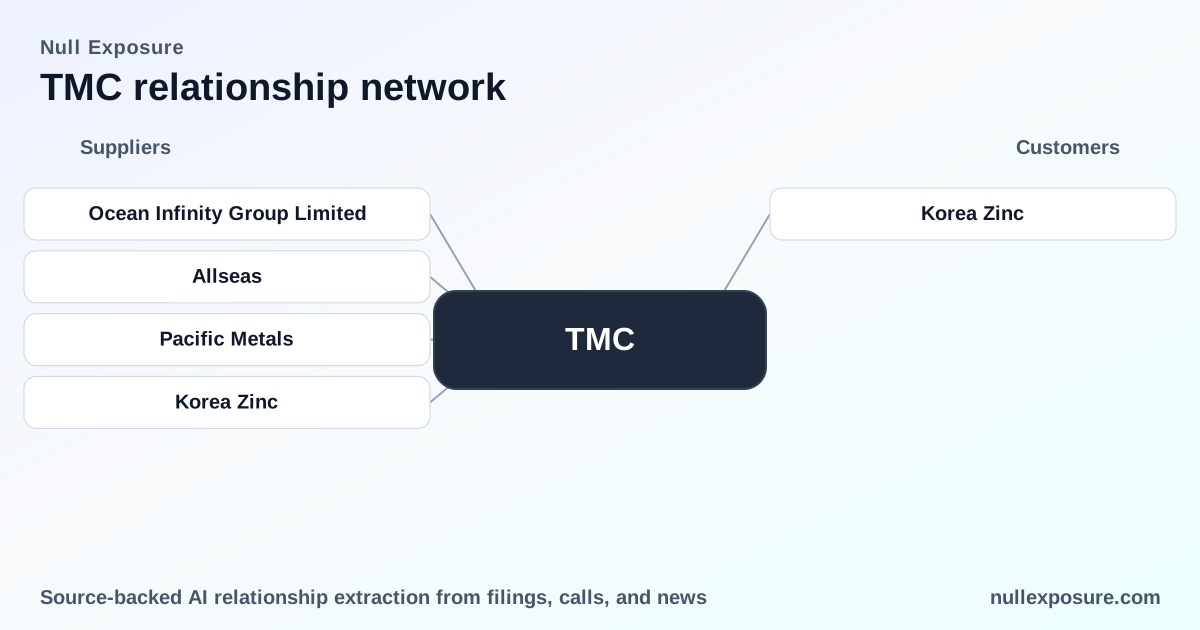
Korea Zinc — strategic investor and processor partner
Korea Zinc agreed in June to invest roughly $85 million in TMC and to test onshore processing routes for nodules, positioning itself as a potential downstream processor and refinement partner. A December 2025 news report on ts2.tech recorded the investment and the technical collaboration to evaluate processing pathways that could underpin future offtake and refining arrangements.
What the company‑level constraints reveal about how TMC contracts and manages counterparties
TMC’s disclosed contract language and excerpts from filings provide clear signals about its commercial posture and counterparty dynamics:
- Long‑term contracting posture: TMC describes copper and nickel offtake agreements that run “for the life of the Company’s rights to the NORI Area.” This structure converts production into predictable long‑dated revenue under anchoring commercial commitments once production commences, supporting project bankability and investor valuation models.
- Seller role and concentrated off‑take allocation: TMC and its subsidiary have historically contracted to deliver 50% of certain nickel and copper production to a single counterparty (Glencore) under life‑of‑area agreements, demonstrating both anchor demand and counterparty concentration at the product level.
- Contract maturity and termination mechanics: Life‑of‑area agreements carry maturity tied to mining rights rather than fixed years, and include standard protections allowing termination for material breach or insolvency — this creates stability in revenue duration but leaves exposure to counterparty credit events.
- Company‑level implication: These constraints collectively show a business that intends to monetize through long‑dated offtakes with a small set of large industrial partners, which supports predictability but concentrates counterparty risk and operational dependency on processing partners.
How the documented relationships change the investment equation
TMC is a development‑stage extractive play whose valuation depends on the conversion of contractual promise into deliverable cash flows. The current relationships illuminate both upside and hazards:
- Upside: Partnerships like Korea Zinc’s investment and testing program are positive signs for onshore processing integration, reducing technical execution risk and improving margin prospects if scale efficiencies are realized.
- Concentration risk: The presence of life‑of‑area offtakes and a large allocation to a single global metals trader (Glencore, per filings) highlights reliance on a few counterparties, which compresses pricing optionality and creates counterparty credit exposure.
- Execution dependency: Revenue realization requires successful commissioning of submarine collection, safe nodule handling, onshore processing trials, and regulatory acceptance; partner commitments help de‑risk each step but do not eliminate operational execution risk.
For a practical, investor‑grade summary of counterparties and contractual exposures, consult https://nullexposure.com/ for ongoing updates and relationship tracking.
Practical risk checklist for research and operations teams
- Counterparty concentration: Monitor the share of production committed to any single offtaker and the counterparty’s credit profile.
- Contract duration vs. flexibility: Life‑of‑area offtakes lock in buyers for the duration of mining rights but include standard breach/insolvency termination triggers — assess how these clauses affect cash‑flow certainty.
- Processing partner integration: Investments and processing tests (e.g., Korea Zinc) are critical milestones; track proof‑of‑concept outcomes and timelines.
- Regulatory and social license risk: Public policy and environmental oversight could alter project economics or timing; contractual protections mitigate commercial but not regulatory risk.
- Execution schedule: Validate milestones for offshore collection, onshore commissioning and ramp to nameplate capacity; partner funding commitments materially affect the schedule.
Bottom line: concentrated partnerships underpin a scalable but execution‑sensitive business
TMC’s monetization thesis rests on long‑dated offtakes and selective strategic partners that provide the processing capability and capital to move from development losses to metal sales. The BC purchases reported in the FY2025 10‑K and Korea Zinc’s $85 million investment and processing tests are tangible signals that industrial buyers are engaging commercially; however, the combination of counterparty concentration and execution complexity defines the principal investment tradeoff. For investors and operators, the critical questions are whether onshore processing tests translate into refinery commitments, whether offtake counterparties diversify beyond a small set, and how regulatory timelines align with commercial ramp‑up.