Treace Medical Concepts (TMCI): Customer Footprint, Commercial Dynamics, and What Investors Should Know
Treace Medical Concepts operates as a specialized orthopedic medical device company that designs, manufactures and sells hardware and procedural systems for foot and ankle surgeons in the United States. The company monetizes through the sale of implant kits, single-use instruments and complementary procedural hardware—primarily the Lapiplasty® and Adductoplasty® systems—supported by a direct sales force and supplemental independent agencies. Revenue is transactional and hardware-driven, with short customer payment terms and a broad base of individual surgeon customers rather than concentrated institutional accounts.
If you want a concise commercial intelligence brief on Treace’s customer activity and its implications, visit https://nullexposure.com/ for the full analytic suite.
How Treace actually sells: commercial posture and contract mechanics
Treace’s operating model is anchored in a field-sales-led commercialization of surgical hardware. Employee sales representatives generated approximately 82% of 2024 revenue, supported by independent agencies focused on surgeon adoption and utilization. Customer invoices are generally payable within 30 days, signaling a short-term contract rhythm and working-capital sensitivity. The company sells implants and procedure kits to physicians, ambulatory surgery centers and hospitals, but the unit economics and go-to-market are oriented around individual surgeon adoption and repeat procedure purchases rather than long-term institutional contracting.
Company disclosures show all revenue is historically U.S.-based and no single customer accounted for 10% or more of revenue through 2024, which positions Treace as commercially diversified across many small buyers rather than dependent on a few large health systems. The product set is principally hardware and single-use implants, which drives gross margins but requires continued procedure volume growth to scale fixed costs.
Public relationship signals: what recent announcements reveal
The public record for TMCI customer relationships in our sample captures two visible, non-commercial signals in 2026: a sports-partnership announcement and the first clinical usage of a new implant screw at a major orthopedic hospital. Both are brand and clinical-adoption oriented rather than large revenue contracts, consistent with Treace’s surgeon-focused commercial model.
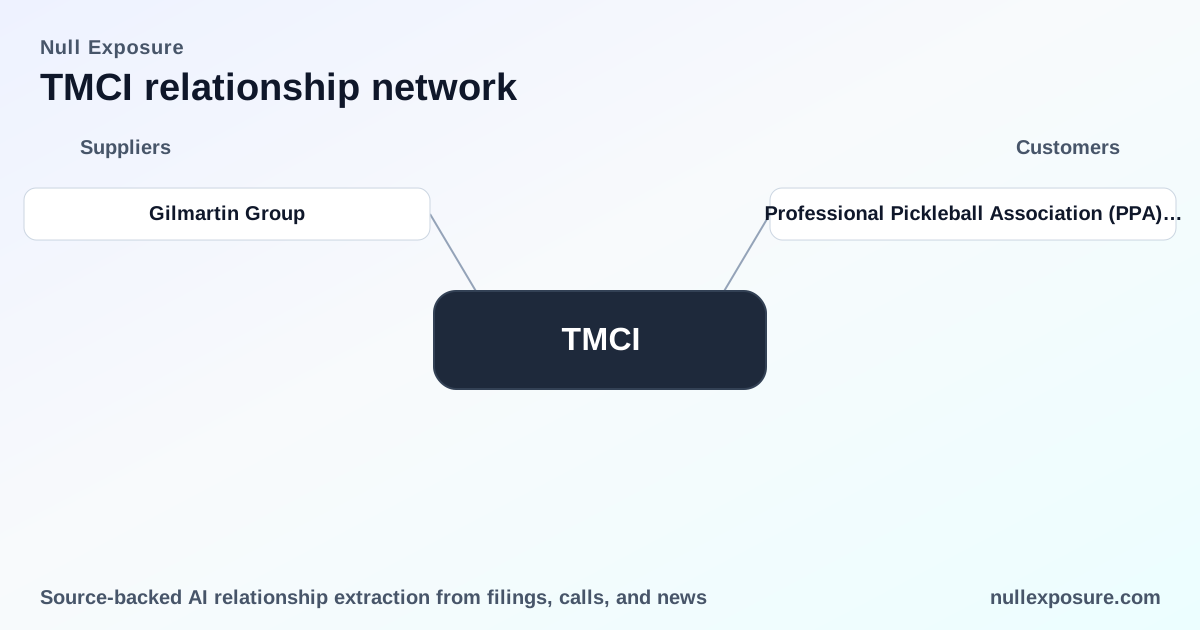
Treace names PPA Tour as marketing partner (Professional Pickleball Association, March 10, 2026)
Treace announced that it was named the first Medical Device Partner and Official Foot and Ankle Solution Partner of the Professional Pickleball Association (PPA) Tour, a sponsorship and brand-placement arrangement intended to raise awareness among athletes and the public. The PPA Tour press release (March 10, 2026) frames this as a strategic marketing partnership rather than a clinical purchasing relationship. (PPA Tour press release, March 10, 2026)
Hospital for Special Surgery performs first cases with SuperBite screws (April–May 2026)
Treace disclosed that Anne Holly Johnson, MD, of Hospital for Special Surgery, performed the first surgical cases using Treace’s new SuperBite™ compression screw system, marking an early clinical adoption milestone for the product. This was reported in Treace press materials and covered by media outlets in early May 2026, and signals clinical validation at a leading orthopedic institution that supports surgeon adoption narratives. (Treace press release/GlobeNewswire April 7, 2026; Globe and Mail coverage May 4, 2026)
What these relationships mean for revenue, adoption and risk
These relationship signals are indicative of Treace’s customer strategy: drive surgeon-level adoption through clinical validation and brand partnerships, then monetize through recurring hardware sales tied to procedures. The PPA Tour partnership is a brand-extension play that aims to broaden awareness among athletes and referring clinicians but does not immediately shift revenue concentration; the Hospital for Special Surgery clinical case is a product-validation milestone that supports future surgeon uptake.
Key operating-model characteristics drawn from company disclosures should shape investor expectations:
- Short payment terms and transactional sales increase sensitivity to procedure cadence and working capital management. Customer invoices payable within 30 days mean inventory and receivables turnover are operational levers.
- Customer base is individual-surgeon centric and geographically concentrated in the U.S., with roughly 3,135 active surgeons reported as of December 31, 2024, up 10% year over year—this underscores adoption-driven growth rather than enterprise contracting.
- Revenue concentration risk is low at the customer level: no single customer accounted for 10% or more of revenue through 2024, reducing counterparty credit concentration but increasing reliance on scaling surgeon volume.
- Product mix is hardware-heavy: the Lapiplasty systems combine instruments and single-use implant kits, producing recurring per-procedure revenue but requiring continuing adoption and replacement purchases.
Risks and upside from customer relationships
Investors should weigh the following, informed by customer signals and company-level constraints:
- Upside: Clinical adoption at top-tier hospitals and high-visibility partnerships accelerate surgeon awareness and can compress sales cycles for independent surgeons, driving scalable per-procedure revenue if conversion rates hold.
- Execution risk: A salesforce-driven model concentrated on individual surgeons requires continuous field investment; if procedure growth slows, short-term payment terms raise working-capital strain.
- Concentration tradeoff: Broad-based, immaterial customer exposures reduce single-counterparty risk but create operational dependence on a large number of small buyers, which favors effective field coverage and surgical training programs.
- Product risk: The business is in the hardware segment, where new product launches (such as SuperBite screws) must demonstrate clinical outcomes and adoption to translate into durable revenue.
Read this before you underwrite growth
For analysts constructing scenarios, model revenue growth as a function of three inputs: active-surgeon growth and conversion, average procedures per surgeon, and per-procedure realized ASPs for single-use implants and instruments. Use company disclosures (FY2024–FY2025 filings) for baseline active-surgeon counts, the stated split between employee and independent sales contributions, and the short payment terms that affect cash conversion cycles.
For a broader set of commercial signals and relationship analytics, see NullExposure’s research portal at https://nullexposure.com/ — it consolidates press, filings and clinical adoption events to help investors quantify go-to-market momentum.
Bold takeaways:
- Treace monetizes primarily through hardware sales to individual surgeons and procedure sites in the United States.
- Commercial momentum is adoption-driven, not enterprise-contracted; clinical validation at major hospitals and public brand partnerships are key levers.
- Short invoice terms and a salesforce-heavy model create working-capital and execution sensitivity that investors must model explicitly.
This investor briefing synthesizes public customer signals and company disclosures to place Treace’s recent relationship announcements into a commercial and capital markets context.